
GENXFINITY MAGAZINE
Stories for the generation that still has more to give.
What We Miss When We Stop Watching Together
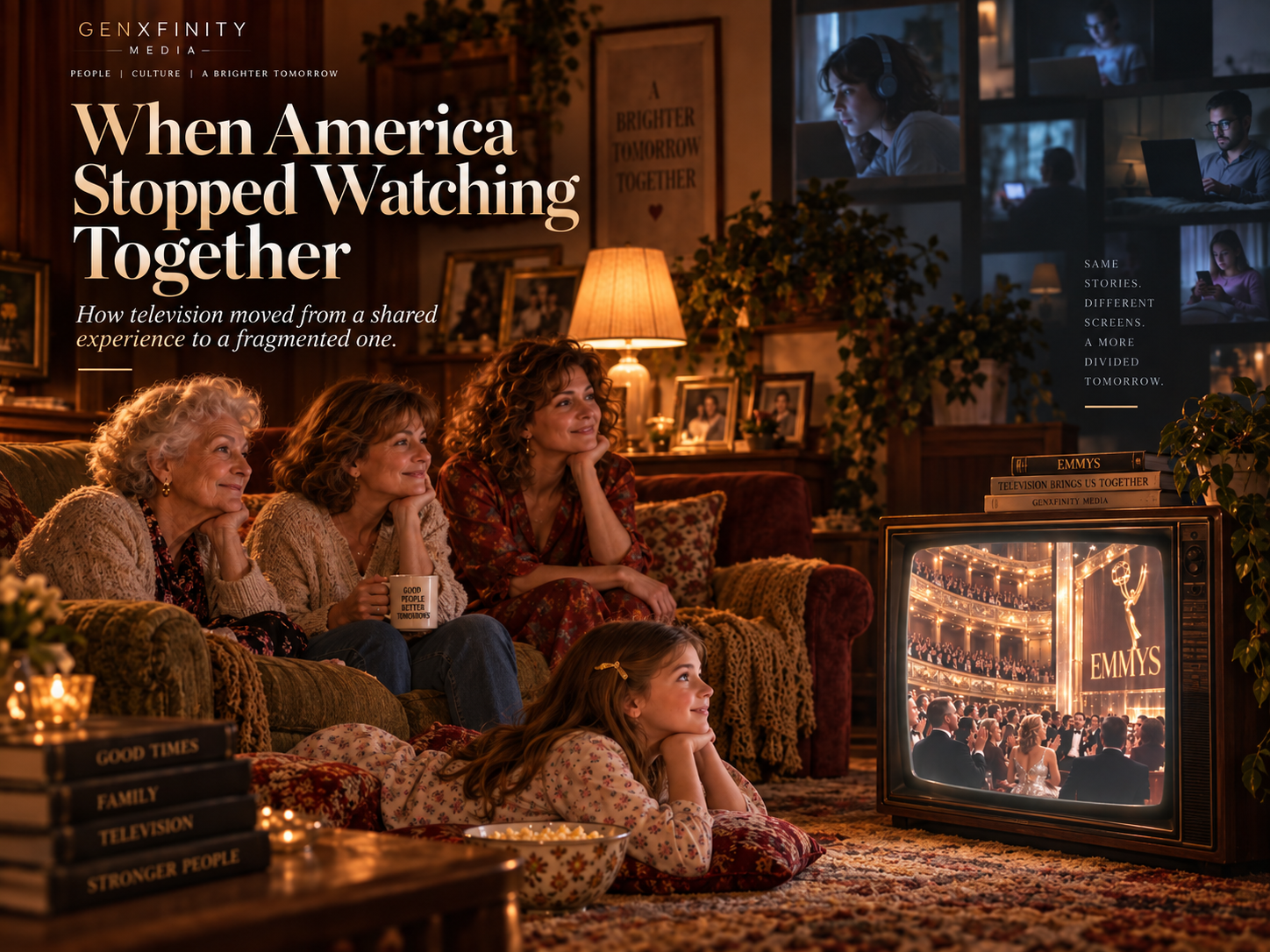
I remember watching the Emmys with my mother, my aunt and my grandmother. Back then, Hollywood seemed to fill the entire theater—and television could fill the entire living room. Streaming gave us more choices than we ever imagined. But somewhere along the way, did we lose the experience of watching together?
The Emmys bring back a living room full of family. What can we carry from that experience into the way we watch today?
By Christine Silva
I can still see it. Not every winner. Not every dress. Not every acceptance speech.
What I remember is the room.
I remember watching the Emmy Awards in the late 1970s and throughout the 1980s with my mother, my aunt and my grandmother. Four women from different generations, sitting together watching television.
When the cameras swept across the theater, Hollywood looked enormous. There seemed to be people everywhere—floor after floor of men in tuxedos and women in gowns. The balconies were part of the spectacle. To me, the audience itself made the occasion feel important.
For years I wondered whether childhood had simply made everything look bigger. Then I looked into the building.
The theater really did have those levels
The Television Academy lists Pasadena Civic Auditorium as the Primetime Emmy venue from 1977 through 1997. The Academy's venue history puts those memories in a setting.
Pasadena Civic’s current technical specifications describe a main floor, loge and upper balcony. The levels I remember were real. The specifications cannot tell us which seats were occupied on a particular Emmy night.
The building explains the picture in my head. The people beside me explain why it stayed there.
Television gave our household a meeting place
The Census Bureau's historical account reports that 9 percent of American households had a television in 1950; by 1965, the figure was 93 percent. Its history of television adoption records how quickly ownership spread.
In our living room, I remember the anticipation, the conversation and the sense that we were sitting down for something together.
I did not experience those evenings as a limitation on choice. I experienced them as family time. Looking back, that is the part I want to hold onto.
The Emmys still bring people together
People still watch together. CBS reported more than 7.42 million viewers for the 2025 Emmy Awards on CBS and Paramount+, its largest television audience since 2021. That is a 2025 result, not a figure for this year’s ceremony. Read CBS’s September 15, 2025 announcement and ratings methodology.
My concern is more personal than a ratings contest: how often do we make room for an experience that belongs to more than one person?
More places to watch, more ways to gather
Nielsen's July 2026 Gauge report put streaming at 49.0 percent of total television viewing, broadcast at 19.5 percent and cable at 18.7 percent. YouTube accounted for 14.2 percent. The reporting interval ran from June 29 through July 26, 2026. These are shares of television viewing, not of every kind of media use on every device. Nielsen's report supplies the figures and measurement notes.
To me, that mix raises a question about attention. The cultural center I remember from childhood no longer feels like a single place.
Deloitte's 2026 Digital Media Trends report adds another perspective. In its survey, 32 percent of consumers said social-media content felt more relevant to them than traditional media, and 33 percent reported a stronger personal connection to social-media creators than to television personalities or actors. The online survey covered 3,575 U.S. consumers in October and November 2025 and was weighted to Census data. The report and methodology describe reported preferences, not a measurement of family closeness.
I do not read those findings as a reason to dismiss a younger person's favorite creator. I read them as a reason to ask what that person finds worth watching. We might discover a point of connection by being curious about each other's choices.
The building can be larger while the evening feels smaller
Peacock Theater lists 7,100 seats, while noting that capacity varies with an event's setup. That is more than Pasadena Civic's listed capacity. Peacock Theater's seating guide makes the comparison possible; neither venue's capacity establishes an actual Emmy attendance count.
Knowing that challenges my own memory in an interesting way. When I say Hollywood looked bigger then, I am describing a feeling. I am not measuring seats or claiming that childhood television was objectively better.
When I watched with my mother, my aunt and my grandmother, none of us thought we were creating a memory. We were just watching television. Decades later, I understand how much of the experience was the company beside me.
Bring the best of that experience forward
That is why I believe this conversation belongs on GenXFinity. If your memories include getting up to change the channel, looking through TV Guide or waiting for the next episode, you have a starting point for this conversation. If your memories began with a different screen, you belong in it too.
Picture a household in which one person is watching a series, another a creator's video and another playing a game. There need not be anything wrong with those choices. I would simply like us to make a little space for a shared choice as well.
I am not interested in pretending everything was better in the past. I want to carry forward something I valued: making an occasion of being together.
Try one shared plan this week: ask someone to pick a movie, an episode, or a video they want to show you, and agree on a time to watch it together. Take turns choosing. Leave room for the possibility that their enthusiasm will surprise you.
We do not need to recreate my childhood living room to try that. We can make a new memory with the people available to us now.
When I think about those Emmy nights, I do not remember who won. I remember who was sitting beside me.
About this article
Personal reflection and cultural commentary by Christine Silva, with sources linked throughout.
When the People You Love Don’t Support the Life You’re Building
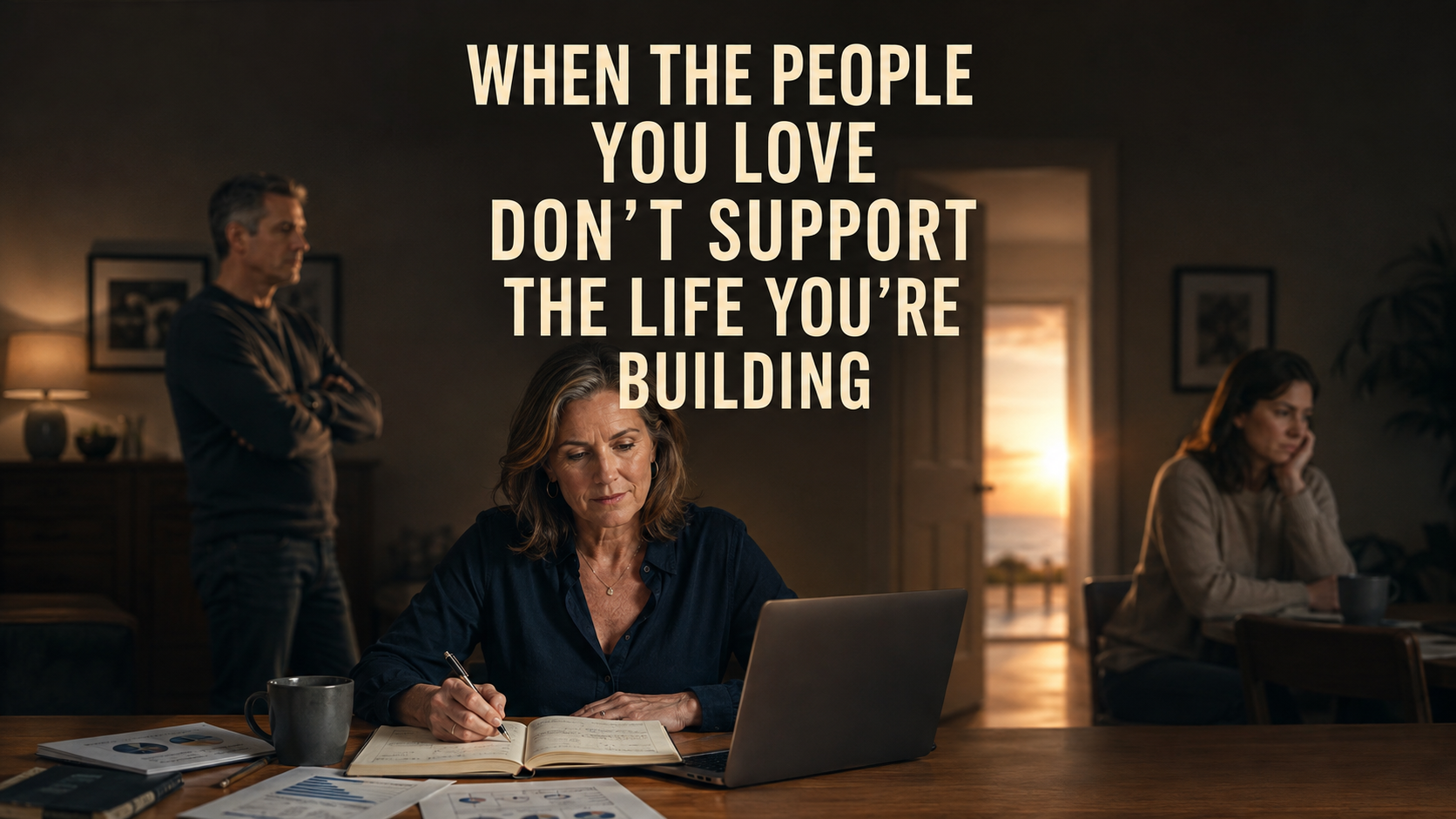
A new venture can become especially lonely when the people closest to you do not understand the person you are becoming. This reflection examines family resistance, entrepreneurial identity, self-trust, and the difference between protecting a vision and refusing legitimate scrutiny.
You can take a new direction seriously without expecting everyone to understand it immediately. The work is learning which doubts deserve an answer—and which expectations no longer fit.
I received an email from someone who follows my work. Generation X. Smart. Capable. Experienced. And stuck.
They were afraid to start: to build something of their own, make a career pivot, or leave behind the version of themselves everyone else had grown comfortable with. The question that stayed with me was simple:
“What if my family doesn’t support me?”
I know what that feels like. I faced it when I began changing the direction of my own life in 2015.
The beginning rarely looks tidy
My reinvention was not one clean move. I moved from restaurants to real estate, then into politics, intellectual-property research, branding, and multimedia. From the outside, that progression may have looked unstable. From inside my life, it felt necessary.
I could feel the pull of the rules I had grown up with: choose a predictable path, remain useful, protect stability, and avoid changes other people might not understand. Responsibility matters. So does providing for the people who depend on us.
But the familiar path was leading me toward a life that no longer fit. I wanted to change direction while I still had the strength and energy to make consequential decisions. So I began moving more intentionally. Some decisions created uncertainty, distance, and resentment.
Somebody had to go first. In my life, that somebody was me.
Support is not the same as agreement
When the people close to you have never built a business, they may struggle to understand why you would take on the uncertainty. But disagreement alone does not tell you what someone’s motives are. A concerned question and a dismissive remark deserve different responses.
A spouse who asks about debt, insurance, household expenses, or money invested in a venture may be asking responsible questions. If the consequences affect the household, the household belongs in the conversation.
Healthy support can include skepticism. It should also include respect. Someone can challenge your assumptions without diminishing your worth. And you cannot label every objection “negativity” simply because it is uncomfortable.
The research is more complicated than “supportive family, successful founder.” A 2020 study followed 61 entrepreneurs over 14 days and found that the relationship between family support, stress, and well-being differed depending on whether the stress involved finances or workload. That small study cannot explain any one family, but it is a useful reminder that support is not a single, simple ingredient. Read the study in the Journal of Business Research.
The practical question is whether everyone involved can discuss the risks honestly and respectfully.
You do not have to choose between standing still and blowing up your life
It can feel as though the options are to remain the person everyone understands or change everything at once. There is room between those extremes.
You can test an idea while remaining employed. Build a portfolio before changing careers. Talk with potential customers before investing heavily. Agree on financial boundaries with the people whose lives are tied to yours.
Consider separating the conversation into three questions:
What exactly worries you about this plan?
What evidence would help us evaluate that concern?
What time, money, and responsibilities are we agreeing to protect while I test it?
Those questions are an invitation to discussion, not a script guaranteed to win approval. Sometimes a concern will reveal a weakness worth fixing. Sometimes the answer will remain no. You can listen carefully and still decide what belongs in your future.
Belief needs something to stand on
Self-belief can help you begin. It cannot establish customer demand or make the numbers work.
The U.S. Small Business Administration’s planning guidance recommends examining demand, market size, competitors, and pricing. Those are useful questions to bring to the table before a dream becomes a substantial financial commitment. Explore the SBA’s market-research and business-planning guidance.
Here is a manageable place to start:
Describe the problem you want to solve in one clear sentence.
Identify who experiences it and speak with potential customers.
Test a small version of the offer before building the expensive version.
Write down the time and money you are prepared to commit.
Decide what evidence would justify continuing, changing direction, or stopping.
You do not have to defend the entire future. Explain the next responsible test: what you will try, what you can afford, and what you need to learn. A plan gives the conversation something concrete to work with; it does not guarantee the business will succeed.
Build another layer of support
Your family does not have to fill every role. Someone can love you deeply and still be the wrong person to evaluate a pricing model or a licensing question.
Look for people who understand the work: an experienced founder, a mentor, a professional association, or an adviser with the relevant expertise. The SBA’s counseling network includes SCORE and Small Business Development Centers, with free counseling and other assistance available through its partners. Check the particular program for services and costs. Find business counseling through the SBA.
Outside support serves a different purpose from family support. It can give you a place to ask basic questions, challenge assumptions, and receive feedback from someone who knows the territory.
You are allowed to be experienced and still be learning.
What I have learned
You do not need everyone to understand your vision at the beginning. You do need enough self-trust to take a responsible next step—and enough humility to change direction when the evidence calls for it.
Some people may understand later. Some may remain skeptical. You cannot make their acceptance the only measure of whether your work deserves a fair test.
If you feel the pull toward something different, investigate it. Test it. Cost it. Listen to legitimate concerns. Let courage and judgment travel together.
We have already lived through enough change to know that the first version of a plan is rarely the last. That experience is worth bringing with you.
The next step does not have to be dramatic. It has to be yours to take—and responsible enough to stand behind.
Related reading
The Career Pivot After 50
Walking Into the Noise
Author’s note: This essay combines personal reflection with general business-planning information. It does not assess your family relationships or provide individualized financial or legal advice. The personal experiences are the author’s account; the linked research supplies context rather than proof of anyone’s motives.
How I Came Back From Injury After 51
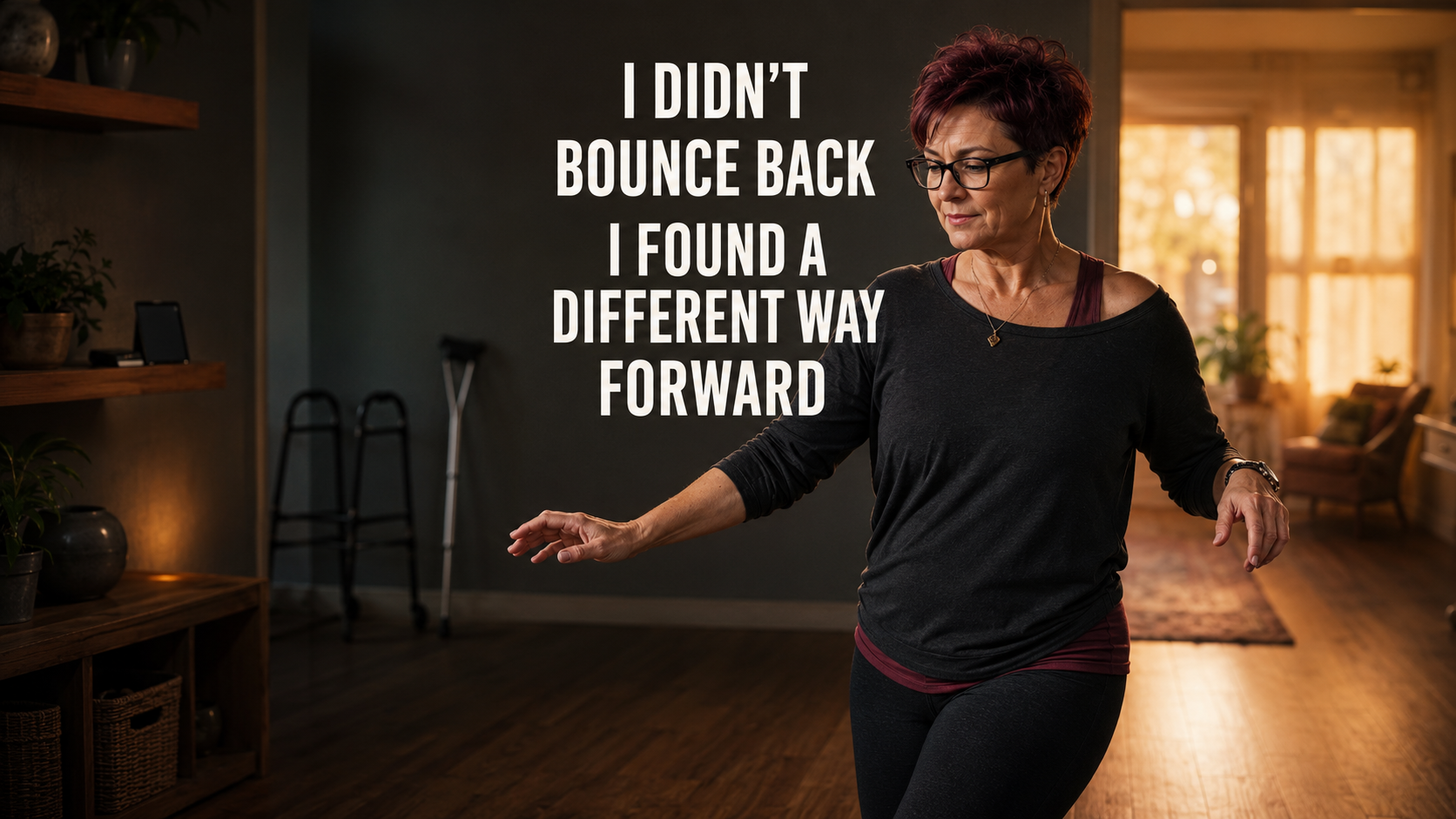
After major ankle reconstruction, prolonged immobility and a total hip replacement, Christine Silva did not simply “bounce back.” This is her account of lost independence, fear of movement, the familiar song that changed her direction and the experience that became a question worthy of serious study.
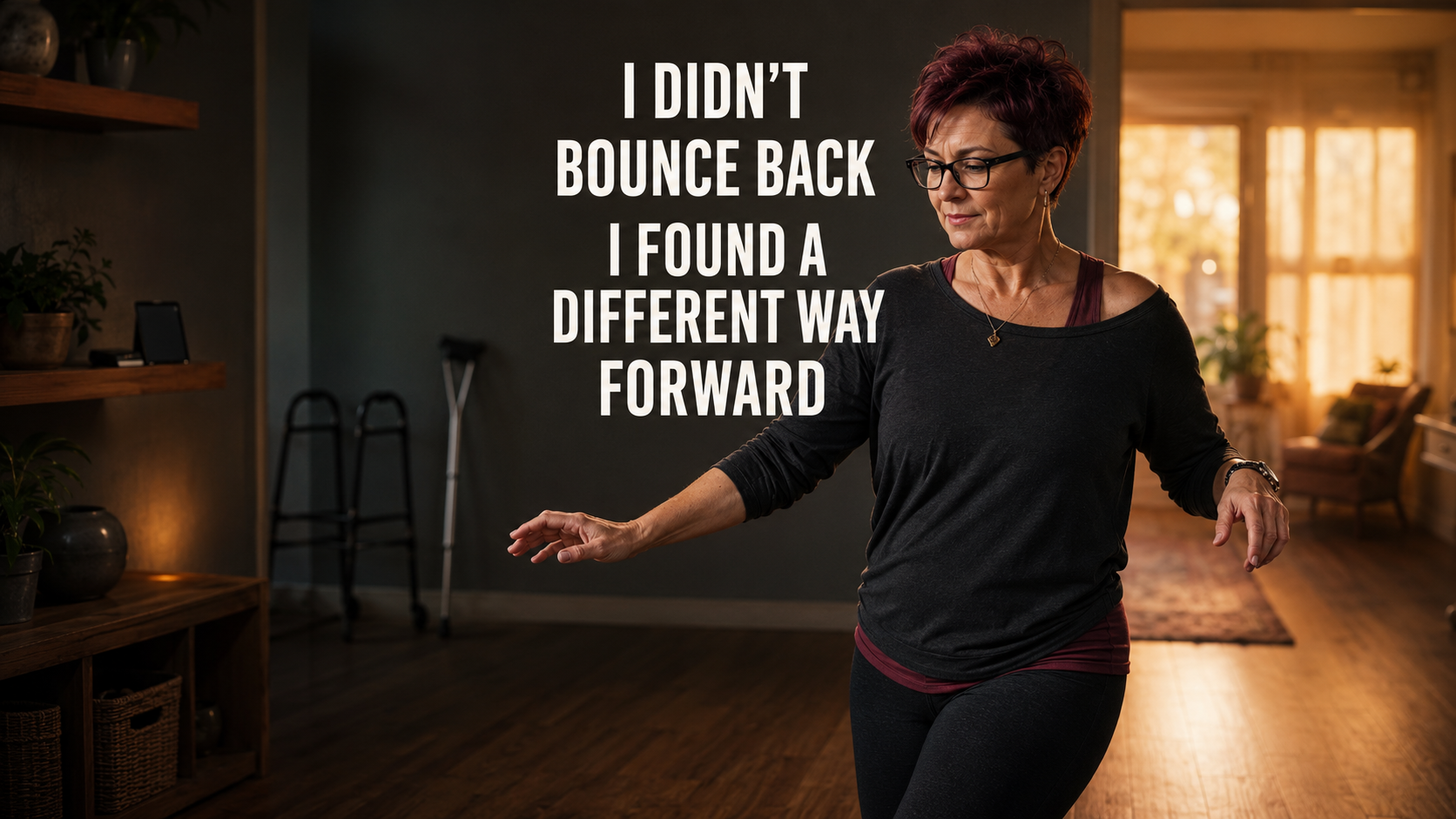
I didn’t bounce back. I found a different way forward—with medical care, rehabilitation, time, and a moment with music that made me curious about movement again.
After age 51, I sustained a serious ankle injury that required major reconstruction. I then spent approximately eight months substantially immobilized. Roughly two years later, I underwent a total hip replacement on the opposite side.
The medical events fit into two sentences. Living through them does not.
I went from being fully independent to needing help with bathing, getting dressed, moving through the house, and having meals prepared. The loss reached into ordinary decisions I had barely noticed before.
Research has documented how widely an ankle fracture can affect daily life. A qualitative study involving 12 patients and six health professionals identified physical, psychological, social, practical, and financial consequences. It described experiences; it did not establish how often each consequence occurs. Read McPhail and colleagues’ study of life after ankle fracture.
For me, dependence was lonely. Not because people did not care, but because I missed the ease of managing my own day.
When every movement becomes a decision
My deepest fear was losing control. I thought before standing. I measured the distance between stable surfaces. I considered whether a step or turn might put me in danger.
Movement that had happened automatically became a negotiation. I was no longer living the way I had before. I was managing every movement, and I was not willing to accept that as the final version of my life.
That determination did not give me a shortcut. Surgery, healing, medical care, and formal rehabilitation are all part of my recovery story. They belong in it, even when I describe the moments that felt more personal.
A familiar song, a different question
The experience that changed my direction happened in my home gym, on a day when I did not feel like showing up. “Return of the Mack” began playing, and something in me responded.
I was not conducting a study or testing a clinical protocol. I started moving to the rhythm in a way that reminded me of how I had moved before the injuries—before every action felt calculated.
I was not counting repetitions or chasing performance. The experience felt less like forcing my body through an exercise and more like allowing it to participate in the music.
That moment gave me a question worth investigating.
Changes arrived in pieces
At first, the changes I noticed were subtle. My shoulders felt less guarded. My upper body began participating more naturally. My hips felt less separate from the rest of the movement.
There was no overnight transformation. I noticed a little more mobility, a little less hesitation, and a gradual return of coordination.
One experience stayed with me. After months of reduced activity, my posture had felt smaller and my shoulders stiff. As I continued moving with the music, I felt them release. The sensation seemed to travel from my shoulders and arms into my trunk and hips.
The closest description I have is cucumber water moving through my veins: clean, cool, and awakening.
I could not separate the possible contributions of practice, attention, music, healing, rehabilitation, confidence, and time. I knew only that the experience was different enough to make me curious.
What the research can—and cannot—tell us
Music can bring personal memories to mind. In a 2009 brain-imaging study, Petr Janata examined the relationship between music, autobiographical memories, and associated brain activity. Read the music-evoked memory study.
Rhythm and movement are also studied together. A 2022 study of younger and older adults found that walking responses varied with musical groove, familiarity, beat perception, and instructions to synchronize. Higher-groove music produced faster walking in both age groups, while some older adults had more difficulty with unfamiliar cues. Read the study of music and gait.
Those studies make the questions worth exploring. They do not explain my recovery or establish that my approach is safe or effective for someone else. Faster walking in a study, for example, does not automatically mean safer walking after surgery.
“Return of the Mack” was not medicine. For me, it became a cue—a connection to a version of myself who remembered moving without the same hesitation.
Rehabilitation remains part of the picture
Professional care belongs in this story alongside the moments that helped me find personal meaning in recovery.
The American Academy of Orthopaedic Surgeons describes exercise and a gradual return to daily activity as important after hip replacement. Its guidance says to check with your surgeon or physical therapist before trying the exercises it describes. Individual instructions matter. Read the AAOS hip-replacement recovery guide.
The question that emerged for me was whether rhythm, coordination, confidence, and personal meaning might complement a recovery process for some people. That is the question I want to explore.
Confidence was the change I noticed most
The change that mattered most to me was the shift from “I hope I don’t fall” toward “I can manage this.” I began to trust my body’s response with less of the same hesitation.
What I can say is that I found a different way to participate in my own recovery. I did not become younger. I became more curious about what was still possible.
If this sounds familiar
You do not have to copy my movements to take something from this story. If you are recovering from surgery or managing pain, weakness, or balance difficulties, bring your questions to the clinician who knows your situation.
You might ask:
What activities are appropriate for me at this stage?
Which restrictions or precautions do I still need to follow?
How can I work on confidence within my rehabilitation plan?
Would music be appropriate during any activities you already recommend?
Those questions can start a conversation without turning someone else’s experience into your treatment plan.
Recovery does not have to resemble a dramatic comeback to matter. In my experience, it arrived in ordinary moments: less hesitation, more participation, and the willingness to keep asking a useful question.
The body that carried you here deserves patience as well as possibility.
— Christine Silva
Author’s note
This personal account contributed to the Freedom Flow Method concept, which has not been clinically validated. This article is not a movement program. Keep following your own care plan, including movement restrictions and prescribed mobility aids, and discuss activity changes with your surgeon or physical therapist.
Related reading
Explore the Freedom Flow Method concept and its development status
Research informing the concept
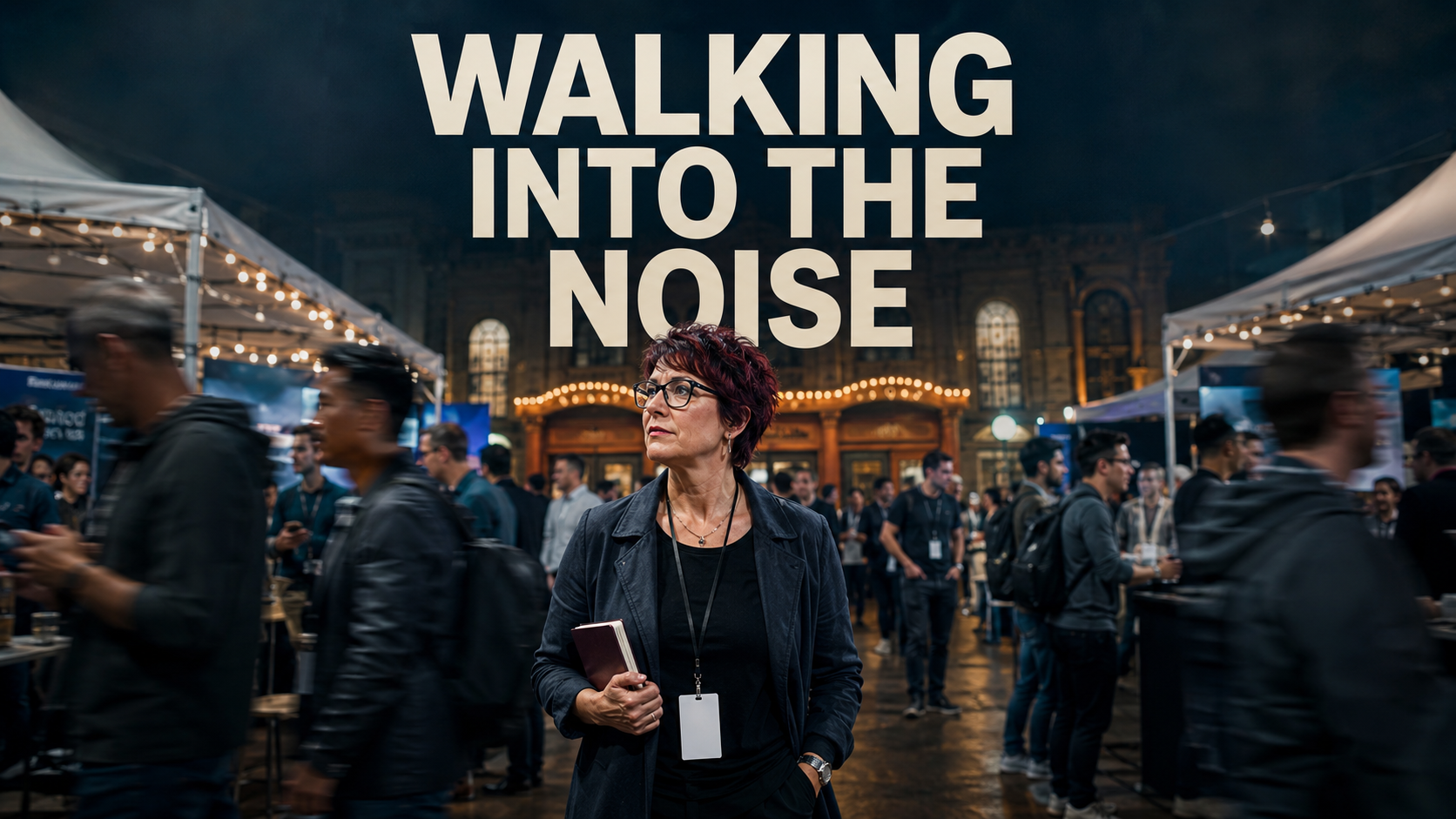
Walking Into the Noise
At the 2026 Startup Grind Conference, Christine Silva entered a world built around speed, visibility and constant pitching. What she discovered was not that she was too late—but that observation must eventually become participation.
A first trip into startup culture reminded me that experience belongs in the room—and that eventually, observation has to become a conversation.
Startup Grind Conference, Redwood City, California | April 28–29, 2026
I walked into the 2026 Startup Grind Conference knowing I was entering a world I had studied but never truly operated within. The theory was familiar. The room was something else.
By then, I knew the private side of building something: the experimentation, mental resets, and moments when you question whether you made the right decision. My feeling of being an impostor arrived long before I reached the conference.
Five years earlier, I had left the Bay Area and moved to South Carolina. Being back meant seeing my brothers, my sister, and friends who knew me before this change in direction. That felt familiar. Walking into Silicon Valley’s startup world brought an entirely different rhythm.
Inside the room
Startup Grind listed the main event for April 28–29 at Redwood City’s Fox Theatre and promoted it as an opportunity to join approximately 5,000 others. That was the organizer’s invitation, not an independently verified attendance count. See the official event listing.
Booths filled the exhibition areas. Conversations overlapped. Founders delivered practiced pitches, each trying to capture attention in an environment built around visibility.
I understood the purpose. I also found it exhausting.
Inside the Fox Theatre, the energy focused. People listened. The speakers who held my attention sounded grounded in experience. Then I would step outside, and the overlapping conversations returned like the noise of a high-volume industrial kitchen.
It was a rhythm I could recognize without feeling at home in it.
The pressure to match the pace
I felt the pull: speak faster, move faster, become visible. Instead, I moved through the conference quietly and deliberately. I was observing, much as I observe operations, people, and systems in my professional work.
There were people actively creating conversations and others who appeared more selective about their attention. I formed impressions about who might be an investor or established leader, but I could not know their roles without speaking to them or reading their badges.
That distinction matters. What I was noticing was behavior, not proof of status.
Ashton Kutcher, according to my family
Startup Grind announced Ashton Kutcher of Sound Ventures as a mainstage speaker. See the organizer’s speaker announcement.
My sister would probably identify him first as Mila Kunis’s husband and second as Michael Kelso. I was thinking about his investment work. Regardless of the hierarchy, I knew I had better get close enough for a picture or hear about it when I got home.
The conversation I did not start
At one point, I sat behind a man who appeared to be an investor and used a cane. I thought there might be a conversation to begin about the movement concept I was developing through the Freedom Flow Method.
And I said nothing.
Part of my hesitation came from a familiar rule: prepare first, speak when you are certain, and do not step forward until you have earned the right. That rule had value in my working life. In that moment, it also helped me delay.
I waited for a better time or a more controlled conversation. The moment passed.
Looking back, his cane did not tell me his interests, medical history, or willingness to discuss mobility. A respectful introduction could have started with the work and left him free to decide whether to engage.
For example: “I’m developing a movement concept informed by my recovery. Would you be open to a brief conversation about how founders test an early idea?”
That is a possible opening, not a conversation that happened. I did not need to share confidential details or deliver an entire pitch. I needed to begin and leave room for the other person’s answer.
The founder I cannot name
I met a woman developing an application intended to help people create AI-generated movies. I did not retain her name and have not identified her company with enough certainty to name it responsibly. I will not guess.
Her idea stayed with me because I understood the human problem: carrying a visual concept that you cannot quite communicate. I could see the appeal of a tool that lets someone develop and revise that idea privately before sharing it.
I did not evaluate her product, so this is not a recommendation or a claim about what it can deliver. It is a reminder that a useful business idea often begins with a problem someone recognizes immediately.
Sometimes the missing piece is a way to show what you mean.
Then there was the burrito
Later, I stepped into a nearby Mexican restaurant. At another table, a man spoke loudly and quickly on his phone. He sounded as though a breakthrough might be happening.
Then the call ended. After a pause, he looked down and said, “Yeah…I’ll just take a burrito.”
That moment captured the rhythm I had been watching: anticipation, momentum, uncertainty, and reset. Then ordinary life returns and asks what you want for lunch.
I followed a path in which family, employment, and daily responsibilities came before starting a business. That history does not disappear when you walk into a conference. It comes with you, along with the experience it produced.
Later does not mean unqualified
The young-founder image is not the whole story. In a study of U.S. ventures, the mean founding age for the one-in-1,000 fastest-growing firms was 45. That is a finding about a specific group, not a prediction for my business—or yours. Read Age and High-Growth Entrepreneurship.
Experience earns a place in the conversation. It still has to meet a real customer need.
But experience is not a reason to count yourself out, either. The work is to make that experience useful to someone else.
A Gen X Startup Grind
I still think there is room for a Startup Grind gathering that feels a little more like a fire pit: people bringing business ideas, honest questions, and perhaps a Diet Coke.
I initially joked that Jimmy Buffett might call the difference a moat. Wrong Buffett.
Warren Buffett described a durable competitive advantage as a business “moat” in his 2007 shareholder letter. My age and my story would not supply one on their own.
The story may earn attention. The product still has to solve a problem.
Arriving with different tools
I left with a useful challenge for myself. I did not have to imitate the room, but I did have to participate.
If you recognize that hesitation, consider one modest aim for your next event: one introduction, one honest question, and one follow-up you have permission to send. You do not have to perform certainty. You can arrive curious and prepared.
Observation has value. Preparation has value. Then comes the moment when an observation becomes a conversation.
That is the work now.
Keep it Move’n.
— Christine Silva
Related reading
When the People You Love Don’t Support the Life You’re Building
The Career Pivot After 50
Editorial note: Conference scenes and conversations are the author’s recollections. The example introduction is explicitly hypothetical. Organizer claims are attributed; research findings do not guarantee an individual business outcome.