
GENXFINITY MAGAZINE
Stories for the generation that still has more to give.
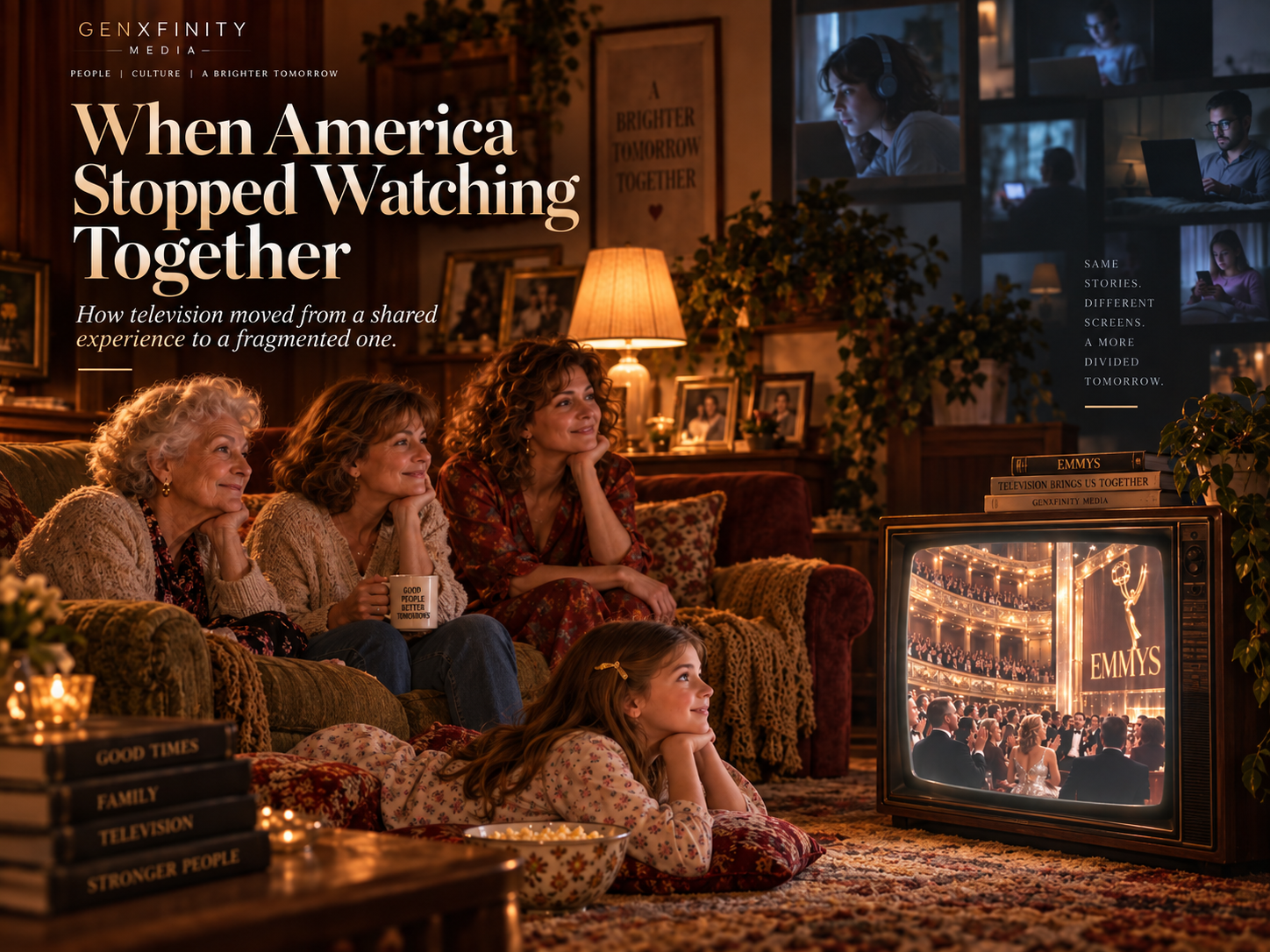
When America Stopped Watching Together - The Emmy’s 2026
I remember watching the Emmys with my mother, my aunt and my grandmother. Back then, Hollywood seemed to fill the entire theater—and television could fill the entire living room. Streaming gave us more choices than we ever imagined. But somewhere along the way, did we lose the experience of watching together?
Thank you
By Christine Silva, Founder & CEO, GenXFinity Media LLC
About this article
This is a GenXFinity Media editorial examining how television moved from a shared American experience to an increasingly fragmented, on-demand one—and what that transition may mean for Hollywood, the traditional television networks and the generations that remember what came before.
Published: September 14, 2026
Last reviewed: September 14, 2026
Estimated read time: 8 minutes
I can still see it. Not every winner. Not every dress. Not every acceptance speech.
What I remember is the room.
I remember watching the Emmy Awards in the late 1970s and throughout the 1980s with my mother, my aunt and my grandmother.
Four women from different generations sitting together watching television.
And when the cameras swept across that theater, Hollywood looked enormous.
There seemed to be people everywhere—floor after floor of men in tuxedos and women dressed in gowns. The balconies were part of the spectacle. The audience itself told you that you were watching something important.
For years I wondered whether childhood had simply made everything look bigger.
Then I looked into it.
The Theater Really Did Have Those Levels
Beginning in 1977, the Primetime Emmy Awards moved to the Pasadena Civic Auditorium, where they remained through 1997. The Television Academy’s history of Emmy venues confirms that 21-year run. (Television Academy) And the building really does match what I remember seeing through our television set. According to the Pasadena Civic Auditorium’s official specifications, the theater has 1,880 seats on its main floor, 560 in the loge and 459 in the upper balcony, for a total capacity of approximately 3,000.
Main floor. Loge. Upper balcony. Three visible levels of people. (Visit Pasadena)
So that childhood image wasn’t entirely nostalgia playing tricks on me. The room was part of the show. And somehow, so were we.
Television Once Gave America a Meeting Place
To understand what has changed, we have to remember just how quickly television became woven into American life.
According to the U.S. Census Bureau’s history of television adoption, only about 9 percent of American households had a television in 1950.
By 1965, 93 percent of American homes had one.
Television went from technological novelty to household institution in barely more than a decade. (Census.gov)
And for much of the period when Generation X was growing up, there weren’t hundreds of channels and thousands of programs waiting on demand.
There were a limited number of major networks.
Programs came on at a particular time.
If you missed one, you couldn’t simply open an app later that evening and start from the beginning.
That limitation created something we rarely discuss when talking about technological progress:
Scarcity Created Common Experience.
When a major show came on, millions of people were watching the same thing at approximately the same time.
Families watched together.
People went to work or school the next morning talking about what they had all seen the night before.
Television didn’t simply distribute entertainment.
It helped create a shared American conversation.
The Emmys Show Just How Much Changed
The numbers are difficult to ignore.
In 1986, the Primetime Emmy Awards reached what the Los Angeles Times, citing Nielsen data, described as the ceremony’s audience high-water mark: 35.8 million viewers. (Los Angeles Times)
Nearly four decades later, the 2025 Emmy Awards were watched by 7.42 million viewers across CBS and Paramount+, according to CBS figures based on Nielsen data. That was actually considered good news: it was the Emmys’ largest television audience since 2021. (Paramount Press Express)
That does not mean Americans stopped watching entertainment.
Quite the opposite.
We are watching enormous amounts of it.
We simply aren’t watching the same entertainment together anymore.
And that distinction may be one of the most consequential changes in the history of television. Streaming Didn’t Kill Watching. It Fragmented It.
This is where my concern about streaming begins.
I don’t believe Netflix, Peacock, Hulu, Disney+, YouTube and the dozens of other platforms are going to eliminate storytelling.
Human beings have been telling stories since long before Hollywood existed.
What streaming may be helping dismantle is the system that made Hollywood and the major television networks the center of American popular culture.
The latest numbers make that transition unmistakable.
In Nielsen’s July 2026 edition of The Gauge, streaming represented 49 percent of all television use in the United States.
Broadcast television represented 19.5 percent.
Cable represented 18.7 percent.
YouTube alone accounted for a record 14.2 percent of all television viewing. (Nielsen)
Think about that for a moment.
A platform built largely around creators and user-uploaded video now captures a substantial share of the time Americans spend watching their actual television screens.
That isn’t merely a change in technology.
It is a transfer of cultural power.
And Streaming Is No Longer the Only Disruptor
Traditional Hollywood first had to compete with streaming companies.
Now streaming companies themselves are competing with creators, gaming, podcasts, short-form video and social platforms.
Deloitte’s 2026 Digital Media Trends research describes today’s entertainment market as increasingly fragmented.
Its survey found that approximately 90 percent of U.S. households have a paid streaming-video subscription, with subscribing households averaging four services.
But audiences are spreading their attention much further than those subscriptions.
Deloitte also found that 32 percent of consumers said social-media content felt more relevant to them than traditional media content, while 33 percent said they felt a stronger personal connection to social-media creators than to television personalities or actors. (Deloitte)
For younger generations, that shift becomes even more pronounced. Deloitte’s March 2026 data found that roughly half of Gen Z respondents said social-media content was more relevant to them than traditional content and that they felt a stronger connection to creators than to television actors and personalities. (Deloitte)
Hollywood isn’t simply competing with another Hollywood anymore.
It is competing with everybody.
More Choice Came With a Price
There are obvious advantages to the world we live in now. We can watch almost anything.
We can watch it almost anywhere.
Independent filmmakers and creators no longer necessarily need permission from a television network to find an audience.
Stories that might never have survived the old network gatekeeping system can now reach millions of people.
Those are meaningful gains.
But technological progress doesn’t mean nothing was lost.
When everybody has his or her own algorithm, subscription services, creators, playlists and viewing schedule, there are fewer moments when tens of millions of people occupy the same cultural room.
We traded scarcity for abundance.
We traded schedules for convenience.
We traded three networks for nearly unlimited choice.
And I wonder whether we also traded some portion of our shared experience.
Because when I remember those Emmy nights, I don’t remember sitting alone choosing something from a menu.
I remember my mom. I remember my aunt. I remember my grandma. I remember all of us.
Is Streaming the Nail in Hollywood’s Coffin?
I originally found myself thinking exactly that.
Maybe streaming will eventually be the nail in the coffin of Hollywood and the television networks we have known since television entered American homes.
After looking more closely at the evidence, I would phrase it differently.
Streaming probably isn’t the coffin of Hollywood.
It may be the coffin of the old Hollywood distribution model.
That is an important distinction.
There is still enormous money in entertainment.
PwC’s 2026 Global Entertainment & Media Outlook projects the worldwide entertainment and media industry will grow to approximately $4.2 trillion by 2030. PwC also expects streaming revenue itself to continue growing, although more slowly in mature markets as subscription fatigue encourages consolidation and bundling. (PwC)
In the United States specifically, PwC estimates the streaming-video market generated approximately $113.3 billion in 2025 and projects it could reach $157.5 billion by 2030. (PwC)
So entertainment isn’t disappearing. The money isn’t disappearing. The audience isn’t disappearing.
The Audience is Scattering.
And that may ultimately prove far more disruptive to traditional Hollywood than simply losing viewers to Netflix.
Even Streaming Is Starting to Look Like Television Again
There is another irony in all of this. The revolution is slowly rediscovering parts of the system it replaced. Streaming services now offer advertising. They bundle services together. They pursue live sports. Some release major programs weekly rather than dropping an entire season at once. Media companies are consolidating.
PwC’s 2026 industry analysis describes streaming consolidation as increasingly structural, with profitability replacing the industry’s earlier growth-at-all-costs mentality. (PwC) In other words, after spending years unbundling television, portions of the industry are beginning to bundle themselves back together.
Technology changed. Human behavior didn’t change quite as much. Companies still need audiences. Advertisers still want those audiences People still want great stories. And businesses still need a way to make the economics work.
But You Can’t Rebuild the Living Room
That may be the part no technology company can manufacture. The old television system forced us into the same room. Literally and culturally. When I watched the Emmys with my mother, my aunt and my grandmother, none of us thought we were creating a memory. We were just watching television. But decades later, I understand that the television program was only part of what I was experiencing.
The other part was family. The room. The conversation. The anticipation. Seeing glamorous people fill three levels of a theater and believing Hollywood was somewhere enormous and almost magical.
Today’s Peacock Theater is actually much larger than Pasadena Civic. Its official capacity is 7,100 seats, compared with Pasadena Civic’s approximately 3,000. (Peacock Theater) Yet that fact makes my reaction even more interesting.
The modern building can be larger while the cultural event can somehow feel smaller. That isn’t a measurement of seats. It is a measurement of attention.
Generation X Has Lived on Both Sides of This Divide
That is why I believe this conversation belongs on GenXFinity. We remember life before streaming because we remember life before the internet became the center of daily existence. We remember getting up to change the television channel. We remember TV Guide. We remember waiting an entire week for the next episode. We remember season premieres that actually felt like events. We remember talking about television the next morning because everybody had watched the same show.
And now we live in a world where one person in a household may be watching Netflix, another YouTube, another TikTok, another playing a video game and another wearing headphones listening to a podcast. Nobody is necessarily doing anything wrong. But everybody can be together while occupying completely different worlds.
That is new.
And I don’t think we yet understand everything that change will mean.
What I Don’t Want Us to Lose
I’m not interested in pretending everything was better in the past It wasn’t. More choice has created opportunity. More platforms have allowed more voices into the conversation. Creators can build audiences without waiting for a Hollywood executive to give them permission. That democratization is important for everyone! But remembering what worked before us matters too. Maybe the lesson isn’t that we need three television networks again.
Maybe the lesson is that human beings still need common experiences.
A movie everyone goes to see. A championship everybody watches. A television finale people discuss the next morning. A concert. A family dinner. An awards show.
A room where everybody puts down their individual screens long enough to experience the same thing.
Because technology can give us nearly unlimited entertainment. What it cannot guarantee is connection. And when I think about those Emmy nights now, all these years later, I realize something…
I don’t remember who won, but I remember who was sitting beside me.
Sources and Further Reading
Television Academy — Emmy Venue History — Historical locations of the Primetime Emmy Awards, including the Pasadena Civic Auditorium era.
Pasadena Civic Auditorium — Technical Specifications — Official seating configuration and capacity.
U.S. Census Bureau — History of Television Adoption — Historical data on the spread of television ownership in American households.
Nielsen — July 2026 The Gauge — Current streaming, broadcast, cable and YouTube shares of U.S. television viewing.
Deloitte — 2026 Digital Media Trends — Research on streaming, fragmented audiences, fandom and creator competition.
PwC — Global Entertainment & Media Outlook 2026–2030 — Industry growth, streaming economics, consolidation and future media forecasts.
Peacock Theater — Official Venue Information — Current seating capacity for the home of the Primetime Emmys.