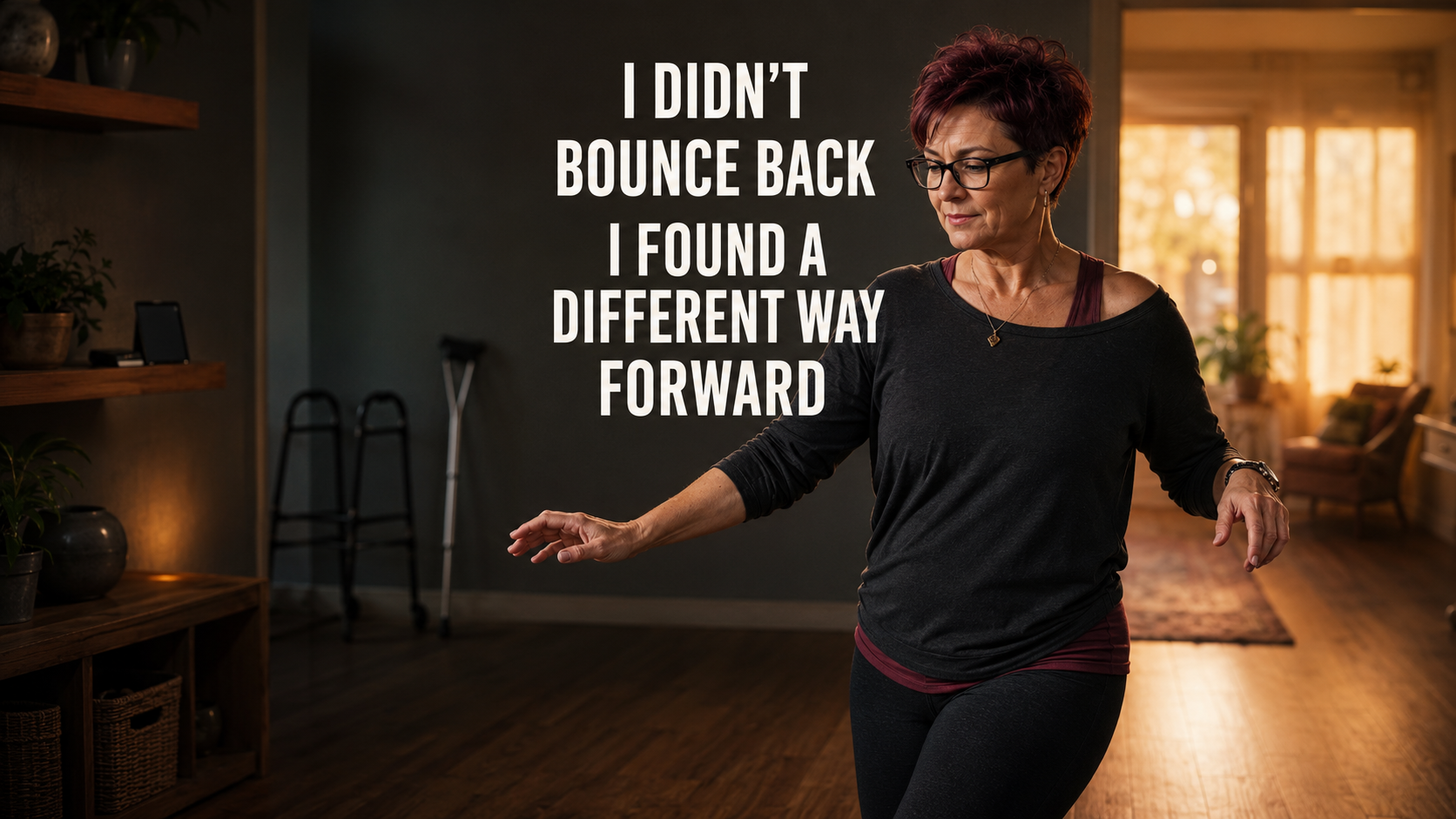
How I Came Back From Injury After 51

I Didn’t Bounce Back—I Found a Different Way Forward

A personal account of injury, lost independence, fear of movement, rhythm, and the experience that led me to question how we recover.

I did not bounce back.

Let us establish that first.

After age 51, I sustained a serious ankle injury that required major reconstruction. I then spent approximately eight months substantially immobilized.

Roughly two years later, I underwent a total hip replacement on the opposite side.

The medical events can be summarized in two sentences.

Living through them cannot.

Almost overnight, everything changed—not only physically, but practically and emotionally.

I went from being fully independent to needing help with basic parts of daily life: bathing, getting dressed, moving safely through the house and having meals prepared.

That loss of independence is not an unusual consequence of a serious orthopedic injury. Researchers studying patients after ankle fractures have documented disruption involving mobility, sleep, work, social participation, emotional health and ordinary activities of daily living. Patients have described fatigue, anxiety, depression and dependence on others during recovery. Read the qualitative research on the lived impact of ankle fractures.

Clinical guidance for ankle fractures also recognizes that patients may experience difficulty with daily activities, disrupted sleep, fatigue, depression, anxiety and loss of independence. Review the clinical discussion of ankle-fracture management and recovery.

But statistics cannot fully explain what it feels like when your own life becomes the case being described.

It is depressing.

It is lonely.

Not necessarily because people do not care.

Because dependence can take a piece of your identity with it.

The Part No One Prepared Me For

For me, the deepest fear was not dying.

It was losing control.

I began planning movement.

I thought before standing. I measured the distance between one stable surface and another. I considered whether a step, turn or change in direction might place me in danger.

Movement that had once happened automatically became a negotiation.

That hesitation changed how I lived.

Researchers use terms such as fear of falling, movement-related fear and kinesiophobia to describe related—but not identical—experiences. These concepts should not be casually diagnosed, but the pattern is well documented: fear can lead people to restrict activity, and prolonged restriction can contribute to deconditioning, isolation, declining mobility and diminished quality of life. Read the research review on fear of falling and activity restriction.

A separate systematic review found that fear-related activity restriction can contribute to physical deconditioning, depression and social isolation. The relationship can become cyclical: fear reduces movement, reduced movement weakens physical capacity, and diminished capacity can reinforce fear. Review the evidence on fear of falling, physical function and psychological health.

Fear of movement has also been studied after total hip replacement. Research has found that some patients continue experiencing substantial kinesiophobia years after surgery, although studies do not agree that it predicts every functional outcome or affects every patient in the same way. Read the study on kinesiophobia following total hip arthroplasty.

I did not have that terminology at the beginning.

I only knew I was no longer living the way I had before.

I was managing every movement.

And I was not willing to accept that as the final version of my life.

The Day Something Changed

The experience that changed my direction did not happen during a dramatic clinical breakthrough.

It happened in my home gym on a day when I did not feel like showing up. “

“Return of the Mack” began playing.

Something in me responded.

That is the only honest way I can describe it.

I did not begin with a formal theory. I was not conducting a study. I was not testing a clinical protocol.

I started moving.

Not counting repetitions.

Not chasing performance.

Not trying to prove anything.

I moved to the rhythm in a way that reminded me of how I had moved before the injuries—before every action felt calculated.

The experience felt less like forcing my body through an exercise and more like allowing it to participate in the music.

That moment became important to me.

It was not medical proof.

It was an observation.

And it gave me a question worth investigating.

Why Familiar Music Can Feel Physical

The idea that music can trigger a physical or autobiographical response is not imaginary.

Research has shown that familiar music can evoke vivid, personally meaningful autobiographical memories. Neuroscientist Petr Janata’s work identified brain activity associated with music-evoked autobiographical memory, helping establish that familiar songs can activate networks involving memory, emotion and self-relevant experience. Read the research on the neural architecture of music-evoked autobiographical memories.

Other studies have found that familiar music is more likely than unfamiliar music to evoke specific autobiographical memories. Review the research on familiarity and music-evoked memory.

Music can also produce what researchers call groove: the pleasurable desire to move with rhythm. Research involving younger and older adults found that high-groove music influenced gait, while familiarity and an individual’s ability to perceive the beat affected the response. Read the study on groove, familiarity and gait in older adults.

That research does not prove what happened in my body that day.

It does establish that rhythm, familiarity, memory and movement can interact.

“Return of the Mack” was not medicine.

But for me, it became a cue.

It connected the person I had become after injury with a version of myself who remembered moving without fear.

What Began Returning

At first, the changes were subtle.

My shoulders felt less guarded.

My upper body began participating more naturally.

My hips started following the movement instead of feeling separate from it.

My balance no longer felt like a negotiation every moment.

There was no single overnight transformation.

Things returned in pieces.

A little more mobility.

A little less hesitation.

A slight return of coordination.

Then repetition.

The small changes began accumulating.

What had felt stiff sometimes felt more fluid. Movements that required conscious planning began feeling less intrusive. My body started operating more like a connected system and less like a collection of parts I was trying to manage individually.

These were my perceptions of my body.

They were meaningful, but they were not controlled clinical measurements.

The Moment I Knew I Needed to Pay Attention

There was one experience I will never forget.

After months of reduced activity, my shoulders had become stiff and guarded. My posture felt smaller. My upper body, arms and hips no longer seemed to move together the way they once had.

As I continued moving with the music, my shoulders began to release.

Slowly.

If someone had been watching, I believe they would have seen my shoulders settle, my chest open and my head begin moving more freely.

It felt as if the change traveled through me—from my shoulders and arms into my trunk and hips.

Not forcefully.

Not all at once.

It felt as though my body were finding a more natural organization.

Physically, the sensation was refreshing. The closest description I have is cucumber water moving through my veins—clean, cool and awakening.

That is a metaphor for what I felt.

It is not a physiological explanation.

I did not know what mechanism, or combination of mechanisms, produced the experience. I could not determine whether the change came from increased activity, repeated practice, music, attention, healing over time, formal rehabilitation, improved confidence, natural recovery or some interaction among those factors.

I only knew the experience was different enough to make me curious.

That curiosity became the beginning of a much larger body of work.

Rhythm and Movement Are Legitimate Areas of Research

Rhythm-based movement is not a fringe concept.

Rhythmic auditory stimulation has been studied as a rehabilitation tool, particularly for gait and motor impairments associated with neurological conditions such as Parkinson’s disease and stroke. Systematic reviews have reported improvements in certain gait and motor outcomes, although results vary by population, protocol and research quality. Review the systematic review of rhythmic auditory stimulation and motor function.

A 2024 study of healthy older adults found that rhythmic auditory stimulation at certain cadences increased the repeatability of whole-body gait patterns. The authors described acoustic stimulation as promising but also noted limitations in its effects. Read the study of auditory stimulation and whole-body movement variability.

Dance research provides another relevant—but still indirect—line of evidence. A meta-analysis found that dance interventions can improve aspects of physical function in healthy older adults. Review the meta-analysis of dance and physical function.

An earlier systematic review reported improvements across measures of balance, muscular strength, endurance and other areas of functional fitness, while also noting methodological limitations and the need for more standardized research. Read the systematic review of dance interventions for older adults.

These findings support the broader proposition that rhythmically cued, coordinated movement deserves serious study.

They do not validate my specific approach.

Evidence from Parkinson’s disease, stroke, healthy older adults or formal dance interventions cannot automatically be applied to people recovering from ankle reconstruction or hip replacement.

That is precisely why direct testing matters.

Rehabilitation Was Part of My Recovery

My experience should not be framed as a rejection of rehabilitation.

Formal rehabilitation occurred during my recovery. Surgery, healing, medical care and rehabilitation all belong in the history of what happened to me.

Modern orthopedic rehabilitation is not limited to isolated exercises. Depending on the patient and stage of recovery, it can include range of motion, strengthening, gait training, balance work, transfers and functional retraining intended to restore independence in bathing, dressing and other daily activities. Review the evidence-based description of postoperative rehabilitation.

After total hip replacement, regular exercise and a gradual return to daily activity are considered important parts of restoring strength and mobility. Those activities should be directed by the patient’s surgeon and physical therapist. Read the American Academy of Orthopaedic Surgeons’ hip-replacement exercise guidance.

A systematic review of total hip arthroplasty rehabilitation also emphasizes that rehabilitation is complex and can include resistance exercise, gait training and other components. It found that the evidence does not support one universally superior program for every patient. Read the systematic review of rehabilitation after total hip arthroplasty.

Research on ankle-fracture rehabilitation similarly shows uncertainty about which approaches are best for which patients. Review the Cochrane evidence on adult ankle-fracture rehabilitation.

My question was never whether rehabilitation matters.

It was whether something could complement the conventional recovery process by helping certain people reconnect movement with rhythm, coordination, confidence and personal meaning.

That remains a research question.

The Real Breakthrough Was Confidence

The change that mattered most to me was not a number on a scale.

It was confidence.

When I began trusting my body’s response, my mind stopped interrupting every movement with the same degree of hesitation.

The internal language began changing from:

“I hope I don’t fall.”

To:

“I can manage this.”

Researchers distinguish fear of falling from falls efficacy or balance confidence. Falls efficacy generally concerns a person’s perceived ability to perform activities or respond to a fall-related threat. That belief can affect agency and participation, although confidence alone does not establish physical safety or eliminate fall risk. Read the research on falls efficacy and balance confidence.

Exercise, tai chi and multifactorial fall-prevention programs have shown some ability to reduce fear of falling in certain community-living populations. Review the systematic evidence on interventions addressing fear of falling.

Confidence matters.

But confidence must remain connected to capacity, medical status and the environment.

Feeling fearless is not the same as being safe.

Why This Experience Reaches Beyond Me

I am not the only person who has confronted mobility loss.

Current CDC data indicate that more than one in four American adults reports some form of disability. Mobility limitations are among the most common forms, particularly in middle-aged and older adults. Review the CDC’s disability data.

Arthritis is another substantial part of this landscape. The CDC estimates that approximately 58.5 million American adults have arthritis, including 25.7 million who report activity limitations attributable to the condition. Review the CDC’s arthritis indicators.

Those numbers do not prove that my experience can help millions.

They establish that millions are living with pain, mobility restrictions or threats to independent living.

Whether the movement approach that emerged from my recovery can help a broader population must be determined through structured development, appropriate safety standards and credible research.

My experience generated a hypothesis.

It did not complete the science.

Where I Am Now

I am now in my mid-50s.

I have lived through ankle reconstruction and total hip replacement.

In my daily life, I experience my movement as more capable, coordinated and confident than it was before I found this approach.

That is my testimony.

It should not be presented as proof that one intervention produced the outcome or that another person will experience the same result.

Recovery is influenced by many factors: the nature of the injury, surgery, medical status, pain, rehabilitation, healing time, strength, balance, confidence, environment and continued activity.

I did not become younger.

I found a different way of participating in my recovery.

And then I began asking whether that experience contained something worthy of disciplined study.

If You Feel Stuck

Do not begin by copying my movements.

Begin with safety.

If you have recently undergone surgery, have difficulty standing, experience dizziness, have a history of falls, live with significant pain or weakness, or have been given movement restrictions, consult your surgeon, physician or physical therapist before changing your activity.

The American Academy of Orthopaedic Surgeons advises that foot-and-ankle conditioning should be performed under medical or physical-therapy supervision when appropriate. Review the AAOS safety guidance.

If movement with music is medically appropriate for you, it does not have to begin with standing.

It may begin seated.

It may be a small shoulder movement, a careful shift in posture or tapping a hand to a familiar beat.

Use a stable environment. Keep necessary mobility aids within reach. Do not close your eyes, make sudden turns or challenge your balance without appropriate supervision.

Stop if you experience chest pain, severe shortness of breath, dizziness, new weakness, loss of balance, sharp pain or another concerning symptom.

Do not force movement through a restriction.

Do not use music to ignore pain or override medical precautions.

The objective is not to prove courage.

It is to explore whether safe movement can feel meaningful again.

Choose a song connected to a time when you felt capable.

Listen.

Notice what it evokes.

If movement is safe for you, let the response begin within the limits of the body you have today.

Not the body you are trying to punish.

Not the body you are trying to reclaim through force.

The body that carried you here.

My body did not simply “remember” in a way science can presently verify from my story.

But rhythm gave me a way to ask it a different question.

And that question changed the direction of my life.

— Christine Silva

Author’s Note

This article describes my personal experience following major ankle reconstruction, prolonged immobility, formal rehabilitation and subsequent total hip replacement. It also describes the observations that contributed to the development of my movement research and The Freedom Flow Method.

My individual recovery cannot establish clinical efficacy, causation, safety or generalizability. The scientific sources cited here support related concepts—including the effects of orthopedic injury, fear of falling, activity restriction, familiar music, rhythmic auditory stimulation and coordinated movement—but they do not validate my specific method.

The Freedom Flow Method should not be represented as medical treatment, physical therapy, fall prevention or a substitute for individualized clinical care unless and until those claims are supported by appropriate research and regulatory review. Anyone recovering from surgery or living with pain, balance impairment, neurological symptoms, mobility limitations or fall risk should consult an appropriately qualified healthcare professional before beginning a new movement practice.

Previous
Previous

When the People You Love Don’t Support the Life You’re Building

Next
Next

Walking Into the Noise