GENXFINITY MAGAZINE

Stories for the generation that still has more to give.
Generation X, Reinvention GenXFinity Media LLC Generation X, Reinvention GenXFinity Media LLC

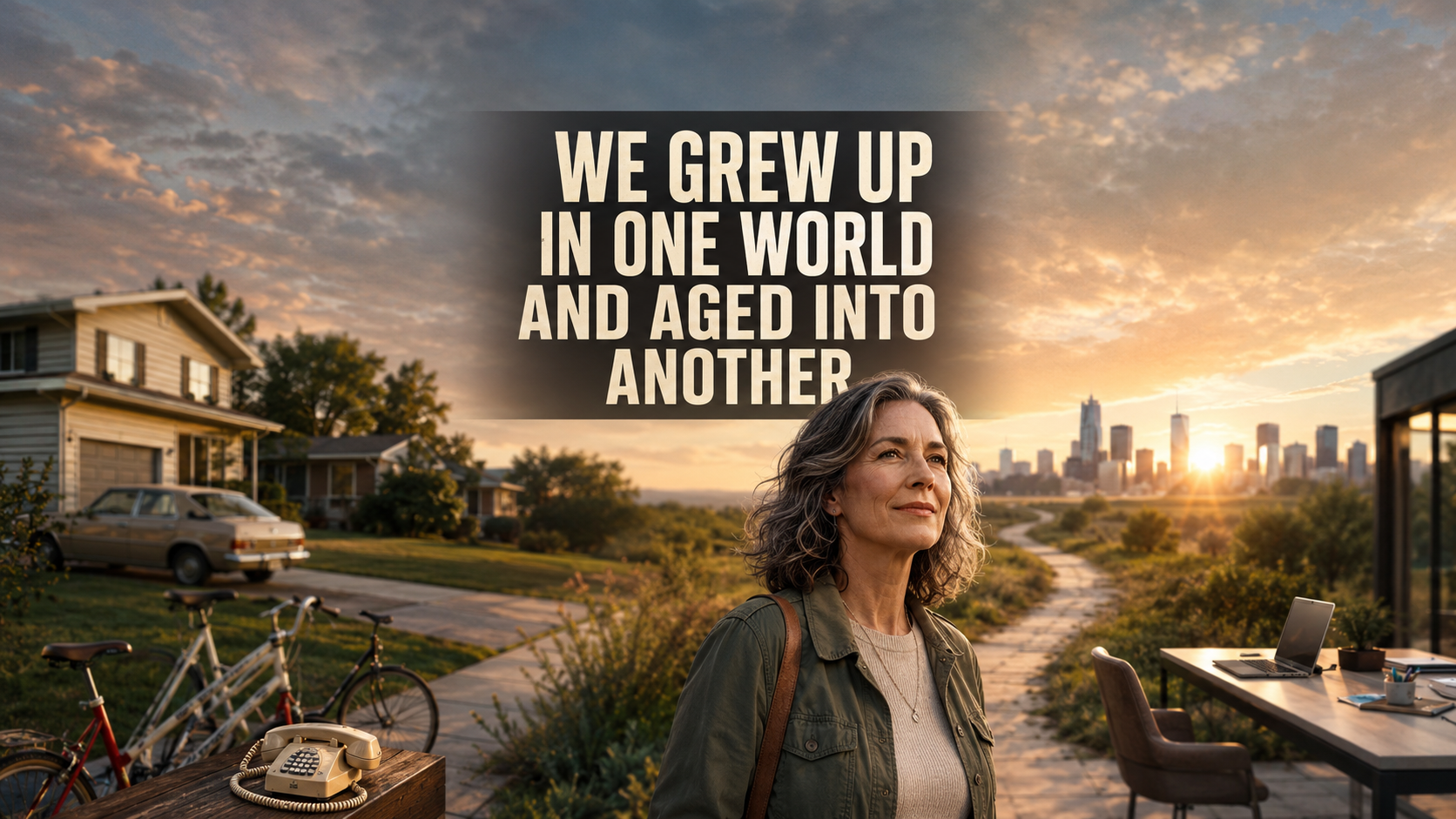
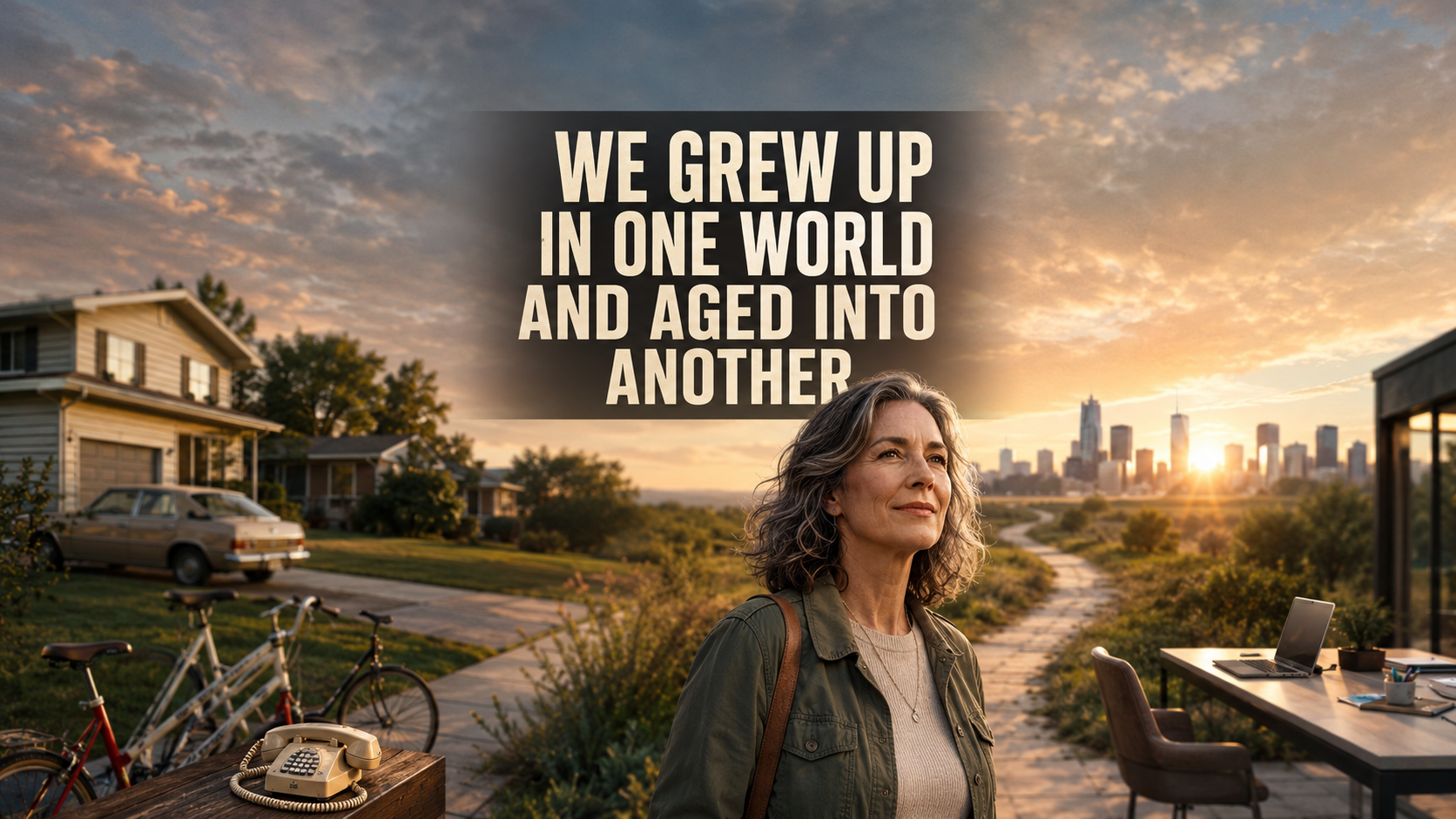
We Grew Up In One World And Aged Into Another

A response to a woman asking how I am handling life in my mid-50s — the aches, the losses, the noise, the hunger to build something real, and the strange realization that this may be the perfect time to begin again.

A reflection on Generation X, midlife exhaustion, reinvention, movement, and the hunger to build a life that finally feels like our own.

A woman recently sent me an email asking how I am handling life in my mid-50s—not financially or professionally, but life itself. She meant the emotional side of it, the physical side of it, and the strange feeling of looking around one day and realizing that the world no longer operates like the one you grew up preparing for.

I understood exactly what she meant because I think many members of Generation X are quietly trying to figure that out right now.

There is a particular kind of exhaustion that can arrive at this stage of life. Not dramatic exhaustion, but the quieter kind—the kind that builds over decades from adapting over and over again while pretending you are fine.

We grew up in one world and aged into another.

The World We Remember

We grew up riding bikes until the streetlights came on. We memorized phone numbers, knocked on doors, and sat in garages talking for hours without documenting the conversation for strangers online. We had friendships that existed without algorithms.

That description will not fit every member of Generation X. Childhood differed by geography, race, class, family structure, disability, and circumstance. The past was not universally safer, simpler, or kinder. But many of us do remember a world in which everyday life was less digitally mediated.

Then the transformation arrived.

Generation X did not merely witness the expansion of the internet, mobile technology, and social media. We learned to work, communicate, shop, bank, research, create, and maintain relationships through systems that did not exist when we were children.

Pew Research Center has documented the scale of this adaptation. By 2021, 96% of Americans ages 50 to 64 reported using the internet, and technology adoption among older age groups had increased substantially over the preceding decades. Review Pew Research Center’s findings on technology adoption among older adults.

We adapted, but adaptation still costs energy.

When Ordinary Life Became a Performance

People talked to one another differently then. Now everybody can sound like a press release. Every opinion feels rehearsed, every interaction feels optimized, and even ordinary life has started sounding branded.

People brand themselves, market themselves, and package themselves. I include myself in that observation. Somewhere along the way, sincerity began to feel almost uncomfortable.

Generation X may notice this shift because many of us remember speaking casually without feeling as though we were building an audience. We remember private mistakes, undocumented conversations, and ordinary moments that disappeared when they ended.

That does not mean previous generations were always more sincere. Human beings have always performed for one another. Social status, reputation, conformity, and image existed long before the internet.

What changed was the scale.

The audience followed us home. The news cycle stopped closing. The comparison never ended. The device became the office, marketplace, television, camera, newspaper, social gathering, and public square—all at once.

The American Psychological Association has reported that constant exposure to news, social media, and digital devices can contribute to stress and media overload. The effects vary by person and depend on factors such as the type of content, frequency of exposure, and how technology is used. Read the APA’s discussion of media overload and mental health.

It would be too broad to say that human beings simply were not designed for modern technology. But it is fair to ask whether constant exposure to information, comparison, outrage, advertising, and manufactured urgency is good for us.

For many people, something inside eventually begins to push back.

We Were Busy Building Lives

While the culture was changing, most of us were busy building lives—working, raising children, holding marriages and relationships together, caring for parents, managing households, and surviving recessions, layoffs, rising costs, and responsibilities that never seemed to slow down.

Then somewhere along the line, our bodies changed too. Not overnight, but just slowly enough to catch us off guard.

Your knees start talking to you in the grocery store. Your back tightens after a long drive. You think strategically before lifting something heavy. Recovery takes longer. Sleep becomes valuable. Peace becomes valuable.

These experiences are common, but they should not all be dismissed as “just aging.” New or worsening pain, severe fatigue, sleep disruption, weakness, balance problems, shortness of breath, or other significant changes can have treatable medical causes and deserve appropriate evaluation.

Some physical change is part of aging. The National Institute on Aging explains that age-related losses in muscle mass and strength can affect physical ability, while sleep patterns can also change over time. Read the National Institute on Aging’s explanation of age-related muscle and strength changes.Learn more about sleep and aging.

The body is changing, but it is not finished.

The Accumulation of Loss

By this age, people begin understanding the value of ordinary things differently: a quiet house, a healthy medical report, a good conversation, energy when you wake up, or one more phone call with somebody you love.

The absence of those things changes people, especially after loss enters your life.

Parents die. Friends disappear. Relationships end. Children grow up and build lives of their own. Caregiving roles begin or conclude. Homes are emptied, family traditions change, and work identities disappear after layoffs, retirement, or restructuring.

Nobody completely prepares you for how emotionally disorienting that can feel. One day you realize that an entire chapter of your life ended quietly while you were busy managing responsibilities.

People do not talk enough about that part—not only the dramatic grief, but the gradual kind. The accumulation. The feeling of becoming unfamiliar to yourself while remaining responsible for everyone else.

I believe many people in their 50s carry grief they never fully processed because life kept moving. That is an observation, not a diagnosis.

Grief does not follow one timetable or appear in one form. Persistent sadness, hopelessness, severe anxiety, inability to function, substance misuse, or thoughts of self-harm require more than inspirational language. They deserve qualified support.

But not every form of midlife unease is a disorder. Sometimes it is recognition—a person finally noticing what the years have cost.

Grieving a World That Changed

Some of that grief is connected to the world itself changing. Not because the past was perfect. It was not.

The world many of us remember also contained prejudice, silence, limited opportunity, untreated trauma, and injustices that should never be romanticized. Still, parts of life felt more grounded. Life felt slower. Conversations felt less managed. People were allowed to exist more privately.

Not every thought needed to be announced. Not every moment required public validation.

Now the noise rarely stops. I think many people my age are exhausted from pretending that this level of noise feels normal.

That does not require rejecting technology. It may require using it more deliberately: turning off notifications, choosing when the news enters the room, protecting conversations from interruption, allowing an experience to remain undocumented, and leaving some thoughts unpublished.

Privacy is not irrelevance. Silence is not failure. A life does not need an audience to have meaning.

The Return to Self

That is where I think many Generation X adults are now—not trying to become younger, but trying to reconnect with themselves. They are trying to remember who they were before life became responsibility, stress, caregiving, work schedules, bills, and survival.

The goal is not to return to adolescence. It is to recover parts of the self that were buried beneath obligation: curiosity, ambition, creativity, play, movement, friendship, the desire to make something, and the belief that another chapter remains possible.

Returning to yourself does not mean abandoning the people who depend on you. It means recognizing that a life built entirely around usefulness to others will eventually ask where you went.

Why the Hunger to Build Returns

Maybe that is why some people in midlife feel pulled toward building something of their own. Not because they have lost their minds, because every person over 50 should become an entrepreneur, or because the internet’s promises of instant income are real.

After decades of working for organizations, raising families, surviving setbacks, adapting to change, and carrying responsibility, people may finally recognize that they have developed something valuable that cannot be taught quickly: judgment, pattern recognition, discipline, resilience, the ability to recover after disappointment, the ability to read a room, the ability to remain steady during uncertainty, and the ability to distinguish urgency from importance.

Young adults can possess these qualities too. Age does not guarantee wisdom, competence, discipline, or emotional maturity. But long experience can create opportunities to develop them.

Those qualities are earned slowly through ordinary life—through showing up when you were tired, going to work when your heart was broken, raising children when money was tight, caring for people while carrying your own fear, burying people you loved and still waking up the next morning because life required it, and doing what had to be done before anyone applauded you for it.

That kind of experience can become infrastructure.

Entrepreneurship Does Not Belong Only to the Young

Our culture often presents entrepreneurship as a young person’s game. The evidence is more complicated.

Research examining millions of business founders found that the average founder of the fastest-growing new ventures was approximately 45 years old. The researchers also found that previous experience in the same industry was associated with a substantially higher likelihood of entrepreneurial success. Read the National Bureau of Economic Research study on age and high-growth entrepreneurship.

That does not mean starting a business in midlife is safe or that age guarantees success. Most businesses do not become high-growth companies. Entrepreneurship can consume savings, affect retirement plans, disrupt health-insurance coverage, create tax and legal exposure, and place pressure on families and relationships.

Experience is an asset. It is not a substitute for market validation, financial planning, legal structure, customer demand, execution, or timing. Still, the research challenges the assumption that meaningful entrepreneurship belongs only to the young.

For some Generation X adults, there is a quiet realization beginning to happen. The hunger is still there—not necessarily the reckless hunger of youth, but something different and more focused.

It is a hunger for excellence, a hunger to build, a hunger to succeed on your own terms after spending decades helping other systems succeed, and a hunger to discover whether there is still another chapter left.

There is—but it requires more than hunger.

Experienced and Inexperienced at the Same Time

Starting something in your 50s requires nerve and humility. It requires learning new tools, new platforms, new language, and new ways of reaching people. It requires recognizing that you can be deeply experienced in one area and completely inexperienced in another.

That is not comfortable, but it is honest. Honesty is a strong foundation.

Midlife may offer certain advantages because it can be clarifying. By this age, you may know what waste feels like. You may recognize bad leadership, hear false promises more quickly, know when people are performing, and understand the cost of building someone else’s dream while your own ideas wait quietly in the background for permission.

But clarity does not remove risk.

Before starting a business, changing careers, or investing substantial money, test the idea. Study the customer. Understand the problem. Calculate the financial runway. Protect health coverage. Identify legal and licensing requirements. Separate revenue from attention, encouragement from demand, and a meaningful idea from a viable business model.

At some point, you may stop waiting for permission. That does not mean you stop doing due diligence.

The Traits That Still Matter

The structure instilled in many of us still has value: work ethic, follow-through, responsibility, common sense, respect for the process, and the ability to get up and do the work even when nobody is watching.

Those are not outdated traits. But they are not uniquely Generation X traits, and we should not pretend that younger generations lack them. They are human traits.

They become competitive advantages when paired with adaptability, current skills, ethical judgment, and a willingness to keep learning. Experience becomes most valuable when it remains teachable.

The moment we decide that age makes us automatically right is the moment experience hardens into rigidity.

The better position is more demanding:

I know things. I have survived things. I have built things. And I still have things to learn.

Why Movement Matters to Me

That is part of why movement has become so important to me as I have gotten older—not movement tied to punishment, organized around shame, or pursued only for appearance.

I mean movement that makes me feel connected to myself again. Movement that reminds me I am still alive inside this body instead of simply managing it.

This is personal to me, but the broader value of physical activity is well established. The Centers for Disease Control and Prevention reports that regular physical activity can support sleep, mental health, physical function, cognition, and independence while helping reduce the risk of several chronic conditions. Even some activity can provide benefits, although the appropriate type and intensity depend on a person’s health and abilities. Review the CDC’s evidence-based overview of physical activity benefits.

Movement is not a cure-all. It does not reverse every illness, eliminate grief, or guarantee independence. People living with disabilities, chronic illness, pain, surgical histories, or mobility limitations may require individualized modifications and clinical guidance.

But movement can still become a way back into conversation with the body.

Not perfection or performance—something real and grounding. Something that cuts through the noise long enough for a person to hear themselves again.

The Strongest Chapter Yet

Despite what parts of the culture may imply, life is not over in your 50s.

That does not mean decline is imaginary. Bodies change. Losses accumulate. Time becomes more visible. Some opportunities narrow. But other things become possible because illusion begins to burn away.

This may be the first time many of us are honest about what we want, what we are tired of, what we still believe in, and what we are no longer willing to postpone.

Maybe this is not simply the beginning of decline. Maybe this is also the age when illusion burns off, experience becomes fuel, and the hunger returns—not to prove something to the world, but to build something that finally feels like your own.

And maybe returning to yourself is not a step backward.

Maybe it is the beginning of your strongest chapter yet.

Author’s Note

This article combines personal reflection with general information about aging, technology, entrepreneurship, grief, and physical activity. It does not claim that every member of Generation X shares the same childhood, resources, health, beliefs, or experience of midlife.

Nothing in this article constitutes medical, mental-health, financial, legal, or business advice. Significant physical symptoms, persistent emotional distress, or major business and financial decisions should be evaluated according to individual circumstances with appropriately qualified professionals.

Read More
Generation X, Reinvention GenXFinity Media LLC Generation X, Reinvention GenXFinity Media LLC

The Reinvention Nobody Prepared Generation X For

Starting over when time moves faster and the life you built begins asking different questions.

There comes a point somewhere after 50 when life changes tone. Not dramatically or all at once—just enough to notice.

The phone rings less, or it rings late.

Some people are helping aging parents through medication schedules, specialist appointments, changing mobility, and memory loss. Others catch themselves reaching for a phone that can no longer call home.

The children may still need guidance, reassurance, or help getting established in an economy different from the one their parents entered. Or they have grown distant in the ordinary ways adulthood sometimes creates—careers, marriages, geography, exhaustion, and life moving too quickly for deeper conversations.

Meanwhile, the mortgage still drafts on schedule. Groceries cost more. The economy keeps reinventing instability and presenting it as normal.

Somewhere inside all of this, many Generation X adults are quietly confronting a question that arrives without warning:

Now that I have spent decades building a life for everyone else, what happens to the parts of me that waited?

Not abandoned.

Waited.

There is a difference.

We Followed the Blueprint We Were Given

Many Generation X men and women did what they were taught to do: graduate, find work, marry, start families, stay loyal, keep the lights on, and push through difficulty privately.

That was not everyone’s path, and it was not always freely chosen. Race, class, disability, sexuality, family structure, geography, discrimination, and economic opportunity shaped what was possible. But for many, the pursuit of stability was not a limitation.

It was a commitment.

Generation X came of age during periods marked by divorce, addiction, layoffs, inflation, recession, and significant economic restructuring. Many people simply wanted to create solid ground for their children—something dependable and calmer than what they inherited.

And many succeeded.

Children were raised. Bills were paid. Homes were maintained. Families were carried through illness, job losses, disappointments, and change.

Family caregiving has become a substantial part of American life. The 2025 Caregiving in the U.S. report estimated that approximately 63 million American adults provide ongoing care to an adult or child with a complex medical condition or disability. The study also found that 29% of caregivers were simultaneously supporting children and an adult—a burden commonly described as sandwich-generation caregiving. Review the 2025 national caregiving research.

Responsibility has a way of consuming oxygen.

Years disappear into school pickups, double shifts, sports practices, aging parents, home repairs, doctor visits, commutes, taxes, and recovering from one financial setback before the next one arrives.

Then one day you look up and realize that decades have passed at full speed.

Not wasted.

Spent.

Generation X Remembers a Different Kind of Freedom

What many people misunderstand about Generation X is that our nostalgia is not always rooted in objects.

It is rooted in atmosphere.

We remember what it felt like to exist before constant digital visibility—before every opinion could become public, every moment could become documentation, and identity could become a performance for strangers online.

Many of us disappeared for entire afternoons as teenagers. There was no location tracking, no smartphone, and no permanent digital trail following an ordinary mistake.

You grabbed your bike and disappeared into neighborhoods until the streetlights flickered on. You wandered malls with friends and no agenda beyond movement itself. Arcades glowed like small worlds hidden inside shopping centers. Music drifted from record stores into crowded hallways. Friday nights felt open-ended in a way that can be difficult to explain to generations raised with continuous digital connection.

That experience was not universal, and freedom was not distributed equally. Some children lived with danger, abuse, discrimination, poverty, disability, or adult responsibilities long before they should have. The past should not be romanticized into something it never was.

Still, Generation X may have been among the last groups to experience adolescence before smartphones, social media, location sharing, and permanent digital records became ordinary features of growing up.

That is a historical observation—not proof that Generation X became more independent, resilient, or psychologically healthy than those who followed.

But it shaped how many of us remember freedom.

The Cost of Constant Exposure

Many Generation X adults learned self-reliance early. We learned to improvise, spend time alone, and tolerate periods of uncertainty without immediate reassurance.

Now we live in a culture that rarely stops talking.

Modern digital life does not merely request attention. Entire business models are built around capturing, measuring, and retaining it.

The American Psychological Association has reported that continuous exposure to news and digital media can contribute to stress and media overload. The effects vary according to the individual, the content, the frequency of exposure, and the way technology is used. Read the APA’s discussion of media overload and mental health.

Technology is not inherently destructive. It gives people access to information, relationships, education, work, healthcare, creativity, and communities that may otherwise remain inaccessible.

But access without boundaries can become saturation.

Perhaps that is part of why some people our age feel mentally exhausted in ways they struggle to articulate. The problem is not simply that the world changed.

It is that the world followed us into every room.

Reinvention After 50 Carries Different Weight

The internet romanticizes reinvention.

Real reinvention is usually quieter—especially later in life.

By 50, risk is no longer theoretical. Major decisions can affect retirement, marriage, health insurance, savings, family stability, housing, debt, and physical energy. You understand consequence differently because you have already lived through enough of it.

Generation X entered adulthood during a long transition in the relationship between employers and workers. Traditional private-sector pensions became less common as responsibility for retirement increasingly shifted toward individual defined-contribution accounts. The Bureau of Labor Statistics reports that participation in defined-benefit pension plans declined over time, while only 15% of private-industry workers had access to such a plan in March 2023. Review the Bureau of Labor Statistics analysis of changing retirement benefits.

Many members of this generation also lived through the Great Recession during critical earning, parenting, and homeownership years. From 2007 to 2009, average home prices fell sharply, financial markets collapsed, unemployment increased, and household net worth declined by trillions of dollars. Read the Federal Reserve’s history of the Great Recession and its financial consequences.

Not every Generation X household experienced those events in the same way. Some benefited from later recoveries; others never regained what was lost.

But economic instability leaves a mark.

It changes how people approach uncertainty.

That may be why many Generation X adults are rebuilding carefully instead of loudly—at kitchen tables after everyone goes to bed, inside converted spare bedrooms, or between full-time jobs and caregiving responsibilities.

They are learning editing software, online business systems, video production, new technologies, consulting, and entrepreneurship.

Not because they suddenly became dreamers.

Because survival by itself eventually stops feeling sufficient.

There comes a point when people begin asking whether they still recognize themselves beneath decades of obligation.

When Nostalgia Becomes Physical

A song plays in a grocery store and suddenly your mind unlocks a forgotten version of yourself.

Not simply younger.

Lighter.

Before chronic stress settled into your shoulders. Before movement became strategic. Before exhaustion followed you into the morning.

That reaction is not evidence that the past was better, and it is not unique to Generation X. But the connection between music, emotion, and autobiographical memory is supported by research.

Studies of music-evoked autobiographical memories have found that familiar music can trigger vivid, personal, and emotionally significant recollections. Music that evokes a memory may produce a stronger emotional response than music that does not. Review peer-reviewed research on music-evoked autobiographical memory and emotion.

Generation X carries strong associations with music because music accompanied so many stages of independence: driving alone for the first time, late-night music television, roller rinks, parking-lot conversations, concert tickets folded into wallets, cassette tapes worn thin through repetition, and songs recorded from the radio while hoping the disc jockey stayed quiet through the introduction.

Those memories became attached to motion, freedom, anticipation, relationships, and possibility.

That is why nostalgia can feel almost physical in midlife.

The body does not literally store a complete historical record of every experience. But sensory cues can reactivate memories and the emotions associated with them.

Many people quietly mourn how difficult that feeling of unrestricted possibility has become to access consistently.

Not because life is hopeless.

Because life became compressed—scheduled, measured, and managed.

The nervous system rarely seems to receive permission to exhale.

The Fear Beneath the Fear

For many people, the deepest concern is not simply aging.

It is losing independence.

It is the fear of becoming physically limited, financially trapped, burdensome to others, or unable to move freely through the world.

That concern may feel especially sharp for people who associate their youth with physical freedom—bikes, skateboards, pickup games, road trips, concerts, and movement before physical caution entered the equation.

Mobility is not a cosmetic issue. It is closely connected to function and independent living. The National Institute on Aging identifies maintaining mobility and preventing disability as important components of preserving independence as people age. Read the National Institute on Aging’s discussion of mobility and independent living.

Aging does not produce one inevitable physical outcome. Genetics, illness, injury, disability, environment, access to healthcare, physical activity, nutrition, and socioeconomic conditions all matter.

Movement is not a guarantee against dependence, and physical limitation is not a personal failure.

But preserving function where possible can become part of reinvention—not because someone is trying to become young again, but because agency matters.

The Clarity That Arrives With Age

Something unexpected can happen with age.

People may become more honest.

Less performative.

Less interested in appearances.

Less willing to participate in exhausting social theater.

That does not happen automatically. Age does not guarantee wisdom, self-awareness, maturity, or integrity.

But enough experience can strip away certain illusions.

You begin to understand what actually matters. You recognize the cost of wasted time, false urgency, bad leadership, empty promises, and relationships sustained only by obligation.

It is not necessarily cynicism.

It can be precision.

Maybe Reinvention Is Recovery

Maybe reinvention is not always about becoming someone new.

Maybe it is about recovering the parts of yourself that survival forced into the background—the creative part, the curious part, the ambitious part, the calm part, and the version of you that existed before exhaustion became your baseline setting.

Generation X stands in an unusual historical position. We remember analog life yet must function inside relentless digital life. We understand solitude but live in a culture of constant exposure. We were taught independence while aging into economic, technological, healthcare, and retirement systems that increasingly require individuals to navigate extraordinary complexity.

That tension lives quietly inside millions of people.

Perhaps that is why so many are beginning again.

Not impulsively.

Not chasing youth.

Not attempting to recreate the past.

They are trying, with hard-earned wisdom and fewer illusions, to build lives that still feel meaningful while there is still time to live them.

Reinvention after 50 is not an escape from responsibility.

It is the decision that the self who carried those responsibilities still belongs in the life that remains.

Author’s Note

This article combines personal and cultural reflection with general information about Generation X, caregiving, retirement, economic change, nostalgia, aging, and mobility. It does not claim that every member of Generation X experienced the same childhood, opportunities, family structure, health, financial conditions, or relationship to technology.

Reinvention may involve emotional, medical, financial, employment, business, tax, insurance, or legal consequences. This article does not provide individualized medical, mental-health, financial, legal, employment, or business advice. Significant health concerns and major career, retirement, caregiving, or financial decisions should be evaluated according to individual circumstances with appropriately qualified professionals.

Read More
Generation X, Reinvention GenXFinity Media LLC Generation X, Reinvention GenXFinity Media LLC

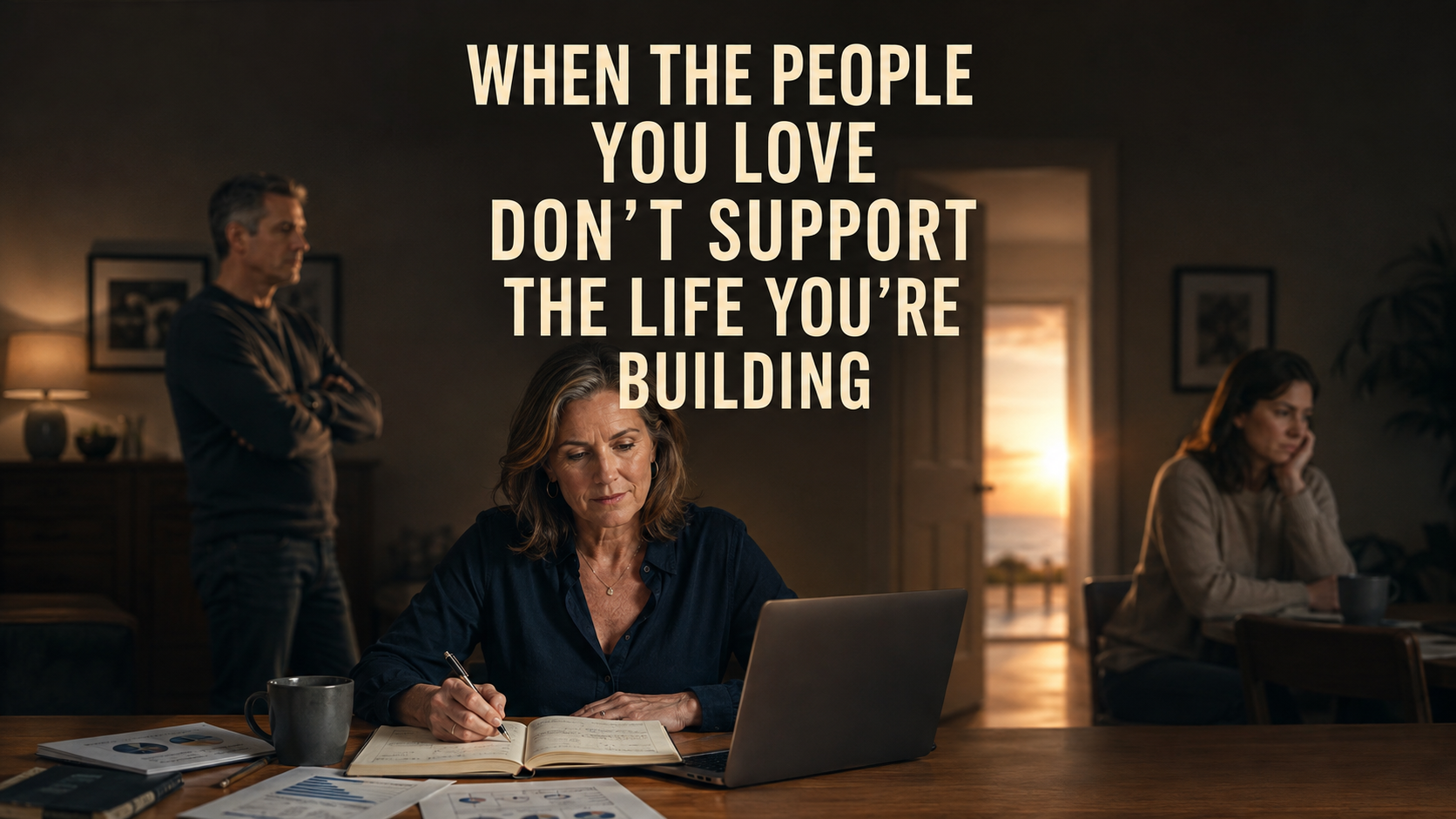
When the People You Love Don’t Support the Life You’re Building

A new venture can become especially lonely when the people closest to you do not understand the person you are becoming. This reflection examines family resistance, entrepreneurial identity, self-trust, and the difference between protecting a vision and refusing legitimate scrutiny.

A reflection on Generation X, entrepreneurship, family resistance, self-trust, and the loneliness of becoming someone new.

I received an email from someone who follows my work.

Generation X. Smart. Capable. Experienced.

And stuck.

Not because they lacked ideas or a strong work ethic. They were afraid to start—to build something of their own, make a career pivot, or leave behind the version of themselves everyone else had grown comfortable with.

The deepest fear was not failure.

It was this:

“What if my family doesn’t support me?”

That question stayed with me because I know exactly

what it feels like.

I had to face it when I began changing the direction of my own life in 2015.

The Beginning Rarely Looks Rational to Other People

My reinvention was not one clean move.

I moved from restaurants to real estate, then into politics, intellectual-property research, branding, and multimedia.

From the outside, that progression may have looked unstable. From inside my life, it felt necessary.

I could feel myself being pulled toward the structural norms I had been raised to follow: choose a predictable path, remain useful, protect stability, and avoid changes that other people might not understand.

Those values are not inherently wrong. Stability matters. Responsibility matters. Providing for the people who depend on us matters.

But the familiar path was leading me back toward a life that no longer fit.

I knew I needed to change direction while I still had the strength, energy, and courage to make consequential decisions.

Not eventually.

Now.

So I began moving more intentionally. I made decisions that created uncertainty, distance, and sometimes resentment.

My reasoning became simple:

Somebody has to go first.

What Happens When You Are the First One

When you are the first person in your family or immediate environment to build something outside the conventional structure of working for someone else, the people around you may not have a framework for understanding it.

Entrepreneurship can look foreign, unrealistic, or unnecessarily risky—especially when nobody close to you has done it before.

Your effort to grow may be interpreted as ego.

Your experimentation may be interpreted as instability.

Your confidence may be interpreted as arrogance.

Your changing priorities may cause people to ask, directly or indirectly:

“Who do you think you are?”

That reaction does not automatically mean they want you to fail

Sometimes people are frightened by changes they cannot control. Sometimes your reinvention disrupts an arrangement that worked well for them. Sometimes they are projecting their own fears. And sometimes they see a weakness in your plan that deserves serious consideration.

The challenge is learning to distinguish concern from control.

A warning supported by evidence should be examined.

A demand that you remain small so someone else can remain comfortable should not govern your life.

Family Support Matters—but It Is Complicated

Research does not show that every entrepreneur begins without family support. It does show that family relationships can influence whether someone pursues a venture, what resources are available, and how entrepreneurial stress affects well-being.

A study published in the Journal of Business Venturing examined the effects of different forms of family support during the startup process. It found that family social capital was positively associated with startup activity, while family financial support produced more complicated—and sometimes negative—effects. Read the study on family support and startup activity.

Another peer-reviewed study found that family support can affect the relationship between entrepreneurial stress and well-being, but the results varied considerably among entrepreneurs. Support matters, but its effects depend on the relationship, circumstances, and type of support being provided. Read the study through the National Library of Medicine.

A broader systematic review reached a similar conclusion: families can provide—or restrict—the emotional, financial, practical, and social resources connected to entrepreneurship. Review the research on entrepreneurship and the family’s role.

The evidence does not support saying that most families oppose entrepreneurship. It supports something more precise:

Some entrepreneurs begin with encouragement. Others encounter skepticism, pressure to remain on a conventional path, or concern about the consequences of an uncertain venture.

When encouragement, practical assistance, professional knowledge, or financial support is absent, the early stages may become more difficult and isolating.

Support Is Not the Same as Agreement

Family support should not require unquestioning approval.

A spouse who asks about debt, insurance, household expenses, retirement, or the amount of money being invested is not necessarily undermining a dream. Those may be responsible questions—especially when the consequences of the venture will affect the entire household.

Healthy support can include skepticism.

It should also include respect.

Ridicule is not due diligence.

Dismissal is not analysis.

Emotional punishment is not protection.

Someone can challenge your assumptions without diminishing your worth. They can ask for evidence without demanding that you abandon the idea.

The same responsibility applies to the entrepreneur.

You cannot label every objection “negativity” simply because it is uncomfortable. You must be willing to hear weaknesses, examine the numbers, revise the plan, and separate criticism of the business from criticism of you.

The question is not merely whether your family supports the idea.

It is whether everyone involved can discuss the risk honestly and respectfully.

The Friction of Becoming

Entrepreneurship requires more than creating a product, filing paperwork, or developing a brand.

It can require an identity transition.

You may no longer see yourself exclusively through the role you occupied for twenty or thirty years. You begin trying on a different professional identity before you have the revenue, results, or public recognition to make it feel legitimate.

Research on career transitions describes this process as movement between established professional roles that can disrupt a person’s sense of identity. These transitions are rarely linear. People experiment, revise their direction, and develop a new understanding of themselves through experience. Read the research on career transitions and professional identity.

That helps explain why reinvention can feel so destabilizing.

You are not merely learning new work.

You are becoming visible to yourself in a different way.

The people around you must decide whether they can relate to this emerging version of you. Some will adapt. Some will need time. Some may never accept the change.

You cannot control that decision.

You can control whether their discomfort becomes the ceiling over your life.

The Choice Is Not Simply “Stay Small or Leave”

It can feel as though there are only two options.

Remain the version of yourself everyone understands.

Or continue evolving and risk losing the approval of the people you love.

Real life is more complicated.

Reinvention does not automatically require abandoning your family, resigning from your job, exhausting your savings, or treating every concerned person as an enemy.

A responsible transition can be gradual.

You can test an idea while remaining employed. You can build a portfolio before changing careers. You can conduct customer interviews before investing heavily. You can establish financial boundaries with your spouse. You can create personal boundaries without cutting people off.

You can listen to criticism without surrendering authority over your own life.

The real decision is not whether to choose your dream over every relationship.

It is whether you will examine the evidence, accept responsibility for the risk, and continue developing a life that remains honest.

Fear of Failure Is Real

Fear can stop capable people before the market ever has the opportunity to respond.

The Global Entrepreneurship Monitor defines the “fear of failure rate” as the percentage of adults who see an entrepreneurial opportunity but report that fear of failure would prevent them from starting a business. Its international research treats fear of failure as a measurable barrier to entrepreneurial action—not as a character defect. Review the Global Entrepreneurship Monitor’s definition.

Fear does not necessarily mean an idea is wrong.

It may mean the consequences matter.

At midlife, those consequences are not theoretical. A failed venture can affect savings, retirement, health insurance, housing, debt, and other people in the household.

Courage at this stage should not mean pretending those risks do not exist.

It should mean measuring them clearly enough to act responsibly.

The Hidden Work of Entrepreneurship

People often associate entrepreneurship with money, branding, investors, business plans, and public launches.

Those elements matter.

But before the public work begins, there is often private work.

You must decide whether you trust yourself enough to become temporarily unfamiliar—to your family, your colleagues, and sometimes even yourself.

You must continue when the early work receives little attention. You must revise ideas to which you have become emotionally attached. You must separate rejection of an offer from rejection of your worth.

You must learn without interpreting inexperience as proof that you do not belong.

You must also continue without constructing a fantasy in which persistence alone guarantees success.

That distinction matters.

Perseverance is necessary.

It is not market validation.

Belief Is Not a Business Model

Self-belief can help you begin, but it cannot establish customer demand, create cash flow, satisfy legal requirements, or make an unworkable model viable.

The U.S. Small Business Administration recommends conducting market research to evaluate demand, market size, pricing, market saturation, customer characteristics, and competitive positioning before making substantial commitments. Review the SBA’s business-planning resources.

That is the discipline required on the other side of inspiration.

Ask whether the problem is real.

Determine who will pay to solve it.

Test the smallest credible version of the offer.

Calculate the amount you can afford to lose.

Understand the legal, tax, insurance, licensing, and intellectual-property implications.

Set measurable conditions for continuing, changing direction, or stopping.

The people around you do not get to kill a viable idea merely because it makes them uncomfortable.

But you do not get to declare an idea viable merely because it feels like your purpose.

Evidence must have a seat at the table.

Build the Support You Do Not Have

If your immediate family cannot provide informed entrepreneurial support, do not spend all your energy trying to convert them.

Build another layer of support.

Find people who understand the work.

That might include an experienced founder, industry mentor, Small Business Development Center adviser, SCORE mentor, attorney, accountant, professional association, or peer group composed of people building businesses at a similar stage.

The Small Business Administration maintains a national network of free and low-cost counseling resources for business owners. Explore the SBA’s counseling network.

Outside support does not replace family.

It serves a different purpose.

Your spouse or sibling may love you deeply and still lack the experience necessary to evaluate a pricing model, licensing strategy, customer-acquisition plan, or intellectual-property question.

Do not confuse emotional proximity with technical authority.

And do not ask one person to perform every role.

What I Have Learned

You do not need everyone to understand your vision at the beginning.

You do need enough self-trust to take the next responsible step before the final outcome is known.

You need the humility to test your assumptions.

You need the discipline to change direction when the evidence requires it.

You need the maturity to hear legitimate concerns without allowing ridicule, fear, or family expectations to control your future.

Support may grow after other people see evidence of progress.

It may not.

Some people will understand later. Some will remain skeptical.

Some relationships may become stronger as your direction becomes clearer. Others may reveal that they depended on you remaining a version of yourself you had already outgrown.

That knowledge can be painful.

It can also be clarifying.

If You Feel the Pull

If you feel an internal pull toward something larger, different, or outside the life other people expect you to live, pay attention to it.

But do more than listen to the feeling.

Investigate it.

Test it.

Cost it.

Protect it.

Build evidence around it.

Do not quit merely because you are afraid.

Do not leap merely because you are inspired.

Move with courage and judgment together.

You may feel isolated because you are early.

That does not automatically mean you are right.

But it does not mean you are wrong.

It means the work has reached the point where belief must become evidence—and where the next responsible step belongs to you.

Author’s Note

This article combines personal reflection with general information about entrepreneurship, career transition, family support, and business planning. It does not suggest that every concerned family member is obstructive, that every unconventional idea is viable, or that persistence guarantees commercial success.

Nothing in this article constitutes individualized financial, legal, tax, mental-health, employment, or business advice. Entrepreneurship can create significant financial and personal risk. Readers should evaluate their circumstances, validate customer demand, protect essential household resources, and consult appropriately qualified professionals before making consequential decisions.

Read More
Movement, Reinvention GenXFinity Media LLC Movement, Reinvention GenXFinity Media LLC

How I Came Back From Injury After 51

After major ankle reconstruction, prolonged immobility and a total hip replacement, Christine Silva did not simply “bounce back.” This is her account of lost independence, fear of movement, the familiar song that changed her direction and the experience that became a question worthy of serious study.
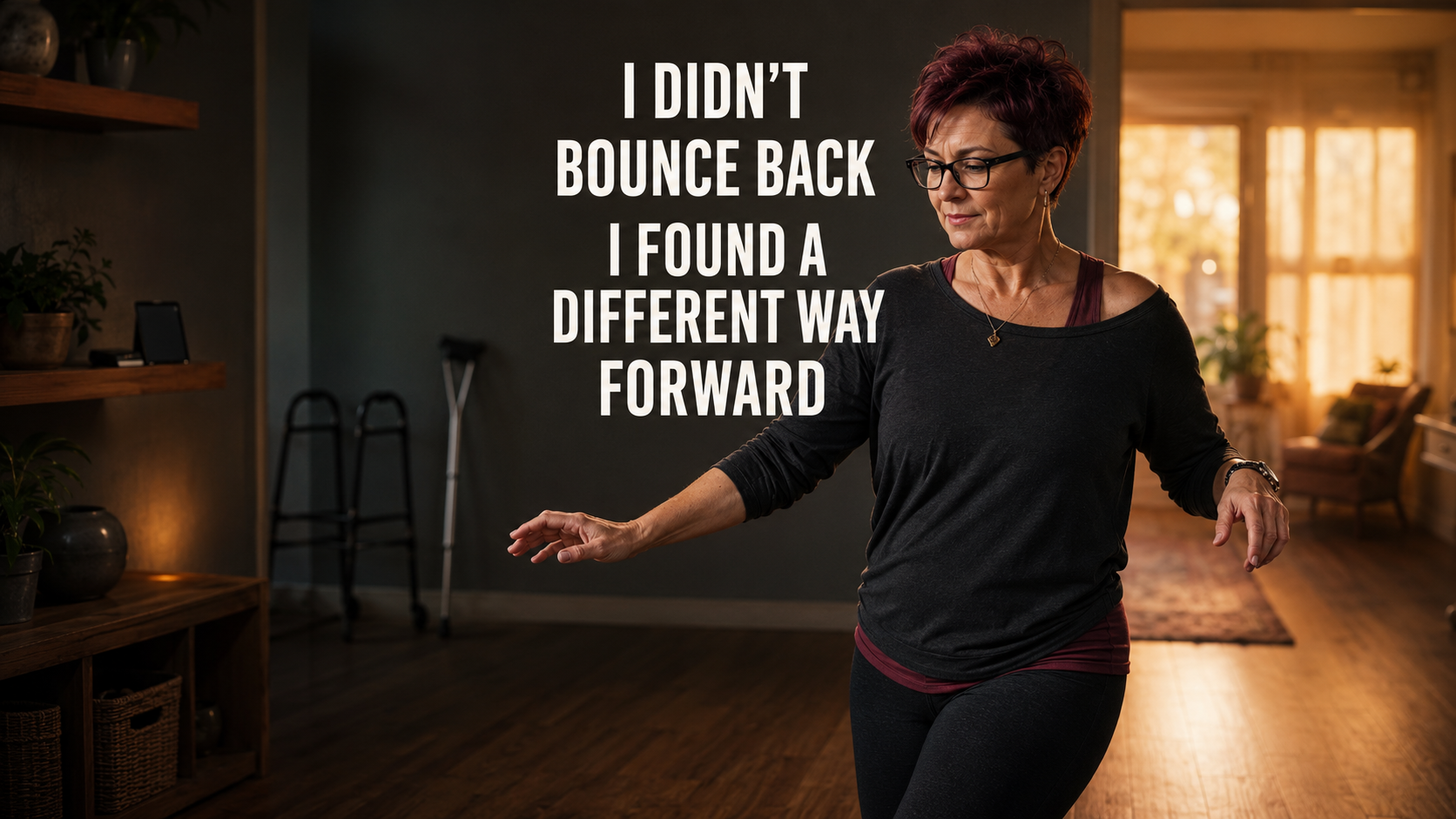
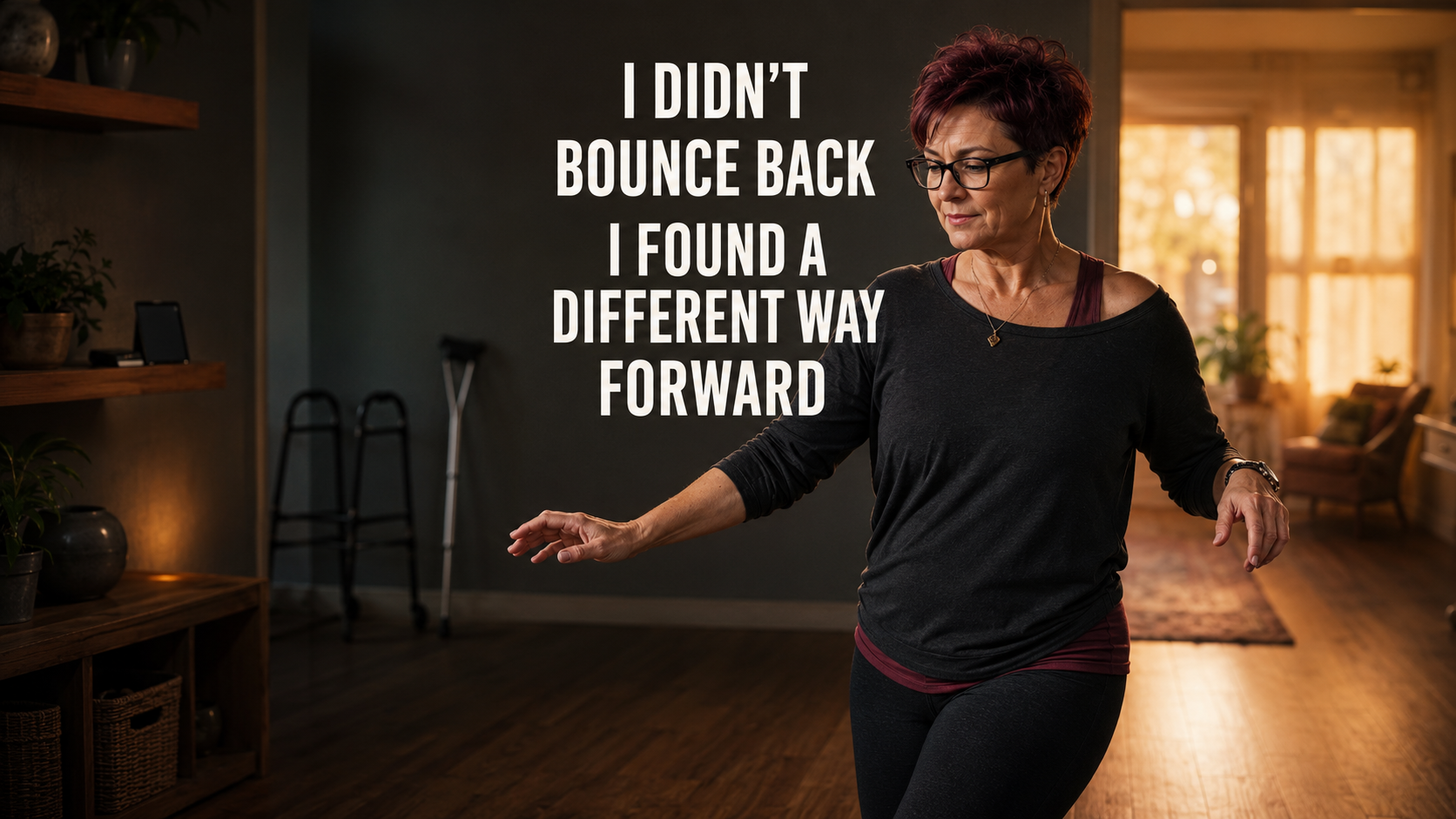
I Didn’t Bounce Back—I Found a Different Way Forward

A personal account of injury, lost independence, fear of movement, rhythm, and the experience that led me to question how we recover.

I did not bounce back.

Let us establish that first.

After age 51, I sustained a serious ankle injury that required major reconstruction. I then spent approximately eight months substantially immobilized.

Roughly two years later, I underwent a total hip replacement on the opposite side.

The medical events can be summarized in two sentences.

Living through them cannot.

Almost overnight, everything changed—not only physically, but practically and emotionally.

I went from being fully independent to needing help with basic parts of daily life: bathing, getting dressed, moving safely through the house and having meals prepared.

That loss of independence is not an unusual consequence of a serious orthopedic injury. Researchers studying patients after ankle fractures have documented disruption involving mobility, sleep, work, social participation, emotional health and ordinary activities of daily living. Patients have described fatigue, anxiety, depression and dependence on others during recovery. Read the qualitative research on the lived impact of ankle fractures.

Clinical guidance for ankle fractures also recognizes that patients may experience difficulty with daily activities, disrupted sleep, fatigue, depression, anxiety and loss of independence. Review the clinical discussion of ankle-fracture management and recovery.

But statistics cannot fully explain what it feels like when your own life becomes the case being described.

It is depressing.

It is lonely.

Not necessarily because people do not care.

Because dependence can take a piece of your identity with it.

The Part No One Prepared Me For

For me, the deepest fear was not dying.

It was losing control.

I began planning movement.

I thought before standing. I measured the distance between one stable surface and another. I considered whether a step, turn or change in direction might place me in danger.

Movement that had once happened automatically became a negotiation.

That hesitation changed how I lived.

Researchers use terms such as fear of falling, movement-related fear and kinesiophobia to describe related—but not identical—experiences. These concepts should not be casually diagnosed, but the pattern is well documented: fear can lead people to restrict activity, and prolonged restriction can contribute to deconditioning, isolation, declining mobility and diminished quality of life. Read the research review on fear of falling and activity restriction.

A separate systematic review found that fear-related activity restriction can contribute to physical deconditioning, depression and social isolation. The relationship can become cyclical: fear reduces movement, reduced movement weakens physical capacity, and diminished capacity can reinforce fear. Review the evidence on fear of falling, physical function and psychological health.

Fear of movement has also been studied after total hip replacement. Research has found that some patients continue experiencing substantial kinesiophobia years after surgery, although studies do not agree that it predicts every functional outcome or affects every patient in the same way. Read the study on kinesiophobia following total hip arthroplasty.

I did not have that terminology at the beginning.

I only knew I was no longer living the way I had before.

I was managing every movement.

And I was not willing to accept that as the final version of my life.

The Day Something Changed

The experience that changed my direction did not happen during a dramatic clinical breakthrough.

It happened in my home gym on a day when I did not feel like showing up. “

“Return of the Mack” began playing.

Something in me responded.

That is the only honest way I can describe it.

I did not begin with a formal theory. I was not conducting a study. I was not testing a clinical protocol.

I started moving.

Not counting repetitions.

Not chasing performance.

Not trying to prove anything.

I moved to the rhythm in a way that reminded me of how I had moved before the injuries—before every action felt calculated.

The experience felt less like forcing my body through an exercise and more like allowing it to participate in the music.

That moment became important to me.

It was not medical proof.

It was an observation.

And it gave me a question worth investigating.

Why Familiar Music Can Feel Physical

The idea that music can trigger a physical or autobiographical response is not imaginary.

Research has shown that familiar music can evoke vivid, personally meaningful autobiographical memories. Neuroscientist Petr Janata’s work identified brain activity associated with music-evoked autobiographical memory, helping establish that familiar songs can activate networks involving memory, emotion and self-relevant experience. Read the research on the neural architecture of music-evoked autobiographical memories.

Other studies have found that familiar music is more likely than unfamiliar music to evoke specific autobiographical memories. Review the research on familiarity and music-evoked memory.

Music can also produce what researchers call groove: the pleasurable desire to move with rhythm. Research involving younger and older adults found that high-groove music influenced gait, while familiarity and an individual’s ability to perceive the beat affected the response. Read the study on groove, familiarity and gait in older adults.

That research does not prove what happened in my body that day.

It does establish that rhythm, familiarity, memory and movement can interact.

“Return of the Mack” was not medicine.

But for me, it became a cue.

It connected the person I had become after injury with a version of myself who remembered moving without fear.

What Began Returning

At first, the changes were subtle.

My shoulders felt less guarded.

My upper body began participating more naturally.

My hips started following the movement instead of feeling separate from it.

My balance no longer felt like a negotiation every moment.

There was no single overnight transformation.

Things returned in pieces.

A little more mobility.

A little less hesitation.

A slight return of coordination.

Then repetition.

The small changes began accumulating.

What had felt stiff sometimes felt more fluid. Movements that required conscious planning began feeling less intrusive. My body started operating more like a connected system and less like a collection of parts I was trying to manage individually.

These were my perceptions of my body.

They were meaningful, but they were not controlled clinical measurements.

The Moment I Knew I Needed to Pay Attention

There was one experience I will never forget.

After months of reduced activity, my shoulders had become stiff and guarded. My posture felt smaller. My upper body, arms and hips no longer seemed to move together the way they once had.

As I continued moving with the music, my shoulders began to release.

Slowly.

If someone had been watching, I believe they would have seen my shoulders settle, my chest open and my head begin moving more freely.

It felt as if the change traveled through me—from my shoulders and arms into my trunk and hips.

Not forcefully.

Not all at once.

It felt as though my body were finding a more natural organization.

Physically, the sensation was refreshing. The closest description I have is cucumber water moving through my veins—clean, cool and awakening.

That is a metaphor for what I felt.

It is not a physiological explanation.

I did not know what mechanism, or combination of mechanisms, produced the experience. I could not determine whether the change came from increased activity, repeated practice, music, attention, healing over time, formal rehabilitation, improved confidence, natural recovery or some interaction among those factors.

I only knew the experience was different enough to make me curious.

That curiosity became the beginning of a much larger body of work.

Rhythm and Movement Are Legitimate Areas of Research

Rhythm-based movement is not a fringe concept.

Rhythmic auditory stimulation has been studied as a rehabilitation tool, particularly for gait and motor impairments associated with neurological conditions such as Parkinson’s disease and stroke. Systematic reviews have reported improvements in certain gait and motor outcomes, although results vary by population, protocol and research quality. Review the systematic review of rhythmic auditory stimulation and motor function.

A 2024 study of healthy older adults found that rhythmic auditory stimulation at certain cadences increased the repeatability of whole-body gait patterns. The authors described acoustic stimulation as promising but also noted limitations in its effects. Read the study of auditory stimulation and whole-body movement variability.

Dance research provides another relevant—but still indirect—line of evidence. A meta-analysis found that dance interventions can improve aspects of physical function in healthy older adults. Review the meta-analysis of dance and physical function.

An earlier systematic review reported improvements across measures of balance, muscular strength, endurance and other areas of functional fitness, while also noting methodological limitations and the need for more standardized research. Read the systematic review of dance interventions for older adults.

These findings support the broader proposition that rhythmically cued, coordinated movement deserves serious study.

They do not validate my specific approach.

Evidence from Parkinson’s disease, stroke, healthy older adults or formal dance interventions cannot automatically be applied to people recovering from ankle reconstruction or hip replacement.

That is precisely why direct testing matters.

Rehabilitation Was Part of My Recovery

My experience should not be framed as a rejection of rehabilitation.

Formal rehabilitation occurred during my recovery. Surgery, healing, medical care and rehabilitation all belong in the history of what happened to me.

Modern orthopedic rehabilitation is not limited to isolated exercises. Depending on the patient and stage of recovery, it can include range of motion, strengthening, gait training, balance work, transfers and functional retraining intended to restore independence in bathing, dressing and other daily activities. Review the evidence-based description of postoperative rehabilitation.

After total hip replacement, regular exercise and a gradual return to daily activity are considered important parts of restoring strength and mobility. Those activities should be directed by the patient’s surgeon and physical therapist. Read the American Academy of Orthopaedic Surgeons’ hip-replacement exercise guidance.

A systematic review of total hip arthroplasty rehabilitation also emphasizes that rehabilitation is complex and can include resistance exercise, gait training and other components. It found that the evidence does not support one universally superior program for every patient. Read the systematic review of rehabilitation after total hip arthroplasty.

Research on ankle-fracture rehabilitation similarly shows uncertainty about which approaches are best for which patients. Review the Cochrane evidence on adult ankle-fracture rehabilitation.

My question was never whether rehabilitation matters.

It was whether something could complement the conventional recovery process by helping certain people reconnect movement with rhythm, coordination, confidence and personal meaning.

That remains a research question.

The Real Breakthrough Was Confidence

The change that mattered most to me was not a number on a scale.

It was confidence.

When I began trusting my body’s response, my mind stopped interrupting every movement with the same degree of hesitation.

The internal language began changing from:

“I hope I don’t fall.”

To:

“I can manage this.”

Researchers distinguish fear of falling from falls efficacy or balance confidence. Falls efficacy generally concerns a person’s perceived ability to perform activities or respond to a fall-related threat. That belief can affect agency and participation, although confidence alone does not establish physical safety or eliminate fall risk. Read the research on falls efficacy and balance confidence.

Exercise, tai chi and multifactorial fall-prevention programs have shown some ability to reduce fear of falling in certain community-living populations. Review the systematic evidence on interventions addressing fear of falling.

Confidence matters.

But confidence must remain connected to capacity, medical status and the environment.

Feeling fearless is not the same as being safe.

Why This Experience Reaches Beyond Me

I am not the only person who has confronted mobility loss.

Current CDC data indicate that more than one in four American adults reports some form of disability. Mobility limitations are among the most common forms, particularly in middle-aged and older adults. Review the CDC’s disability data.

Arthritis is another substantial part of this landscape. The CDC estimates that approximately 58.5 million American adults have arthritis, including 25.7 million who report activity limitations attributable to the condition. Review the CDC’s arthritis indicators.

Those numbers do not prove that my experience can help millions.

They establish that millions are living with pain, mobility restrictions or threats to independent living.

Whether the movement approach that emerged from my recovery can help a broader population must be determined through structured development, appropriate safety standards and credible research.

My experience generated a hypothesis.

It did not complete the science.

Where I Am Now

I am now in my mid-50s.

I have lived through ankle reconstruction and total hip replacement.

In my daily life, I experience my movement as more capable, coordinated and confident than it was before I found this approach.

That is my testimony.

It should not be presented as proof that one intervention produced the outcome or that another person will experience the same result.

Recovery is influenced by many factors: the nature of the injury, surgery, medical status, pain, rehabilitation, healing time, strength, balance, confidence, environment and continued activity.

I did not become younger.

I found a different way of participating in my recovery.

And then I began asking whether that experience contained something worthy of disciplined study.

If You Feel Stuck

Do not begin by copying my movements.

Begin with safety.

If you have recently undergone surgery, have difficulty standing, experience dizziness, have a history of falls, live with significant pain or weakness, or have been given movement restrictions, consult your surgeon, physician or physical therapist before changing your activity.

The American Academy of Orthopaedic Surgeons advises that foot-and-ankle conditioning should be performed under medical or physical-therapy supervision when appropriate. Review the AAOS safety guidance.

If movement with music is medically appropriate for you, it does not have to begin with standing.

It may begin seated.

It may be a small shoulder movement, a careful shift in posture or tapping a hand to a familiar beat.

Use a stable environment. Keep necessary mobility aids within reach. Do not close your eyes, make sudden turns or challenge your balance without appropriate supervision.

Stop if you experience chest pain, severe shortness of breath, dizziness, new weakness, loss of balance, sharp pain or another concerning symptom.

Do not force movement through a restriction.

Do not use music to ignore pain or override medical precautions.

The objective is not to prove courage.

It is to explore whether safe movement can feel meaningful again.

Choose a song connected to a time when you felt capable.

Listen.

Notice what it evokes.

If movement is safe for you, let the response begin within the limits of the body you have today.

Not the body you are trying to punish.

Not the body you are trying to reclaim through force.

The body that carried you here.

My body did not simply “remember” in a way science can presently verify from my story.

But rhythm gave me a way to ask it a different question.

And that question changed the direction of my life.

— Christine Silva

Author’s Note

This article describes my personal experience following major ankle reconstruction, prolonged immobility, formal rehabilitation and subsequent total hip replacement. It also describes the observations that contributed to the development of my movement research and The Freedom Flow Method.

My individual recovery cannot establish clinical efficacy, causation, safety or generalizability. The scientific sources cited here support related concepts—including the effects of orthopedic injury, fear of falling, activity restriction, familiar music, rhythmic auditory stimulation and coordinated movement—but they do not validate my specific method.

The Freedom Flow Method should not be represented as medical treatment, physical therapy, fall prevention or a substitute for individualized clinical care unless and until those claims are supported by appropriate research and regulatory review. Anyone recovering from surgery or living with pain, balance impairment, neurological symptoms, mobility limitations or fall risk should consult an appropriately qualified healthcare professional before beginning a new movement practice.

Read More