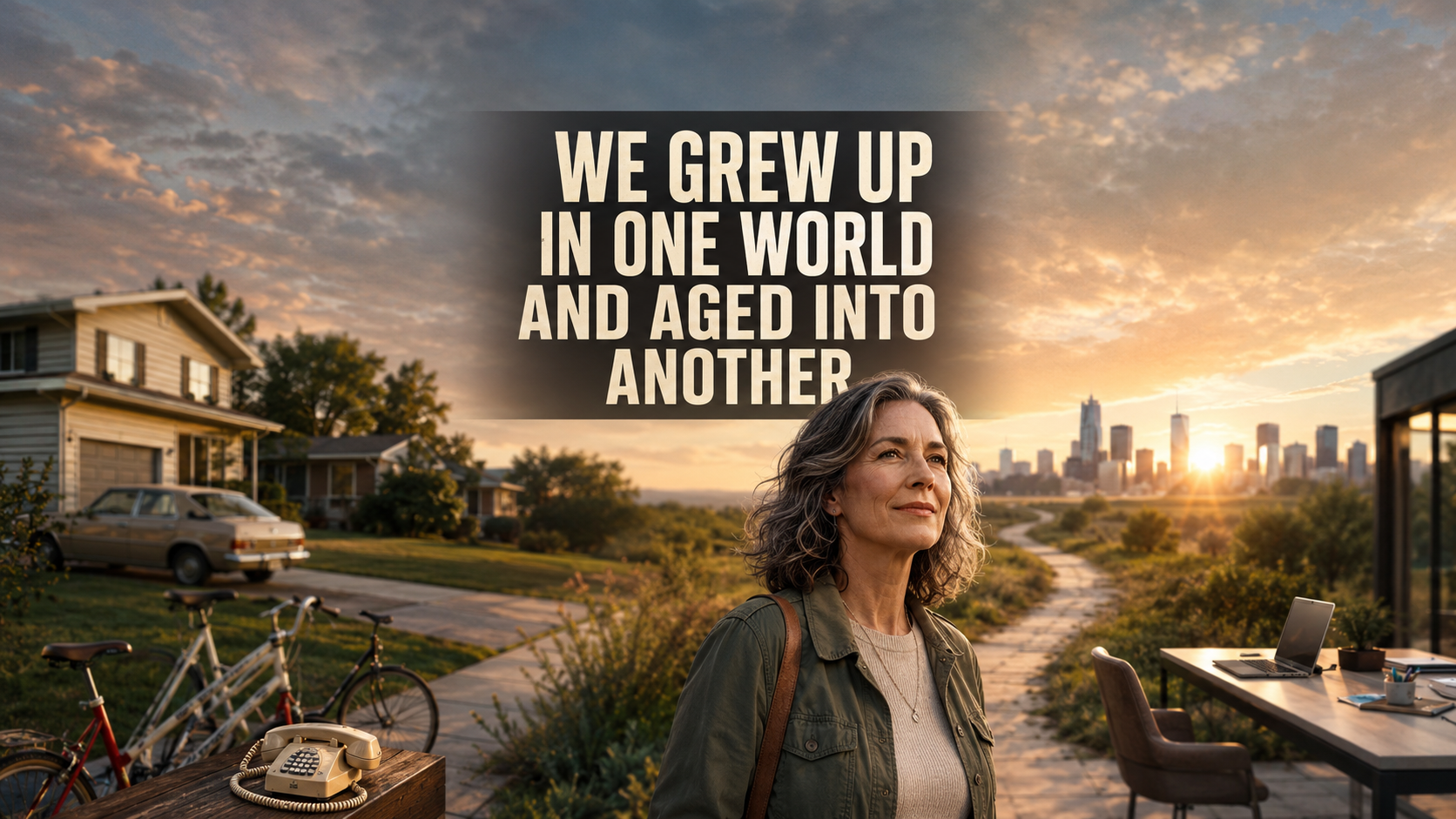
We Grew Up In One World And Aged Into Another

A reflection on Generation X, midlife exhaustion, reinvention, movement, and the hunger to build a life that finally feels like our own.

A woman recently sent me an email asking how I am handling life in my mid-50s—not financially or professionally, but life itself. She meant the emotional side of it, the physical side of it, and the strange feeling of looking around one day and realizing that the world no longer operates like the one you grew up preparing for.

I understood exactly what she meant because I think many members of Generation X are quietly trying to figure that out right now.

There is a particular kind of exhaustion that can arrive at this stage of life. Not dramatic exhaustion, but the quieter kind—the kind that builds over decades from adapting over and over again while pretending you are fine.

We grew up in one world and aged into another.

The World We Remember

We grew up riding bikes until the streetlights came on. We memorized phone numbers, knocked on doors, and sat in garages talking for hours without documenting the conversation for strangers online. We had friendships that existed without algorithms.

That description will not fit every member of Generation X. Childhood differed by geography, race, class, family structure, disability, and circumstance. The past was not universally safer, simpler, or kinder. But many of us do remember a world in which everyday life was less digitally mediated.

Then the transformation arrived.

Generation X did not merely witness the expansion of the internet, mobile technology, and social media. We learned to work, communicate, shop, bank, research, create, and maintain relationships through systems that did not exist when we were children.

Pew Research Center has documented the scale of this adaptation. By 2021, 96% of Americans ages 50 to 64 reported using the internet, and technology adoption among older age groups had increased substantially over the preceding decades. Review Pew Research Center’s findings on technology adoption among older adults.

We adapted, but adaptation still costs energy.

When Ordinary Life Became a Performance

People talked to one another differently then. Now everybody can sound like a press release. Every opinion feels rehearsed, every interaction feels optimized, and even ordinary life has started sounding branded.

People brand themselves, market themselves, and package themselves. I include myself in that observation. Somewhere along the way, sincerity began to feel almost uncomfortable.

Generation X may notice this shift because many of us remember speaking casually without feeling as though we were building an audience. We remember private mistakes, undocumented conversations, and ordinary moments that disappeared when they ended.

That does not mean previous generations were always more sincere. Human beings have always performed for one another. Social status, reputation, conformity, and image existed long before the internet.

What changed was the scale.

The audience followed us home. The news cycle stopped closing. The comparison never ended. The device became the office, marketplace, television, camera, newspaper, social gathering, and public square—all at once.

The American Psychological Association has reported that constant exposure to news, social media, and digital devices can contribute to stress and media overload. The effects vary by person and depend on factors such as the type of content, frequency of exposure, and how technology is used. Read the APA’s discussion of media overload and mental health.

It would be too broad to say that human beings simply were not designed for modern technology. But it is fair to ask whether constant exposure to information, comparison, outrage, advertising, and manufactured urgency is good for us.

For many people, something inside eventually begins to push back.

We Were Busy Building Lives

While the culture was changing, most of us were busy building lives—working, raising children, holding marriages and relationships together, caring for parents, managing households, and surviving recessions, layoffs, rising costs, and responsibilities that never seemed to slow down.

Then somewhere along the line, our bodies changed too. Not overnight, but just slowly enough to catch us off guard.

Your knees start talking to you in the grocery store. Your back tightens after a long drive. You think strategically before lifting something heavy. Recovery takes longer. Sleep becomes valuable. Peace becomes valuable.

These experiences are common, but they should not all be dismissed as “just aging.” New or worsening pain, severe fatigue, sleep disruption, weakness, balance problems, shortness of breath, or other significant changes can have treatable medical causes and deserve appropriate evaluation.

Some physical change is part of aging. The National Institute on Aging explains that age-related losses in muscle mass and strength can affect physical ability, while sleep patterns can also change over time. Read the National Institute on Aging’s explanation of age-related muscle and strength changes.Learn more about sleep and aging.

The body is changing, but it is not finished.

The Accumulation of Loss

By this age, people begin understanding the value of ordinary things differently: a quiet house, a healthy medical report, a good conversation, energy when you wake up, or one more phone call with somebody you love.

The absence of those things changes people, especially after loss enters your life.

Parents die. Friends disappear. Relationships end. Children grow up and build lives of their own. Caregiving roles begin or conclude. Homes are emptied, family traditions change, and work identities disappear after layoffs, retirement, or restructuring.

Nobody completely prepares you for how emotionally disorienting that can feel. One day you realize that an entire chapter of your life ended quietly while you were busy managing responsibilities.

People do not talk enough about that part—not only the dramatic grief, but the gradual kind. The accumulation. The feeling of becoming unfamiliar to yourself while remaining responsible for everyone else.

I believe many people in their 50s carry grief they never fully processed because life kept moving. That is an observation, not a diagnosis.

Grief does not follow one timetable or appear in one form. Persistent sadness, hopelessness, severe anxiety, inability to function, substance misuse, or thoughts of self-harm require more than inspirational language. They deserve qualified support.

But not every form of midlife unease is a disorder. Sometimes it is recognition—a person finally noticing what the years have cost.

Grieving a World That Changed

Some of that grief is connected to the world itself changing. Not because the past was perfect. It was not.

The world many of us remember also contained prejudice, silence, limited opportunity, untreated trauma, and injustices that should never be romanticized. Still, parts of life felt more grounded. Life felt slower. Conversations felt less managed. People were allowed to exist more privately.

Not every thought needed to be announced. Not every moment required public validation.

Now the noise rarely stops. I think many people my age are exhausted from pretending that this level of noise feels normal.

That does not require rejecting technology. It may require using it more deliberately: turning off notifications, choosing when the news enters the room, protecting conversations from interruption, allowing an experience to remain undocumented, and leaving some thoughts unpublished.

Privacy is not irrelevance. Silence is not failure. A life does not need an audience to have meaning.

The Return to Self

That is where I think many Generation X adults are now—not trying to become younger, but trying to reconnect with themselves. They are trying to remember who they were before life became responsibility, stress, caregiving, work schedules, bills, and survival.

The goal is not to return to adolescence. It is to recover parts of the self that were buried beneath obligation: curiosity, ambition, creativity, play, movement, friendship, the desire to make something, and the belief that another chapter remains possible.

Returning to yourself does not mean abandoning the people who depend on you. It means recognizing that a life built entirely around usefulness to others will eventually ask where you went.

Why the Hunger to Build Returns

Maybe that is why some people in midlife feel pulled toward building something of their own. Not because they have lost their minds, because every person over 50 should become an entrepreneur, or because the internet’s promises of instant income are real.

After decades of working for organizations, raising families, surviving setbacks, adapting to change, and carrying responsibility, people may finally recognize that they have developed something valuable that cannot be taught quickly: judgment, pattern recognition, discipline, resilience, the ability to recover after disappointment, the ability to read a room, the ability to remain steady during uncertainty, and the ability to distinguish urgency from importance.

Young adults can possess these qualities too. Age does not guarantee wisdom, competence, discipline, or emotional maturity. But long experience can create opportunities to develop them.

Those qualities are earned slowly through ordinary life—through showing up when you were tired, going to work when your heart was broken, raising children when money was tight, caring for people while carrying your own fear, burying people you loved and still waking up the next morning because life required it, and doing what had to be done before anyone applauded you for it.

That kind of experience can become infrastructure.

Entrepreneurship Does Not Belong Only to the Young

Our culture often presents entrepreneurship as a young person’s game. The evidence is more complicated.

Research examining millions of business founders found that the average founder of the fastest-growing new ventures was approximately 45 years old. The researchers also found that previous experience in the same industry was associated with a substantially higher likelihood of entrepreneurial success. Read the National Bureau of Economic Research study on age and high-growth entrepreneurship.

That does not mean starting a business in midlife is safe or that age guarantees success. Most businesses do not become high-growth companies. Entrepreneurship can consume savings, affect retirement plans, disrupt health-insurance coverage, create tax and legal exposure, and place pressure on families and relationships.

Experience is an asset. It is not a substitute for market validation, financial planning, legal structure, customer demand, execution, or timing. Still, the research challenges the assumption that meaningful entrepreneurship belongs only to the young.

For some Generation X adults, there is a quiet realization beginning to happen. The hunger is still there—not necessarily the reckless hunger of youth, but something different and more focused.

It is a hunger for excellence, a hunger to build, a hunger to succeed on your own terms after spending decades helping other systems succeed, and a hunger to discover whether there is still another chapter left.

There is—but it requires more than hunger.

Experienced and Inexperienced at the Same Time

Starting something in your 50s requires nerve and humility. It requires learning new tools, new platforms, new language, and new ways of reaching people. It requires recognizing that you can be deeply experienced in one area and completely inexperienced in another.

That is not comfortable, but it is honest. Honesty is a strong foundation.

Midlife may offer certain advantages because it can be clarifying. By this age, you may know what waste feels like. You may recognize bad leadership, hear false promises more quickly, know when people are performing, and understand the cost of building someone else’s dream while your own ideas wait quietly in the background for permission.

But clarity does not remove risk.

Before starting a business, changing careers, or investing substantial money, test the idea. Study the customer. Understand the problem. Calculate the financial runway. Protect health coverage. Identify legal and licensing requirements. Separate revenue from attention, encouragement from demand, and a meaningful idea from a viable business model.

At some point, you may stop waiting for permission. That does not mean you stop doing due diligence.

The Traits That Still Matter

The structure instilled in many of us still has value: work ethic, follow-through, responsibility, common sense, respect for the process, and the ability to get up and do the work even when nobody is watching.

Those are not outdated traits. But they are not uniquely Generation X traits, and we should not pretend that younger generations lack them. They are human traits.

They become competitive advantages when paired with adaptability, current skills, ethical judgment, and a willingness to keep learning. Experience becomes most valuable when it remains teachable.

The moment we decide that age makes us automatically right is the moment experience hardens into rigidity.

The better position is more demanding:

I know things. I have survived things. I have built things. And I still have things to learn.

Why Movement Matters to Me

That is part of why movement has become so important to me as I have gotten older—not movement tied to punishment, organized around shame, or pursued only for appearance.

I mean movement that makes me feel connected to myself again. Movement that reminds me I am still alive inside this body instead of simply managing it.

This is personal to me, but the broader value of physical activity is well established. The Centers for Disease Control and Prevention reports that regular physical activity can support sleep, mental health, physical function, cognition, and independence while helping reduce the risk of several chronic conditions. Even some activity can provide benefits, although the appropriate type and intensity depend on a person’s health and abilities. Review the CDC’s evidence-based overview of physical activity benefits.

Movement is not a cure-all. It does not reverse every illness, eliminate grief, or guarantee independence. People living with disabilities, chronic illness, pain, surgical histories, or mobility limitations may require individualized modifications and clinical guidance.

But movement can still become a way back into conversation with the body.

Not perfection or performance—something real and grounding. Something that cuts through the noise long enough for a person to hear themselves again.

The Strongest Chapter Yet

Despite what parts of the culture may imply, life is not over in your 50s.

That does not mean decline is imaginary. Bodies change. Losses accumulate. Time becomes more visible. Some opportunities narrow. But other things become possible because illusion begins to burn away.

This may be the first time many of us are honest about what we want, what we are tired of, what we still believe in, and what we are no longer willing to postpone.

Maybe this is not simply the beginning of decline. Maybe this is also the age when illusion burns off, experience becomes fuel, and the hunger returns—not to prove something to the world, but to build something that finally feels like your own.

And maybe returning to yourself is not a step backward.

Maybe it is the beginning of your strongest chapter yet.

Author’s Note

This article combines personal reflection with general information about aging, technology, entrepreneurship, grief, and physical activity. It does not claim that every member of Generation X shares the same childhood, resources, health, beliefs, or experience of midlife.

Nothing in this article constitutes medical, mental-health, financial, legal, or business advice. Significant physical symptoms, persistent emotional distress, or major business and financial decisions should be evaluated according to individual circumstances with appropriately qualified professionals.

Previous
Previous

The Last Version of Us: Why Families Become Strangers While Everyone Is Still Alive

Next
Next

The Reinvention Nobody Prepared Generation X For