GENXFINITY MAGAZINE
Stories for the generation that still has more to give.
What We Miss When We Stop Watching Together
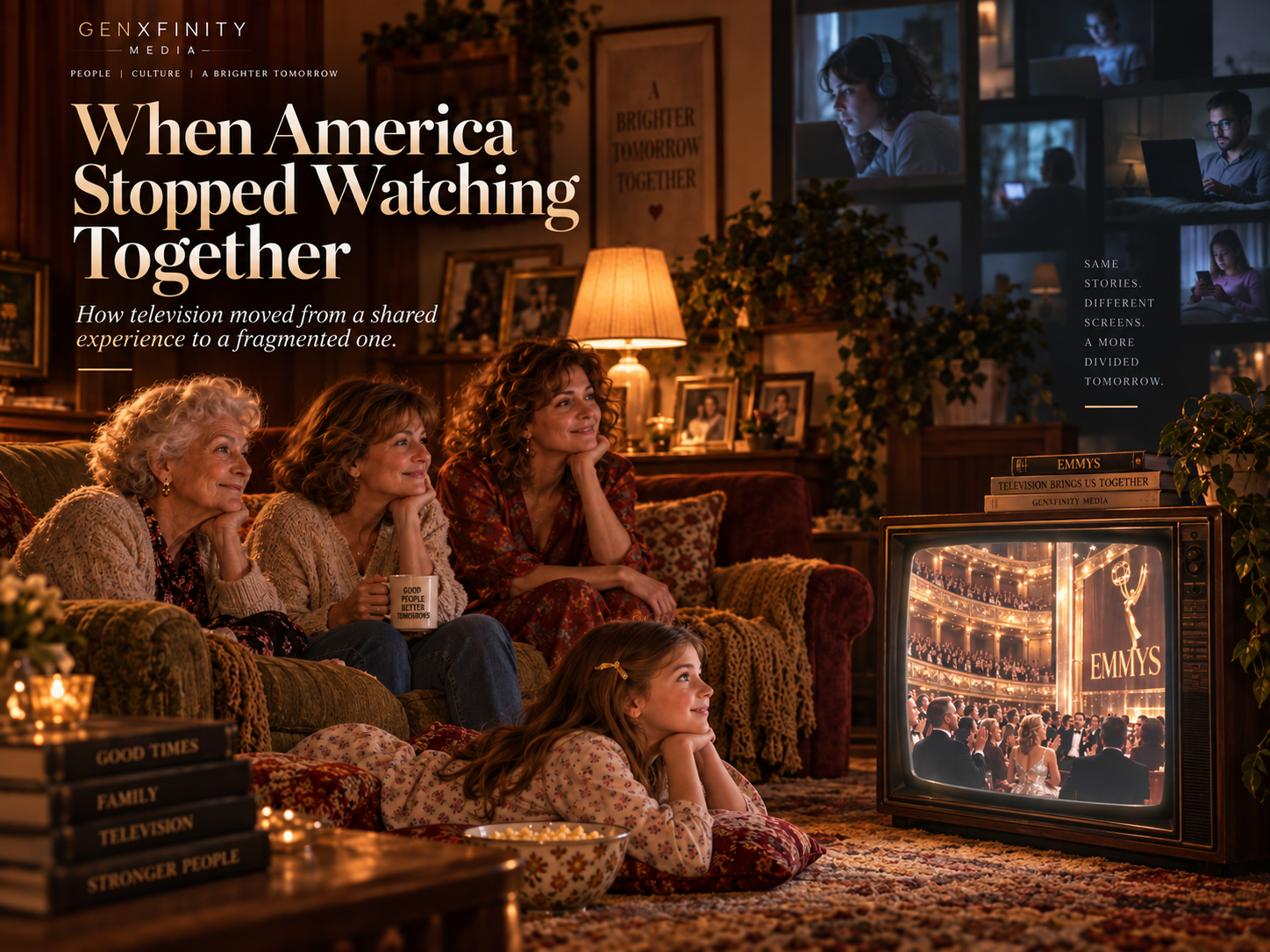
I remember watching the Emmys with my mother, my aunt and my grandmother. Back then, Hollywood seemed to fill the entire theater—and television could fill the entire living room. Streaming gave us more choices than we ever imagined. But somewhere along the way, did we lose the experience of watching together?
The Emmys bring back a living room full of family. What can we carry from that experience into the way we watch today?
By Christine Silva
I can still see it. Not every winner. Not every dress. Not every acceptance speech.
What I remember is the room.
I remember watching the Emmy Awards in the late 1970s and throughout the 1980s with my mother, my aunt and my grandmother. Four women from different generations, sitting together watching television.
When the cameras swept across the theater, Hollywood looked enormous. There seemed to be people everywhere—floor after floor of men in tuxedos and women in gowns. The balconies were part of the spectacle. To me, the audience itself made the occasion feel important.
For years I wondered whether childhood had simply made everything look bigger. Then I looked into the building.
The theater really did have those levels
The Television Academy lists Pasadena Civic Auditorium as the Primetime Emmy venue from 1977 through 1997. The Academy's venue history puts those memories in a setting.
Pasadena Civic’s current technical specifications describe a main floor, loge and upper balcony. The levels I remember were real. The specifications cannot tell us which seats were occupied on a particular Emmy night.
The building explains the picture in my head. The people beside me explain why it stayed there.
Television gave our household a meeting place
The Census Bureau's historical account reports that 9 percent of American households had a television in 1950; by 1965, the figure was 93 percent. Its history of television adoption records how quickly ownership spread.
In our living room, I remember the anticipation, the conversation and the sense that we were sitting down for something together.
I did not experience those evenings as a limitation on choice. I experienced them as family time. Looking back, that is the part I want to hold onto.
The Emmys still bring people together
People still watch together. CBS reported more than 7.42 million viewers for the 2025 Emmy Awards on CBS and Paramount+, its largest television audience since 2021. That is a 2025 result, not a figure for this year’s ceremony. Read CBS’s September 15, 2025 announcement and ratings methodology.
My concern is more personal than a ratings contest: how often do we make room for an experience that belongs to more than one person?
More places to watch, more ways to gather
Nielsen's July 2026 Gauge report put streaming at 49.0 percent of total television viewing, broadcast at 19.5 percent and cable at 18.7 percent. YouTube accounted for 14.2 percent. The reporting interval ran from June 29 through July 26, 2026. These are shares of television viewing, not of every kind of media use on every device. Nielsen's report supplies the figures and measurement notes.
To me, that mix raises a question about attention. The cultural center I remember from childhood no longer feels like a single place.
Deloitte's 2026 Digital Media Trends report adds another perspective. In its survey, 32 percent of consumers said social-media content felt more relevant to them than traditional media, and 33 percent reported a stronger personal connection to social-media creators than to television personalities or actors. The online survey covered 3,575 U.S. consumers in October and November 2025 and was weighted to Census data. The report and methodology describe reported preferences, not a measurement of family closeness.
I do not read those findings as a reason to dismiss a younger person's favorite creator. I read them as a reason to ask what that person finds worth watching. We might discover a point of connection by being curious about each other's choices.
The building can be larger while the evening feels smaller
Peacock Theater lists 7,100 seats, while noting that capacity varies with an event's setup. That is more than Pasadena Civic's listed capacity. Peacock Theater's seating guide makes the comparison possible; neither venue's capacity establishes an actual Emmy attendance count.
Knowing that challenges my own memory in an interesting way. When I say Hollywood looked bigger then, I am describing a feeling. I am not measuring seats or claiming that childhood television was objectively better.
When I watched with my mother, my aunt and my grandmother, none of us thought we were creating a memory. We were just watching television. Decades later, I understand how much of the experience was the company beside me.
Bring the best of that experience forward
That is why I believe this conversation belongs on GenXFinity. If your memories include getting up to change the channel, looking through TV Guide or waiting for the next episode, you have a starting point for this conversation. If your memories began with a different screen, you belong in it too.
Picture a household in which one person is watching a series, another a creator's video and another playing a game. There need not be anything wrong with those choices. I would simply like us to make a little space for a shared choice as well.
I am not interested in pretending everything was better in the past. I want to carry forward something I valued: making an occasion of being together.
Try one shared plan this week: ask someone to pick a movie, an episode, or a video they want to show you, and agree on a time to watch it together. Take turns choosing. Leave room for the possibility that their enthusiasm will surprise you.
We do not need to recreate my childhood living room to try that. We can make a new memory with the people available to us now.
When I think about those Emmy nights, I do not remember who won. I remember who was sitting beside me.
About this article
Personal reflection and cultural commentary by Christine Silva, with sources linked throughout.
We Grew Up In One World And Aged Into Another
A response to a woman asking how I am handling life in my mid-50s — the aches, the losses, the noise, the hunger to build something real, and the strange realization that this may be the perfect time to begin again.
On learning new tools without losing the person using them.
A woman recently emailed me to ask how I am handling life in my mid-50s. She was not asking about money or work. She meant life itself: the emotional side, the physical side, and the strange feeling that the world no longer operates like the one you grew up preparing for.
I understood the question. Sometimes it feels as though we have spent decades learning the next system while trying to keep the rest of life running.
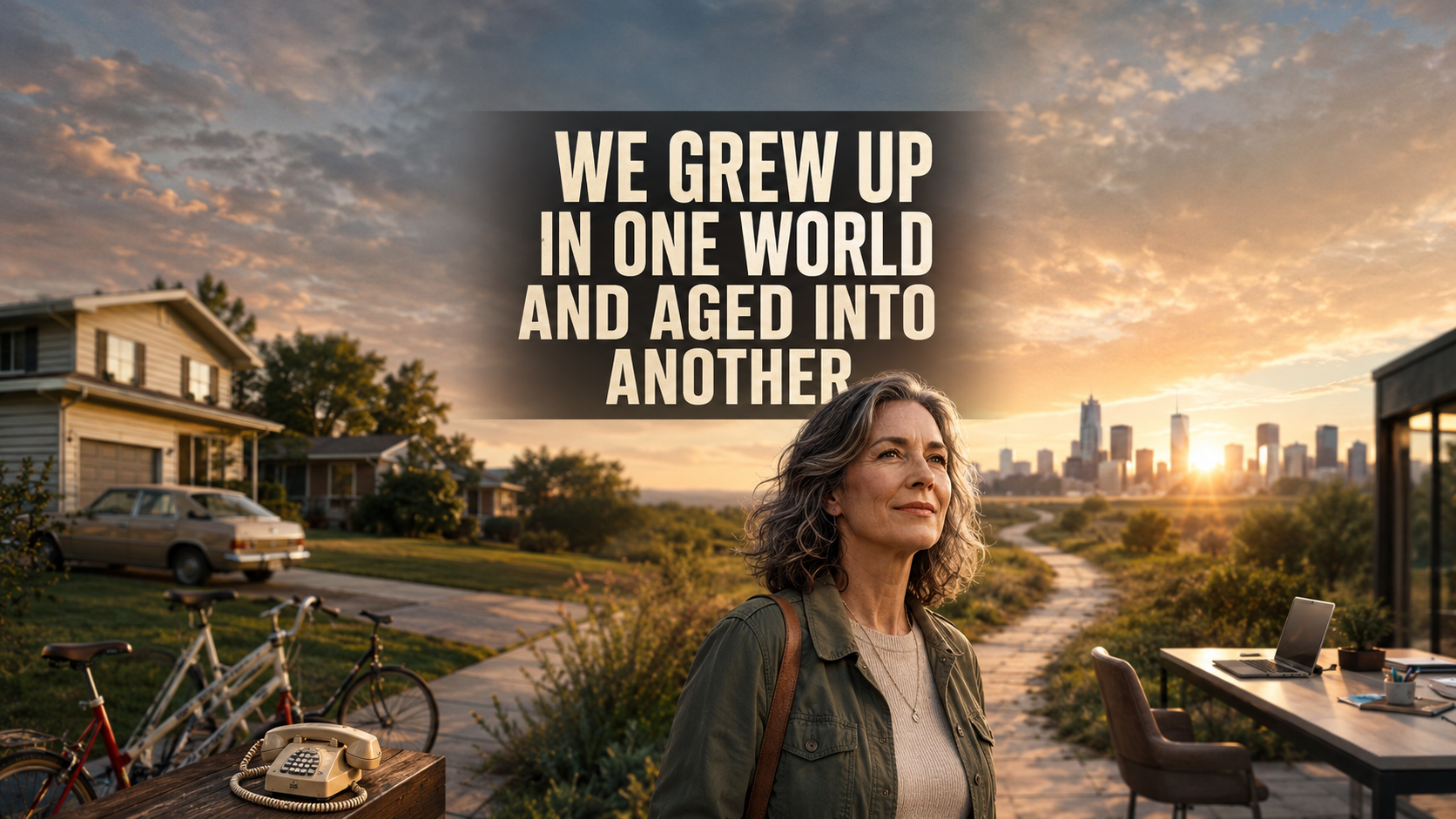
We grew up in one world and aged into another. That can be tiring. It also means we have practiced adapting.
Give yourself credit for what you learned
Many of us remember memorized phone numbers, conversations in garages, and friendships that did not need an app. The past had its problems, but I still value the room it left for an ordinary, private afternoon.
Then we learned new ways to work, bank, shop, communicate, and create. The transition was substantial. In Pew Research Center's 2021 survey, 96% of U.S. adults ages 50–64 said they used the internet. Read Pew's technology-adoption findings.
When another unfamiliar tool arrives, it may help to remember how many you have already learned. You are allowed to begin with questions. You are also allowed to decide that a particular tool is not useful to you.
When ordinary life starts to feel like a performance
I sometimes catch myself sounding like a press release. The message is polished, the purpose is clear, and somewhere along the way the person has almost disappeared.
I do it too. Running a business makes you think about presentation. But I miss conversations that do not feel as though they are auditioning for an audience.
Image and status existed long before social media. What feels different to me is how easily the audience follows us home.
I do not want to give up the useful parts of technology. I want to decide when it gets my attention. A conversation can stay private. A day can go undocumented. A thought does not need to become a post to count.
The life we were building kept happening
While the tools changed, there were still jobs, households, relationships, children, parents, bills, and setbacks to manage. Your version of that list may look different from mine. The feeling of being needed in several directions may be familiar anyway.
Then there are the quieter changes: a family home emptied, a work identity lost, a tradition that no longer happens, or the realization that you cannot make one more call to someone you love.
I think some midlife unease comes from finally noticing what changed while we were busy coping. Grief, exhaustion, and health concerns deserve attention on their own terms. Sometimes what we need is support and room to breathe.
Before taking on the next tool, ask a smaller question: “What would actually make this part of my day easier?” Start with the need. You do not owe every new feature a place in your life.
Experienced and new at the same time
Starting again requires an uncomfortable combination: confidence in what you know and honesty about what you do not.
You may understand an industry deeply and still need help with a website. You may be excellent with people and new to pricing your work. Neither erases the other.
The position I want to hold is simple: I know things. I have survived things. I have built things. And I still have things to learn.
Follow-through, curiosity, and good judgment are not owned by one generation. They become useful when we keep practicing them.
Another chapter does not have to be a spectacle
I do not think the next chapter must become the biggest or most impressive one. It might be more honest. It might leave room for a friendship, a craft, a calmer schedule, or work that makes better use of what you know.
Choose one unfamiliar tool you have a reason to learn. Give it a small job, check the result, and decide whether to try again. If AI is the tool in front of you, AI Without the Jargon gives you a place to start with fictional details.
We have learned our way through change before. We can bring that experience forward without pretending the work is effortless.
We are still allowed to build a life we want to live.
Author's note
This is a personal and cultural essay with linked research. The experiences described are not universal to Gen X. Health and business decisions depend on individual circumstances.
Related reading: The Career Pivot After 50 and The Reinvention Nobody Prepared Generation X For.
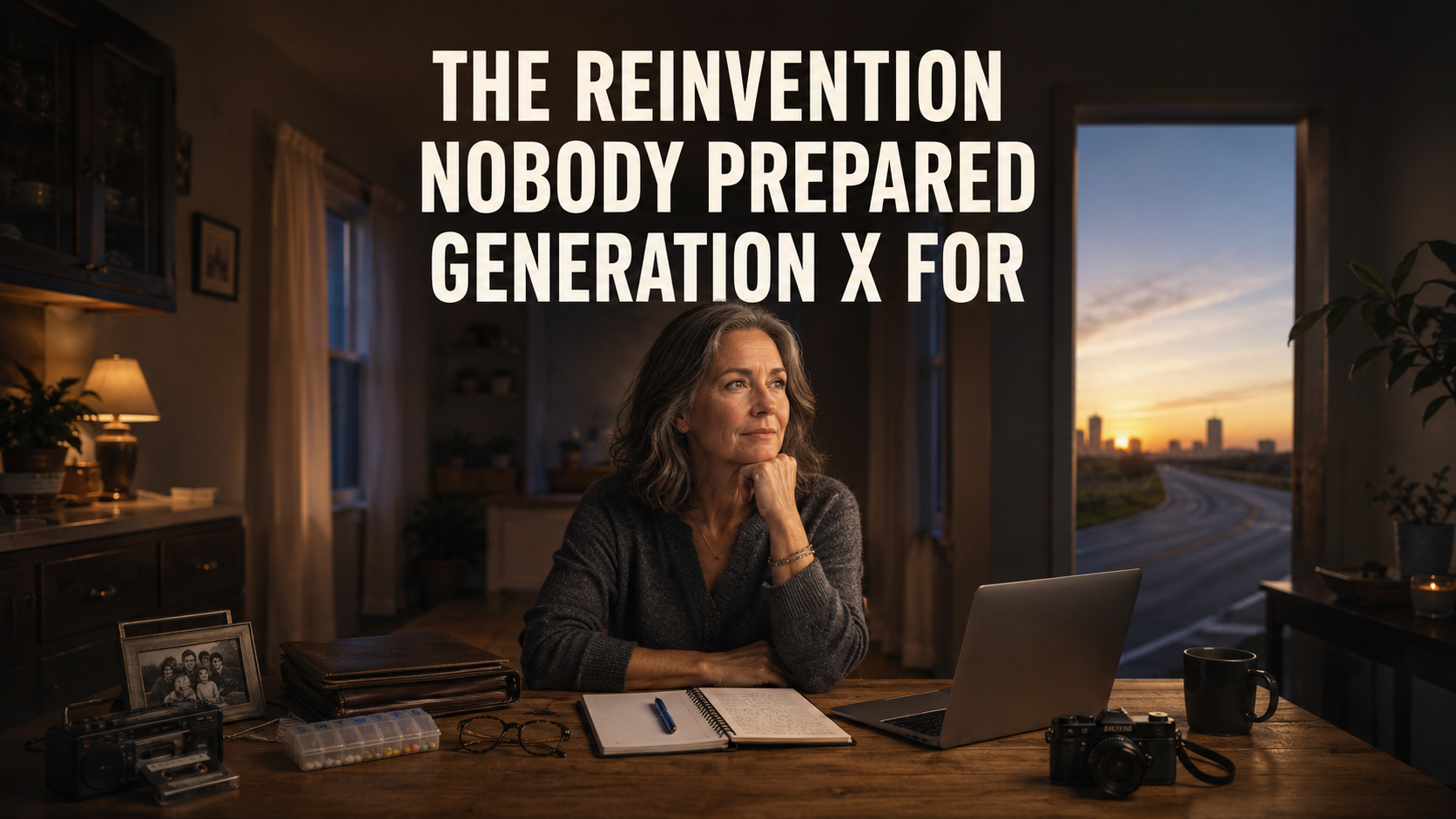
The Reinvention Nobody Prepared Generation X For
Midlife reinvention has to fit the life you actually have. A Gen X reflection on caregiving, changing work, nostalgia, and small experiments that make room for what comes next.
Making room for yourself when the responsibilities are real and the next chapter still matters.
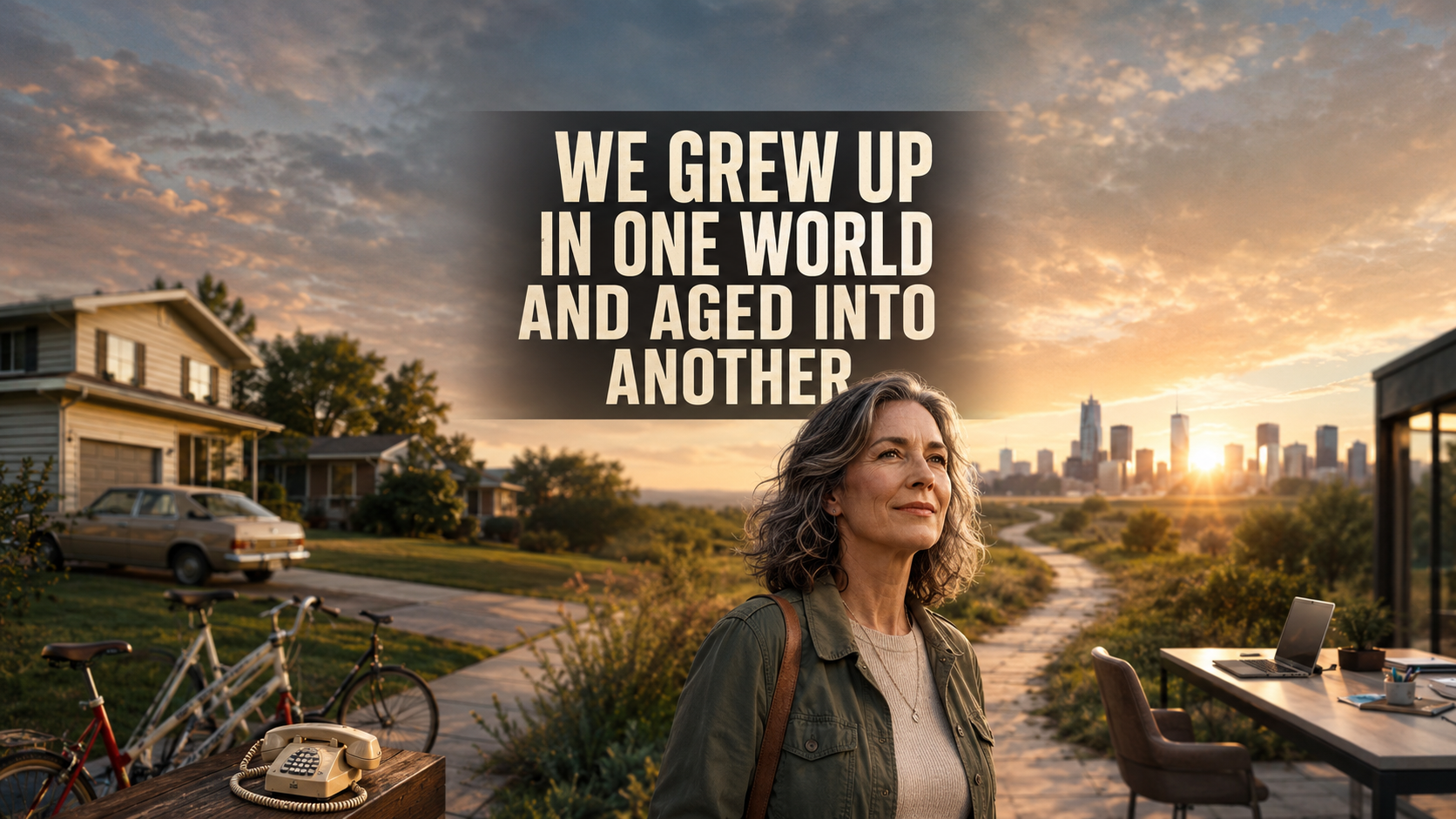
The appointment is on the calendar. The bill is due. Somebody needs a ride, an answer, a decision, or reassurance that things will work out.
Then, in a quiet moment, another question arrives: What happens to the parts of me that have been waiting?
For some of us, that is what reinvention after 50 feels like. It does not begin with a dramatic exit. It begins with noticing that we still have interests and ambitions of our own.
Wanting room for those things does not mean the life we built was a mistake. It means we still belong in it.
The responsibilities were real
Many Gen X adults were taught to pursue stability: find work, keep your commitments, pay the bills, and push through. Our circumstances shaped the choices, but the message to be dependable may sound familiar.
For those who built life around being dependable, it can be difficult to admit that dependability has become exhausting.
Caregiving alone represents a substantial share of daily life in this country. The 2025 Caregiving in the U.S. report estimated that 63 million American adults, across age groups, were family caregivers. Explore the 2025 caregiving report.
Statistics cannot show the whole of a person's Tuesday. There may be medications to organize, work to finish, a parent to check on, and a child who still needs help getting established.
An encouraging article cannot manufacture spare time or replace practical support. Any discussion of a new chapter needs to begin with the life someone actually has.
What we miss about the old days
For me, nostalgia is often about atmosphere. Music in a record store. An afternoon without a device asking where I am. Time that did not feel as though it had to become content.
Those memories sit alongside harder parts of the past. Some people were carrying responsibilities or facing danger long before they should have been.
Still, a memory can tell us something about what we miss now: privacy, play, unhurried friendship, curiosity, or the freedom to do something without turning it into a performance.
Name the quality you miss, then look for one small way to make room for it now. Unhurried friendship might mean a regular phone call. Curiosity might mean time for a class. Choose what fits your life.
Reinvention carries different stakes now
By midlife, a large decision can involve more than ambition. It may affect a partner, dependents, insurance, savings, housing, and plans for retirement.
The systems around work have also changed. The Bureau of Labor Statistics documents the long shift in private-sector retirement benefits toward defined-contribution plans, including 401(k)-style accounts, and away from the earlier dominance of traditional defined-benefit pensions. Read BLS's history of retirement benefits.
Careful planning is not a lack of courage. It is recognition that consequences reach beyond the person having the idea.
Before turning a possibility into a commitment, write down what you would need to protect and what you could reasonably test. Which expenses continue? Who depends on your time? What would you need to learn? What result would justify taking another step?
You do not have to confuse a bold goal with an oversized first move.
A small experiment is still a beginning
The internet makes reinvention look like a reveal: a new identity, a new business, a declaration that everything has changed.
I am more interested in what happens before the reveal. A class. A conversation. An hour reserved for work that matters to you. A first attempt that gives you useful information.
If the idea is a business, an experiment might mean speaking with potential customers before buying equipment. If it is a career change, it might mean comparing a few actual job descriptions with your experience. If it is simply wanting a fuller life, it might mean making one recurring plan with a friend.
Choose a step that fits your circumstances and teaches you something without asking you to gamble more than you can carry.
Your body belongs in the plan
In midlife, wanting independence can take on a very practical meaning. You may care less about how movement looks and more about what it lets you do.
The CDC identifies physical-function and fall-prevention benefits among the reasons physical activity matters. The appropriate activity depends on a person's abilities and health. Read the CDC's physical-activity overview.
Physical limitations are not moral failures. Rest, treatment, adaptations, and support may belong in the plan as much as activity does.
Reinvention does not require pretending you have the same energy or obligations you had at 25. It requires being honest about what supports the life you want now.
Perhaps this is recovery, too
I sometimes think reinvention is less about becoming an entirely different person than about recovering parts of ourselves that responsibility pushed into the background.
The curious part. The creative part. The part that likes learning. The part that wants to try something before deciding it is too late.
Experience does not make us automatically wise, and it does not remove the need to learn. But it can give us material to work with: questions we know to ask, patterns we recognize, and a clearer sense of what we do not want to repeat.
Write down one thing that has been waiting. Beside it, name the time or support it would need and one responsibility you could share, simplify, or postpone. Then choose a small next step. If there is no room yet, asking for help can be the first step.
The person who carried all those responsibilities still gets a place in the life ahead.
Author's note
This is a cultural reflection supported by linked background research. It does not assume a shared Gen X childhood or prescribe a particular health, career, or financial decision.
Related reading: We Grew Up in One World and Aged Into Another and The Career Pivot After 50.