GENXFINITY MAGAZINE

Stories for the generation that still has more to give.

Technology & AI, Generation X GenXFinity Media LLC Technology & AI, Generation X GenXFinity Media LLC

AI Is as Smart as Its User

A bootstrapped Gen X founder explains how she learned to direct, challenge, and verify AI while researching intellectual property—and why better preparation changed what she expected from professional expertise.

How I used AI to research intellectual property, prepare for legal counsel, and become a better-informed founder—without confusing the tool with the expert.

Generation X has already lived through more than one technological revolution.

We researched with encyclopedias before we searched with Google. We remember when computers were separate from everyday life, when the internet was optional, and when nobody carried the collective knowledge of the world in a pocket.

Now we are being told that artificial intelligence will change everything.

Maybe it will. But before AI can change anything for us, we need to understand what it is—and what it is not.

I believe AI is as smart as its user.

Not literally. AI has capabilities and limitations that do not change simply because we become better users. But the usefulness of what it gives us depends heavily on the direction, context, judgment, and scrutiny we bring to the conversation.

Research has found that large language models can produce significantly different results in response to relatively small changes in prompt wording, format, and examples. That makes the quality of the user’s instructions consequential, although even a well-designed prompt cannot guarantee accuracy. A 2024 study published by the Association for Computational Linguistics examined this sensitivity to variations in prompts.

If I use AI like Google, it responds like a more conversational search engine. If I give it a clear assignment, direct it toward reliable sources, ask it to challenge my thinking, and show it how I learn, it becomes something much more useful.

It becomes a working partner.

Learning How to Work With AI

My understanding of AI developed through AI for Business and AI Prompting courses included in my MBA certificate program at Augment Entrepreneur School.

The courses gave me a foundation, but learning to use AI effectively required practice.

I had to spend time explaining what I was trying to accomplish, what information mattered, how I processed new material, and how I wanted the findings presented. I learned to narrow broad questions into focused assignments.

Most importantly, I learned that receiving an answer is not the same as establishing that the answer is correct.

Generative AI can produce false or internally inconsistent information, misrepresent sources, miss important context, combine unrelated facts, and present uncertain conclusions confidently. The National Institute of Standards and Technology identifies confidently stated false or erroneous content—sometimes described as “confabulations” or hallucinations—as a significant generative-AI risk. NIST recommends appropriate human review, oversight, testing, and documentation. Read NIST’s Generative Artificial Intelligence Risk Management Profile.

AI-generated work has to be questioned and verified.

That is not a weakness we can afford to ignore. It is part of the user’s responsibility.

When AI Became More Than a Search Engine

The moment AI became truly valuable to me was during my intellectual-property research.

As the founder of a bootstrapped startup, I had to do much of the preliminary work myself. My patent attorney charged approximately $450 an hour. I did not want to spend those hours delivering incomplete information, correcting avoidable misunderstandings, or asking questions I could have researched beforehand.

I wanted to use my attorney’s time for the work that genuinely required professional legal expertise.

So I spent nearly a year learning about patents and developing a structured research process with AI.

I directed my AI to study official United States Patent and Trademark Office materials and other reliable patent-law resources. I used it to help me understand terminology, processes, patent classifications, prior-art research, novelty questions, claim concepts, and the legal framework surrounding patent protection.

The USPTO explains that an examiner’s prior-art search ordinarily includes textual and classification searching across patents and other published documents. The agency also encourages inventors to conduct preliminary searches using its patent databases. Review the USPTO’s explanation of patent searching and prior art.

I preliminary search, whether conducted by a person or assisted by AI, cannot establish patentability or guarantee that every relevant piece of prior art has been found.

Patent examination involves much more than locating similar ideas. A USPTO examiner reviews the application and the claimed invention for compliance with applicable legal requirements. Preparing and prosecuting a patent application requires knowledge of patent law, USPTO rules and procedures, and the scientific or technical field involved.

The USPTO allows inventors to represent themselves, but it recommends using a registered patent attorney or patent agent because an applicant may not obtain the full scope of available protection without experienced professional assistance. Learn more from the USPTO about applying for patents and working with registered patent practitioners.

That professional expertise remained important to me. My goal was to arrive prepared enough to use it intelligently.

Teaching AI to Challenge Me

I did not ask my AI to tell me that my assumptions were correct.

I prompted it to approach the research from the analytical perspective of a USPTO patent examiner. That did not transform the AI into an examiner, attorney, patent agent, or legal authority. It simply gave the research a more disciplined point of view.

I instructed it to:

  • Search for information that might contradict my assumptions.

  • Help identify potentially relevant prior art.

  • Examine novelty questions and possible similarities.

  • Explain patent classifications and unfamiliar terminology.

  • Identify inconsistencies or missing information.

  • Separate established facts from interpretations.

  • Flag questions requiring professional legal review.

  • Cite the underlying sources so I could verify the work.

I wanted the AI to find weaknesses—not validate what I hoped was true.

That approach helped me organize my research, understand difficult material, recognize better questions, and reduce possible errors in the information I presented to my attorney.

AI Researched. I Evaluated. My Attorney Advised.

Those roles mattered.

AI was a research tool. I remained responsible for evaluating and verifying its findings. My attorney remained responsible for providing professional legal advice.

The USPTO has issued formal guidance addressing the use of AI-based tools in matters before the agency. The guidance recognizes that AI may be used while preparing patent and trademark applications and other submissions. However, using AI does not displace the responsibilities imposed on applicants, attorneys, agents, and other parties.

The guidance warns about risks that include inaccurate or misleading AI-generated material, disclosure of confidential information, improper signatures, and reliance on unverified facts or legal authorities. Read the USPTO’s official guidance on using AI-based tools in practice before the agency.

That aligned with the process I was developing. I did not automatically accept what AI produced. I examined the sources, questioned its conclusions, and continued refining the assignment when an answer was incomplete.

In my experience, this preparation reduced the number of paid research hours I needed from my patent attorney. It allowed me to reserve more of that expensive professional time for legal analysis and decisions.

But it also revealed a problem in the relationship.

When Preparation Is Not Taken Seriously

My attorney did not identify a specific error that invalidated the entire body of research. Instead, I felt that the work I had spent nearly a year developing was not being taken seriously.

I was not asking him to trust AI.

I was asking him to evaluate the research, examine the underlying sources, identify what was accurate or inaccurate, and apply the professional judgment I was paying for.

I welcomed scrutiny. In fact, I had deliberately instructed my AI to challenge my assumptions. What I could not accept was having disciplined, source-based preparation dismissed without meaningful engagement.

Eventually, I ended the attorney-client relationship.

AI had not replaced my need for qualified legal counsel. It helped me understand what I needed from that professional relationship: critical thinking, mutual respect, careful evaluation, and a willingness to examine the evidence.

The Lesson Was Bigger Than Patent Research

This experience changed how I think about AI.

AI can help a bootstrapped founder reduce the cost of becoming informed. It can translate unfamiliar language, organize complex research, identify gaps, explore opposing arguments, and prepare us for more productive conversations with experts.

But it cannot assume our responsibility.

We still have to:

  • Choose trustworthy sources.

  • Protect confidential information.

  • Verify important claims.

  • Recognize when we have reached the limits of our knowledge.

  • Consult qualified professionals when professional judgment is required.

  • Make the final decision ourselves.

Protecting confidential information requires more than telling an AI system to keep something private. Before submitting sensitive business, invention, legal, medical, or financial information, users should understand how the particular service stores, retains, uses, and potentially discloses submitted material.

Lawyers have separate professional obligations when using generative AI, including duties involving competence, confidentiality, client communication, supervision, verification, candor, and reasonable fees. The American Bar Association addresses these obligations in Formal Opinion 512.

For inventors, confidentiality is especially important. Public disclosure of invention details can affect patent rights, and the privacy protections, data-use terms, and retention practices of AI services are not all the same.

The goal is not to remove human expertise. The goal is to become a more knowledgeable participant in decisions affecting our businesses, finances, health, and future.

Why Generation X Is Ready for This

Generation X may be better prepared for AI than we realize.

That is my assessment, not a claim that every member of our generation has the same experience or ability.

We remember doing research without instant answers. Many of us learned to question sources before social media turned every opinion into apparent expertise. We entered adulthood before technology began anticipating our every move—and then adapted to each new wave anyway.

We know how to learn independently.

We know how to be skeptical without becoming paralyzed.

And many of us have reached a stage of life where we are building businesses, changing careers, protecting ideas, and creating second acts without unlimited time or money.

AI can help—but only if we stop treating it like magic.

It is not an oracle. It is not automatically an expert. It is not a replacement for our judgment.

It is a powerful tool that becomes more useful when we give it a defined role, reliable information, meaningful context, and clear standards for its work.

That is what I mean when I say AI is as smart as its user.

The real advantage does not belong to the person who asks AI the most questions. It belongs to the person who learns how to ask better questions, challenge the answers, verify the evidence, and decide what to do with the knowledge that comes back.

Author’s Note

This article describes my personal experience using AI-assisted research. It is not legal advice. AI-generated legal or patent information should be independently verified, and inventors should consider consulting a registered patent attorney or patent agent.

The USPTO also provides an Inventors Assistance Center, a Pro Se Assistance Program, and a qualifying Patent Pro Bono Program.

Read More
Generation X, Reinvention GenXFinity Media LLC Generation X, Reinvention GenXFinity Media LLC

We Grew Up In One World And Aged Into Another

A response to a woman asking how I am handling life in my mid-50s — the aches, the losses, the noise, the hunger to build something real, and the strange realization that this may be the perfect time to begin again.

A reflection on Generation X, midlife exhaustion, reinvention, movement, and the hunger to build a life that finally feels like our own.

A woman recently sent me an email asking how I am handling life in my mid-50s—not financially or professionally, but life itself. She meant the emotional side of it, the physical side of it, and the strange feeling of looking around one day and realizing that the world no longer operates like the one you grew up preparing for.

I understood exactly what she meant because I think many members of Generation X are quietly trying to figure that out right now.

There is a particular kind of exhaustion that can arrive at this stage of life. Not dramatic exhaustion, but the quieter kind—the kind that builds over decades from adapting over and over again while pretending you are fine.

We grew up in one world and aged into another.

The World We Remember

We grew up riding bikes until the streetlights came on. We memorized phone numbers, knocked on doors, and sat in garages talking for hours without documenting the conversation for strangers online. We had friendships that existed without algorithms.

That description will not fit every member of Generation X. Childhood differed by geography, race, class, family structure, disability, and circumstance. The past was not universally safer, simpler, or kinder. But many of us do remember a world in which everyday life was less digitally mediated.

Then the transformation arrived.

Generation X did not merely witness the expansion of the internet, mobile technology, and social media. We learned to work, communicate, shop, bank, research, create, and maintain relationships through systems that did not exist when we were children.

Pew Research Center has documented the scale of this adaptation. By 2021, 96% of Americans ages 50 to 64 reported using the internet, and technology adoption among older age groups had increased substantially over the preceding decades. Review Pew Research Center’s findings on technology adoption among older adults.

We adapted, but adaptation still costs energy.

When Ordinary Life Became a Performance

People talked to one another differently then. Now everybody can sound like a press release. Every opinion feels rehearsed, every interaction feels optimized, and even ordinary life has started sounding branded.

People brand themselves, market themselves, and package themselves. I include myself in that observation. Somewhere along the way, sincerity began to feel almost uncomfortable.

Generation X may notice this shift because many of us remember speaking casually without feeling as though we were building an audience. We remember private mistakes, undocumented conversations, and ordinary moments that disappeared when they ended.

That does not mean previous generations were always more sincere. Human beings have always performed for one another. Social status, reputation, conformity, and image existed long before the internet.

What changed was the scale.

The audience followed us home. The news cycle stopped closing. The comparison never ended. The device became the office, marketplace, television, camera, newspaper, social gathering, and public square—all at once.

The American Psychological Association has reported that constant exposure to news, social media, and digital devices can contribute to stress and media overload. The effects vary by person and depend on factors such as the type of content, frequency of exposure, and how technology is used. Read the APA’s discussion of media overload and mental health.

It would be too broad to say that human beings simply were not designed for modern technology. But it is fair to ask whether constant exposure to information, comparison, outrage, advertising, and manufactured urgency is good for us.

For many people, something inside eventually begins to push back.

We Were Busy Building Lives

While the culture was changing, most of us were busy building lives—working, raising children, holding marriages and relationships together, caring for parents, managing households, and surviving recessions, layoffs, rising costs, and responsibilities that never seemed to slow down.

Then somewhere along the line, our bodies changed too. Not overnight, but just slowly enough to catch us off guard.

Your knees start talking to you in the grocery store. Your back tightens after a long drive. You think strategically before lifting something heavy. Recovery takes longer. Sleep becomes valuable. Peace becomes valuable.

These experiences are common, but they should not all be dismissed as “just aging.” New or worsening pain, severe fatigue, sleep disruption, weakness, balance problems, shortness of breath, or other significant changes can have treatable medical causes and deserve appropriate evaluation.

Some physical change is part of aging. The National Institute on Aging explains that age-related losses in muscle mass and strength can affect physical ability, while sleep patterns can also change over time. Read the National Institute on Aging’s explanation of age-related muscle and strength changes.Learn more about sleep and aging.

The body is changing, but it is not finished.

The Accumulation of Loss

By this age, people begin understanding the value of ordinary things differently: a quiet house, a healthy medical report, a good conversation, energy when you wake up, or one more phone call with somebody you love.

The absence of those things changes people, especially after loss enters your life.

Parents die. Friends disappear. Relationships end. Children grow up and build lives of their own. Caregiving roles begin or conclude. Homes are emptied, family traditions change, and work identities disappear after layoffs, retirement, or restructuring.

Nobody completely prepares you for how emotionally disorienting that can feel. One day you realize that an entire chapter of your life ended quietly while you were busy managing responsibilities.

People do not talk enough about that part—not only the dramatic grief, but the gradual kind. The accumulation. The feeling of becoming unfamiliar to yourself while remaining responsible for everyone else.

I believe many people in their 50s carry grief they never fully processed because life kept moving. That is an observation, not a diagnosis.

Grief does not follow one timetable or appear in one form. Persistent sadness, hopelessness, severe anxiety, inability to function, substance misuse, or thoughts of self-harm require more than inspirational language. They deserve qualified support.

But not every form of midlife unease is a disorder. Sometimes it is recognition—a person finally noticing what the years have cost.

Grieving a World That Changed

Some of that grief is connected to the world itself changing. Not because the past was perfect. It was not.

The world many of us remember also contained prejudice, silence, limited opportunity, untreated trauma, and injustices that should never be romanticized. Still, parts of life felt more grounded. Life felt slower. Conversations felt less managed. People were allowed to exist more privately.

Not every thought needed to be announced. Not every moment required public validation.

Now the noise rarely stops. I think many people my age are exhausted from pretending that this level of noise feels normal.

That does not require rejecting technology. It may require using it more deliberately: turning off notifications, choosing when the news enters the room, protecting conversations from interruption, allowing an experience to remain undocumented, and leaving some thoughts unpublished.

Privacy is not irrelevance. Silence is not failure. A life does not need an audience to have meaning.

The Return to Self

That is where I think many Generation X adults are now—not trying to become younger, but trying to reconnect with themselves. They are trying to remember who they were before life became responsibility, stress, caregiving, work schedules, bills, and survival.

The goal is not to return to adolescence. It is to recover parts of the self that were buried beneath obligation: curiosity, ambition, creativity, play, movement, friendship, the desire to make something, and the belief that another chapter remains possible.

Returning to yourself does not mean abandoning the people who depend on you. It means recognizing that a life built entirely around usefulness to others will eventually ask where you went.

Why the Hunger to Build Returns

Maybe that is why some people in midlife feel pulled toward building something of their own. Not because they have lost their minds, because every person over 50 should become an entrepreneur, or because the internet’s promises of instant income are real.

After decades of working for organizations, raising families, surviving setbacks, adapting to change, and carrying responsibility, people may finally recognize that they have developed something valuable that cannot be taught quickly: judgment, pattern recognition, discipline, resilience, the ability to recover after disappointment, the ability to read a room, the ability to remain steady during uncertainty, and the ability to distinguish urgency from importance.

Young adults can possess these qualities too. Age does not guarantee wisdom, competence, discipline, or emotional maturity. But long experience can create opportunities to develop them.

Those qualities are earned slowly through ordinary life—through showing up when you were tired, going to work when your heart was broken, raising children when money was tight, caring for people while carrying your own fear, burying people you loved and still waking up the next morning because life required it, and doing what had to be done before anyone applauded you for it.

That kind of experience can become infrastructure.

Entrepreneurship Does Not Belong Only to the Young

Our culture often presents entrepreneurship as a young person’s game. The evidence is more complicated.

Research examining millions of business founders found that the average founder of the fastest-growing new ventures was approximately 45 years old. The researchers also found that previous experience in the same industry was associated with a substantially higher likelihood of entrepreneurial success. Read the National Bureau of Economic Research study on age and high-growth entrepreneurship.

That does not mean starting a business in midlife is safe or that age guarantees success. Most businesses do not become high-growth companies. Entrepreneurship can consume savings, affect retirement plans, disrupt health-insurance coverage, create tax and legal exposure, and place pressure on families and relationships.

Experience is an asset. It is not a substitute for market validation, financial planning, legal structure, customer demand, execution, or timing. Still, the research challenges the assumption that meaningful entrepreneurship belongs only to the young.

For some Generation X adults, there is a quiet realization beginning to happen. The hunger is still there—not necessarily the reckless hunger of youth, but something different and more focused.

It is a hunger for excellence, a hunger to build, a hunger to succeed on your own terms after spending decades helping other systems succeed, and a hunger to discover whether there is still another chapter left.

There is—but it requires more than hunger.

Experienced and Inexperienced at the Same Time

Starting something in your 50s requires nerve and humility. It requires learning new tools, new platforms, new language, and new ways of reaching people. It requires recognizing that you can be deeply experienced in one area and completely inexperienced in another.

That is not comfortable, but it is honest. Honesty is a strong foundation.

Midlife may offer certain advantages because it can be clarifying. By this age, you may know what waste feels like. You may recognize bad leadership, hear false promises more quickly, know when people are performing, and understand the cost of building someone else’s dream while your own ideas wait quietly in the background for permission.

But clarity does not remove risk.

Before starting a business, changing careers, or investing substantial money, test the idea. Study the customer. Understand the problem. Calculate the financial runway. Protect health coverage. Identify legal and licensing requirements. Separate revenue from attention, encouragement from demand, and a meaningful idea from a viable business model.

At some point, you may stop waiting for permission. That does not mean you stop doing due diligence.

The Traits That Still Matter

The structure instilled in many of us still has value: work ethic, follow-through, responsibility, common sense, respect for the process, and the ability to get up and do the work even when nobody is watching.

Those are not outdated traits. But they are not uniquely Generation X traits, and we should not pretend that younger generations lack them. They are human traits.

They become competitive advantages when paired with adaptability, current skills, ethical judgment, and a willingness to keep learning. Experience becomes most valuable when it remains teachable.

The moment we decide that age makes us automatically right is the moment experience hardens into rigidity.

The better position is more demanding:

I know things. I have survived things. I have built things. And I still have things to learn.

Why Movement Matters to Me

That is part of why movement has become so important to me as I have gotten older—not movement tied to punishment, organized around shame, or pursued only for appearance.

I mean movement that makes me feel connected to myself again. Movement that reminds me I am still alive inside this body instead of simply managing it.

This is personal to me, but the broader value of physical activity is well established. The Centers for Disease Control and Prevention reports that regular physical activity can support sleep, mental health, physical function, cognition, and independence while helping reduce the risk of several chronic conditions. Even some activity can provide benefits, although the appropriate type and intensity depend on a person’s health and abilities. Review the CDC’s evidence-based overview of physical activity benefits.

Movement is not a cure-all. It does not reverse every illness, eliminate grief, or guarantee independence. People living with disabilities, chronic illness, pain, surgical histories, or mobility limitations may require individualized modifications and clinical guidance.

But movement can still become a way back into conversation with the body.

Not perfection or performance—something real and grounding. Something that cuts through the noise long enough for a person to hear themselves again.

The Strongest Chapter Yet

Despite what parts of the culture may imply, life is not over in your 50s.

That does not mean decline is imaginary. Bodies change. Losses accumulate. Time becomes more visible. Some opportunities narrow. But other things become possible because illusion begins to burn away.

This may be the first time many of us are honest about what we want, what we are tired of, what we still believe in, and what we are no longer willing to postpone.

Maybe this is not simply the beginning of decline. Maybe this is also the age when illusion burns off, experience becomes fuel, and the hunger returns—not to prove something to the world, but to build something that finally feels like your own.

And maybe returning to yourself is not a step backward.

Maybe it is the beginning of your strongest chapter yet.

Author’s Note

This article combines personal reflection with general information about aging, technology, entrepreneurship, grief, and physical activity. It does not claim that every member of Generation X shares the same childhood, resources, health, beliefs, or experience of midlife.

Nothing in this article constitutes medical, mental-health, financial, legal, or business advice. Significant physical symptoms, persistent emotional distress, or major business and financial decisions should be evaluated according to individual circumstances with appropriately qualified professionals.

Read More
Generation X, Reinvention GenXFinity Media LLC Generation X, Reinvention GenXFinity Media LLC

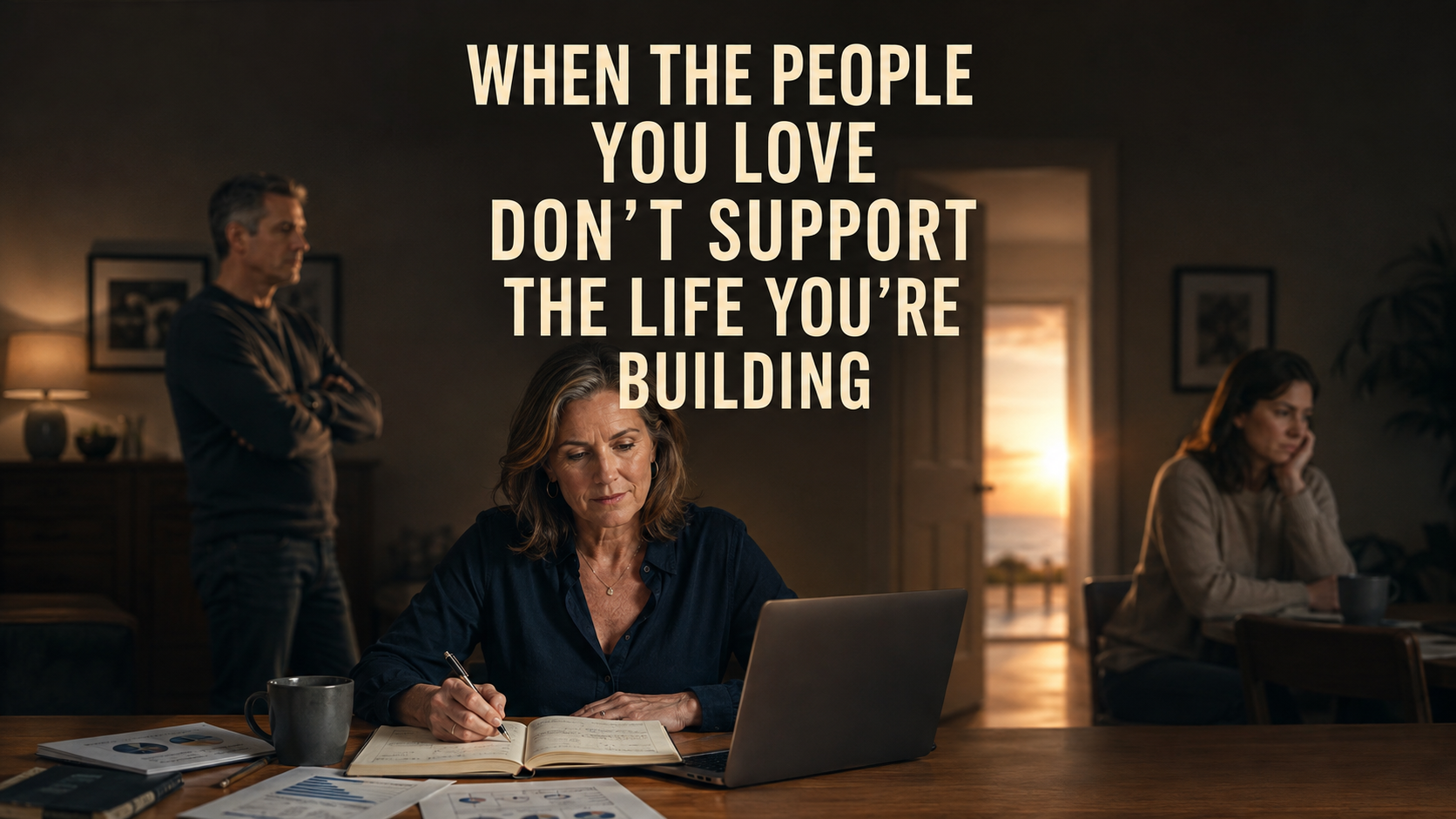
When the People You Love Don’t Support the Life You’re Building

A new venture can become especially lonely when the people closest to you do not understand the person you are becoming. This reflection examines family resistance, entrepreneurial identity, self-trust, and the difference between protecting a vision and refusing legitimate scrutiny.

A reflection on Generation X, entrepreneurship, family resistance, self-trust, and the loneliness of becoming someone new.

I received an email from someone who follows my work.

Generation X. Smart. Capable. Experienced.

And stuck.

Not because they lacked ideas or a strong work ethic. They were afraid to start—to build something of their own, make a career pivot, or leave behind the version of themselves everyone else had grown comfortable with.

The deepest fear was not failure.

It was this:

“What if my family doesn’t support me?”

That question stayed with me because I know exactly

what it feels like.

I had to face it when I began changing the direction of my own life in 2015.

The Beginning Rarely Looks Rational to Other People

My reinvention was not one clean move.

I moved from restaurants to real estate, then into politics, intellectual-property research, branding, and multimedia.

From the outside, that progression may have looked unstable. From inside my life, it felt necessary.

I could feel myself being pulled toward the structural norms I had been raised to follow: choose a predictable path, remain useful, protect stability, and avoid changes that other people might not understand.

Those values are not inherently wrong. Stability matters. Responsibility matters. Providing for the people who depend on us matters.

But the familiar path was leading me back toward a life that no longer fit.

I knew I needed to change direction while I still had the strength, energy, and courage to make consequential decisions.

Not eventually.

Now.

So I began moving more intentionally. I made decisions that created uncertainty, distance, and sometimes resentment.

My reasoning became simple:

Somebody has to go first.

What Happens When You Are the First One

When you are the first person in your family or immediate environment to build something outside the conventional structure of working for someone else, the people around you may not have a framework for understanding it.

Entrepreneurship can look foreign, unrealistic, or unnecessarily risky—especially when nobody close to you has done it before.

Your effort to grow may be interpreted as ego.

Your experimentation may be interpreted as instability.

Your confidence may be interpreted as arrogance.

Your changing priorities may cause people to ask, directly or indirectly:

“Who do you think you are?”

That reaction does not automatically mean they want you to fail

Sometimes people are frightened by changes they cannot control. Sometimes your reinvention disrupts an arrangement that worked well for them. Sometimes they are projecting their own fears. And sometimes they see a weakness in your plan that deserves serious consideration.

The challenge is learning to distinguish concern from control.

A warning supported by evidence should be examined.

A demand that you remain small so someone else can remain comfortable should not govern your life.

Family Support Matters—but It Is Complicated

Research does not show that every entrepreneur begins without family support. It does show that family relationships can influence whether someone pursues a venture, what resources are available, and how entrepreneurial stress affects well-being.

A study published in the Journal of Business Venturing examined the effects of different forms of family support during the startup process. It found that family social capital was positively associated with startup activity, while family financial support produced more complicated—and sometimes negative—effects. Read the study on family support and startup activity.

Another peer-reviewed study found that family support can affect the relationship between entrepreneurial stress and well-being, but the results varied considerably among entrepreneurs. Support matters, but its effects depend on the relationship, circumstances, and type of support being provided. Read the study through the National Library of Medicine.

A broader systematic review reached a similar conclusion: families can provide—or restrict—the emotional, financial, practical, and social resources connected to entrepreneurship. Review the research on entrepreneurship and the family’s role.

The evidence does not support saying that most families oppose entrepreneurship. It supports something more precise:

Some entrepreneurs begin with encouragement. Others encounter skepticism, pressure to remain on a conventional path, or concern about the consequences of an uncertain venture.

When encouragement, practical assistance, professional knowledge, or financial support is absent, the early stages may become more difficult and isolating.

Support Is Not the Same as Agreement

Family support should not require unquestioning approval.

A spouse who asks about debt, insurance, household expenses, retirement, or the amount of money being invested is not necessarily undermining a dream. Those may be responsible questions—especially when the consequences of the venture will affect the entire household.

Healthy support can include skepticism.

It should also include respect.

Ridicule is not due diligence.

Dismissal is not analysis.

Emotional punishment is not protection.

Someone can challenge your assumptions without diminishing your worth. They can ask for evidence without demanding that you abandon the idea.

The same responsibility applies to the entrepreneur.

You cannot label every objection “negativity” simply because it is uncomfortable. You must be willing to hear weaknesses, examine the numbers, revise the plan, and separate criticism of the business from criticism of you.

The question is not merely whether your family supports the idea.

It is whether everyone involved can discuss the risk honestly and respectfully.

The Friction of Becoming

Entrepreneurship requires more than creating a product, filing paperwork, or developing a brand.

It can require an identity transition.

You may no longer see yourself exclusively through the role you occupied for twenty or thirty years. You begin trying on a different professional identity before you have the revenue, results, or public recognition to make it feel legitimate.

Research on career transitions describes this process as movement between established professional roles that can disrupt a person’s sense of identity. These transitions are rarely linear. People experiment, revise their direction, and develop a new understanding of themselves through experience. Read the research on career transitions and professional identity.

That helps explain why reinvention can feel so destabilizing.

You are not merely learning new work.

You are becoming visible to yourself in a different way.

The people around you must decide whether they can relate to this emerging version of you. Some will adapt. Some will need time. Some may never accept the change.

You cannot control that decision.

You can control whether their discomfort becomes the ceiling over your life.

The Choice Is Not Simply “Stay Small or Leave”

It can feel as though there are only two options.

Remain the version of yourself everyone understands.

Or continue evolving and risk losing the approval of the people you love.

Real life is more complicated.

Reinvention does not automatically require abandoning your family, resigning from your job, exhausting your savings, or treating every concerned person as an enemy.

A responsible transition can be gradual.

You can test an idea while remaining employed. You can build a portfolio before changing careers. You can conduct customer interviews before investing heavily. You can establish financial boundaries with your spouse. You can create personal boundaries without cutting people off.

You can listen to criticism without surrendering authority over your own life.

The real decision is not whether to choose your dream over every relationship.

It is whether you will examine the evidence, accept responsibility for the risk, and continue developing a life that remains honest.

Fear of Failure Is Real

Fear can stop capable people before the market ever has the opportunity to respond.

The Global Entrepreneurship Monitor defines the “fear of failure rate” as the percentage of adults who see an entrepreneurial opportunity but report that fear of failure would prevent them from starting a business. Its international research treats fear of failure as a measurable barrier to entrepreneurial action—not as a character defect. Review the Global Entrepreneurship Monitor’s definition.

Fear does not necessarily mean an idea is wrong.

It may mean the consequences matter.

At midlife, those consequences are not theoretical. A failed venture can affect savings, retirement, health insurance, housing, debt, and other people in the household.

Courage at this stage should not mean pretending those risks do not exist.

It should mean measuring them clearly enough to act responsibly.

The Hidden Work of Entrepreneurship

People often associate entrepreneurship with money, branding, investors, business plans, and public launches.

Those elements matter.

But before the public work begins, there is often private work.

You must decide whether you trust yourself enough to become temporarily unfamiliar—to your family, your colleagues, and sometimes even yourself.

You must continue when the early work receives little attention. You must revise ideas to which you have become emotionally attached. You must separate rejection of an offer from rejection of your worth.

You must learn without interpreting inexperience as proof that you do not belong.

You must also continue without constructing a fantasy in which persistence alone guarantees success.

That distinction matters.

Perseverance is necessary.

It is not market validation.

Belief Is Not a Business Model

Self-belief can help you begin, but it cannot establish customer demand, create cash flow, satisfy legal requirements, or make an unworkable model viable.

The U.S. Small Business Administration recommends conducting market research to evaluate demand, market size, pricing, market saturation, customer characteristics, and competitive positioning before making substantial commitments. Review the SBA’s business-planning resources.

That is the discipline required on the other side of inspiration.

Ask whether the problem is real.

Determine who will pay to solve it.

Test the smallest credible version of the offer.

Calculate the amount you can afford to lose.

Understand the legal, tax, insurance, licensing, and intellectual-property implications.

Set measurable conditions for continuing, changing direction, or stopping.

The people around you do not get to kill a viable idea merely because it makes them uncomfortable.

But you do not get to declare an idea viable merely because it feels like your purpose.

Evidence must have a seat at the table.

Build the Support You Do Not Have

If your immediate family cannot provide informed entrepreneurial support, do not spend all your energy trying to convert them.

Build another layer of support.

Find people who understand the work.

That might include an experienced founder, industry mentor, Small Business Development Center adviser, SCORE mentor, attorney, accountant, professional association, or peer group composed of people building businesses at a similar stage.

The Small Business Administration maintains a national network of free and low-cost counseling resources for business owners. Explore the SBA’s counseling network.

Outside support does not replace family.

It serves a different purpose.

Your spouse or sibling may love you deeply and still lack the experience necessary to evaluate a pricing model, licensing strategy, customer-acquisition plan, or intellectual-property question.

Do not confuse emotional proximity with technical authority.

And do not ask one person to perform every role.

What I Have Learned

You do not need everyone to understand your vision at the beginning.

You do need enough self-trust to take the next responsible step before the final outcome is known.

You need the humility to test your assumptions.

You need the discipline to change direction when the evidence requires it.

You need the maturity to hear legitimate concerns without allowing ridicule, fear, or family expectations to control your future.

Support may grow after other people see evidence of progress.

It may not.

Some people will understand later. Some will remain skeptical.

Some relationships may become stronger as your direction becomes clearer. Others may reveal that they depended on you remaining a version of yourself you had already outgrown.

That knowledge can be painful.

It can also be clarifying.

If You Feel the Pull

If you feel an internal pull toward something larger, different, or outside the life other people expect you to live, pay attention to it.

But do more than listen to the feeling.

Investigate it.

Test it.

Cost it.

Protect it.

Build evidence around it.

Do not quit merely because you are afraid.

Do not leap merely because you are inspired.

Move with courage and judgment together.

You may feel isolated because you are early.

That does not automatically mean you are right.

But it does not mean you are wrong.

It means the work has reached the point where belief must become evidence—and where the next responsible step belongs to you.

Author’s Note

This article combines personal reflection with general information about entrepreneurship, career transition, family support, and business planning. It does not suggest that every concerned family member is obstructive, that every unconventional idea is viable, or that persistence guarantees commercial success.

Nothing in this article constitutes individualized financial, legal, tax, mental-health, employment, or business advice. Entrepreneurship can create significant financial and personal risk. Readers should evaluate their circumstances, validate customer demand, protect essential household resources, and consult appropriately qualified professionals before making consequential decisions.

Read More