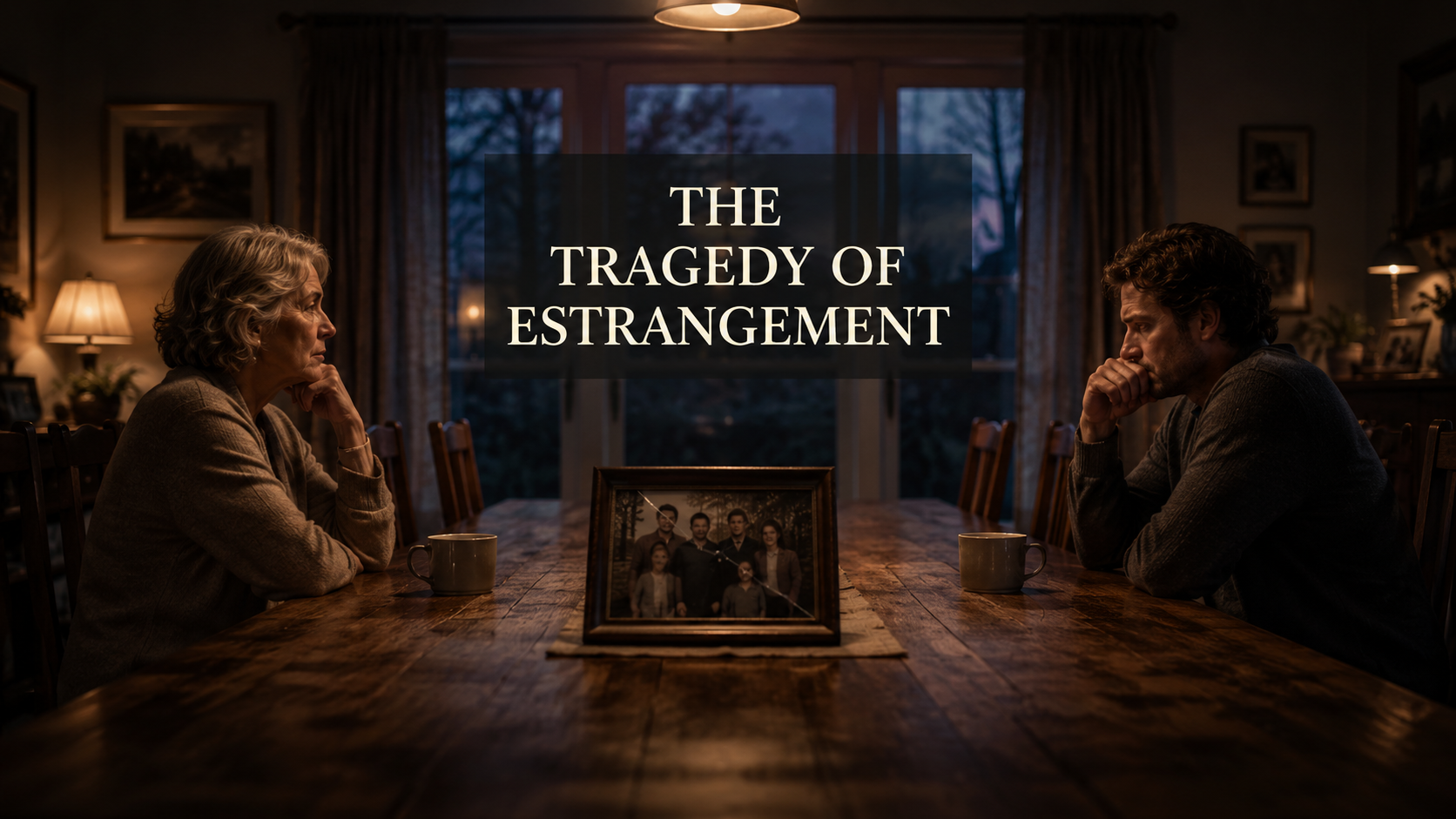
The Last Version of Us: When Families Become Strangers While Everyone Is Still Alive
A reflection on family distance, accountability, and making room for change without surrendering safety.
The birthday still comes. The photograph is still in the drawer. The person is somewhere in the world, but the relationship you remember is no longer part of daily life.
Family estrangement can be difficult to explain because the loss does not arrive with a funeral or a clear ending. A parent may be mourning silence. An adult child may be protecting a boundary. A grandparent may be wondering what the next generation will know of the family story.
Those experiences can exist at the same time. They do not establish that everyone caused equal harm or owes the same response.
The Cornell Family Estrangement and Reconciliation Project reports that 27% of Americans in its research were estranged from a close relative, including parents, children, siblings, and other relatives. Read the project's explanation and findings.
If this is part of your life, you are not the only person trying to find language for it.
The photograph where time stopped
Sometimes we remember someone most vividly at the moment they hurt us: the argument, the betrayal, the words spoken, or the apology that never came.
Consider two possible questions. A parent might ask, “How did my worst moments erase everything I gave?” An adult child might ask, “How can you not understand what those moments did to me?”
Both deserve to be heard. But hearing a question is different from accepting its premise. A history of providing does not cancel harmful conduct. A person's pain does not make every conclusion about another person's motives certain.
The harder conversation asks what happened, what its effects were, and what has changed since. It leaves room for complexity without using complexity to dodge accountability.
The tools we inherited
In some families, love was expressed by showing up, working overtime, and keeping food in the refrigerator. Talking about hurt was less familiar. A person could learn how to provide without learning how to apologize.
That history may help explain a limitation. It does not erase its consequences.
The CDC describes how adverse childhood experiences can affect health and relationships, with effects that can reach the next generation. It also emphasizes the protective role of safe, stable, nurturing relationships. Read the CDC's overview of childhood adversity.
We can recognize what a parent did not receive and still ask that parent to take responsibility for what they did. We can understand an adult child's need for distance without pretending we know every detail of the relationship.
Care, advice, and control
When children become adults, the relationship has to make room for adult choices. Advice is no longer an instruction simply because it comes from a parent.
Concern may be loving. It can also become pressure when it is repeated after a clear answer. A difficult conversation may be worth having, but cruelty and coercion do not become care because someone calls them honesty.
For someone choosing to reflect on their own conduct, useful questions might be:
Was I trying to understand, or trying to secure agreement?
Have I listened to the boundary already stated?
What specific action can I acknowledge without immediately defending it?
What would changed behavior look like over time?
Start with the question you can answer most honestly.
The family around the fracture
Siblings, grandparents, friends, and partners can find themselves pulled into the dispute. Support becomes complicated when people are asked to carry messages, repeat allegations, or persuade someone to resume contact.
My view is that support should begin with listening and respect for the person's choices. Ask what they need rather than assuming the answer is a reunion.
“Would you like me to listen, help you think through an option, or give you some space?” is often a more useful place to start than “But they're your family.”
Children should not have to serve as messengers or judges in an adult conflict. Family history can be explained with care without recruiting the next generation to prove a point.
Change is possible. It is not owed.
A U.S. longitudinal study found that many respondents classified as estranged from a parent moved out of that category in later survey waves. The finding describes changes in contact and closeness; it cannot establish that a particular relationship became safe or fully repaired. Read the study's abstract and methods summary.
That distinction matters. Contact is not the same as trust. A holiday invitation is not evidence of accountability. Time passing is not a substitute for different behavior.
For people who both want to consider repair, the questions become practical: What contact is welcome? What topics or behaviors are off limits? What happens if a boundary is crossed? Is there enough evidence of change to take even a small step?
No one owes renewed access because another person has decided the time is right. A person can change and still have to respect someone else's decision to remain apart.
When the goal is peace
Reconciliation is not the only possible outcome. Some people want limited contact. Others need distance. Some are still deciding. A qualified professional familiar with estrangement and, where relevant, abuse can help someone examine their own circumstances without a predetermined demand to reunite.
If contact involves threats, coercion, stalking, or abuse, this essay should not be read as encouragement to initiate it. Safety takes priority over a satisfying family ending.
There can be grief even when a boundary is necessary. Missing someone does not automatically mean the boundary was wrong.
The last version of us
I want to leave room for a person to be more than their worst chapter. I also want to leave room for the person hurt by that chapter to decide what happens next.
Perhaps two questions belong together: “What happened between us?” and “Who are we now?” Neither cancels the other.
Sometimes the answers make a new relationship possible. Sometimes they make the need for distance clearer. Either way, dignity requires honesty about the past and consent about the future.
Author's note
This essay combines reflection with linked research. It does not diagnose a family, assign equal blame, or prescribe reconciliation. The questions are illustrative and are not a substitute for individualized mental-health or legal support.
Related reading: When Home Becomes a Holding Pattern.