
GENXFINITY MAGAZINE
Stories for the generation that still has more to give.
How I Came Back From Injury After 51
After major ankle reconstruction, prolonged immobility and a total hip replacement, Christine Silva did not simply “bounce back.” This is her account of lost independence, fear of movement, the familiar song that changed her direction and the experience that became a question worthy of serious study.
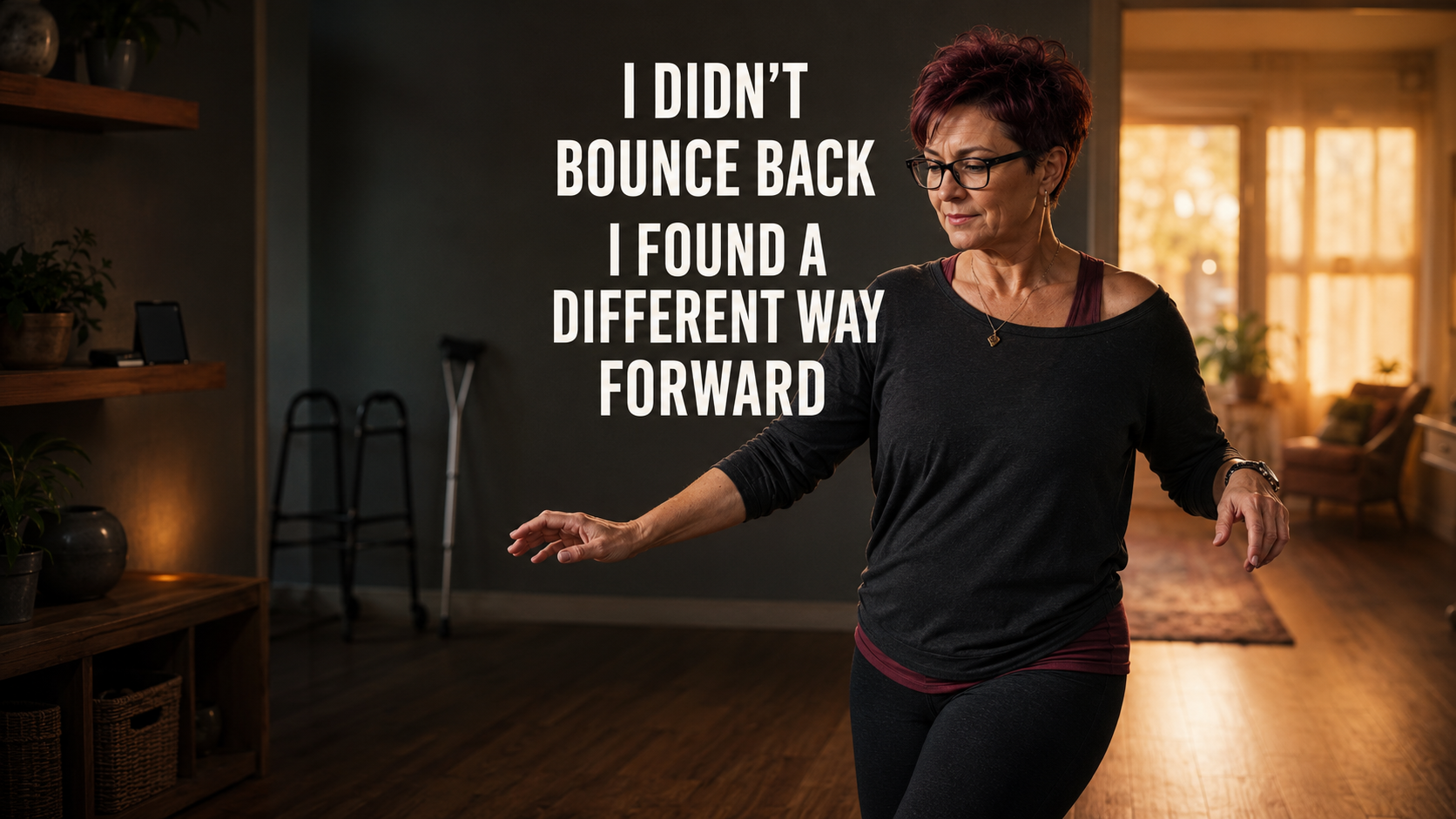
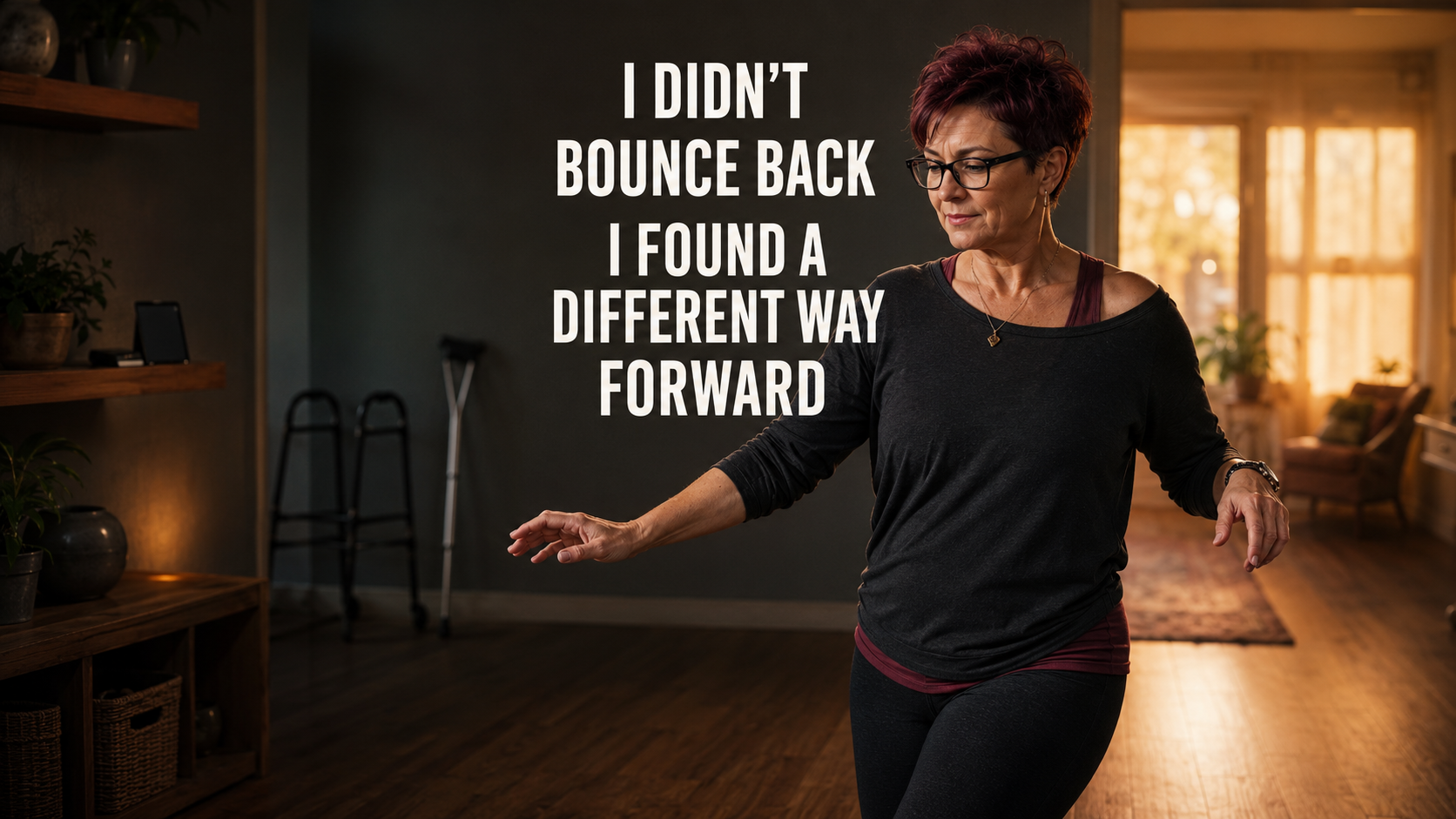
I didn’t bounce back. I found a different way forward—with medical care, rehabilitation, time, and a moment with music that made me curious about movement again.
After age 51, I sustained a serious ankle injury that required major reconstruction. I then spent approximately eight months substantially immobilized. Roughly two years later, I underwent a total hip replacement on the opposite side.
The medical events fit into two sentences. Living through them does not.
I went from being fully independent to needing help with bathing, getting dressed, moving through the house, and having meals prepared. The loss reached into ordinary decisions I had barely noticed before.
Research has documented how widely an ankle fracture can affect daily life. A qualitative study involving 12 patients and six health professionals identified physical, psychological, social, practical, and financial consequences. It described experiences; it did not establish how often each consequence occurs. Read McPhail and colleagues’ study of life after ankle fracture.
For me, dependence was lonely. Not because people did not care, but because I missed the ease of managing my own day.
When every movement becomes a decision
My deepest fear was losing control. I thought before standing. I measured the distance between stable surfaces. I considered whether a step or turn might put me in danger.
Movement that had happened automatically became a negotiation. I was no longer living the way I had before. I was managing every movement, and I was not willing to accept that as the final version of my life.
That determination did not give me a shortcut. Surgery, healing, medical care, and formal rehabilitation are all part of my recovery story. They belong in it, even when I describe the moments that felt more personal.
A familiar song, a different question
The experience that changed my direction happened in my home gym, on a day when I did not feel like showing up. “Return of the Mack” began playing, and something in me responded.
I was not conducting a study or testing a clinical protocol. I started moving to the rhythm in a way that reminded me of how I had moved before the injuries—before every action felt calculated.
I was not counting repetitions or chasing performance. The experience felt less like forcing my body through an exercise and more like allowing it to participate in the music.
That moment gave me a question worth investigating.
Changes arrived in pieces
At first, the changes I noticed were subtle. My shoulders felt less guarded. My upper body began participating more naturally. My hips felt less separate from the rest of the movement.
There was no overnight transformation. I noticed a little more mobility, a little less hesitation, and a gradual return of coordination.
One experience stayed with me. After months of reduced activity, my posture had felt smaller and my shoulders stiff. As I continued moving with the music, I felt them release. The sensation seemed to travel from my shoulders and arms into my trunk and hips.
The closest description I have is cucumber water moving through my veins: clean, cool, and awakening.
I could not separate the possible contributions of practice, attention, music, healing, rehabilitation, confidence, and time. I knew only that the experience was different enough to make me curious.
What the research can—and cannot—tell us
Music can bring personal memories to mind. In a 2009 brain-imaging study, Petr Janata examined the relationship between music, autobiographical memories, and associated brain activity. Read the music-evoked memory study.
Rhythm and movement are also studied together. A 2022 study of younger and older adults found that walking responses varied with musical groove, familiarity, beat perception, and instructions to synchronize. Higher-groove music produced faster walking in both age groups, while some older adults had more difficulty with unfamiliar cues. Read the study of music and gait.
Those studies make the questions worth exploring. They do not explain my recovery or establish that my approach is safe or effective for someone else. Faster walking in a study, for example, does not automatically mean safer walking after surgery.
“Return of the Mack” was not medicine. For me, it became a cue—a connection to a version of myself who remembered moving without the same hesitation.
Rehabilitation remains part of the picture
Professional care belongs in this story alongside the moments that helped me find personal meaning in recovery.
The American Academy of Orthopaedic Surgeons describes exercise and a gradual return to daily activity as important after hip replacement. Its guidance says to check with your surgeon or physical therapist before trying the exercises it describes. Individual instructions matter. Read the AAOS hip-replacement recovery guide.
The question that emerged for me was whether rhythm, coordination, confidence, and personal meaning might complement a recovery process for some people. That is the question I want to explore.
Confidence was the change I noticed most
The change that mattered most to me was the shift from “I hope I don’t fall” toward “I can manage this.” I began to trust my body’s response with less of the same hesitation.
What I can say is that I found a different way to participate in my own recovery. I did not become younger. I became more curious about what was still possible.
If this sounds familiar
You do not have to copy my movements to take something from this story. If you are recovering from surgery or managing pain, weakness, or balance difficulties, bring your questions to the clinician who knows your situation.
You might ask:
What activities are appropriate for me at this stage?
Which restrictions or precautions do I still need to follow?
How can I work on confidence within my rehabilitation plan?
Would music be appropriate during any activities you already recommend?
Those questions can start a conversation without turning someone else’s experience into your treatment plan.
Recovery does not have to resemble a dramatic comeback to matter. In my experience, it arrived in ordinary moments: less hesitation, more participation, and the willingness to keep asking a useful question.
The body that carried you here deserves patience as well as possibility.
— Christine Silva
Author’s note
This personal account contributed to the Freedom Flow Method concept, which has not been clinically validated. This article is not a movement program. Keep following your own care plan, including movement restrictions and prescribed mobility aids, and discuss activity changes with your surgeon or physical therapist.
Related reading
Explore the Freedom Flow Method concept and its development status
Research informing the concept