GENXFINITY MAGAZINE
Stories for the generation that still has more to give.
When Home Becomes a Holding Pattern
When parental support becomes indefinite, home can shift from a launchpad into a holding pattern. This article examines prolonged dependence, excessive gaming, parental enabling, and the difficult line between helping an adult child and preventing him from learning how to survive independently.
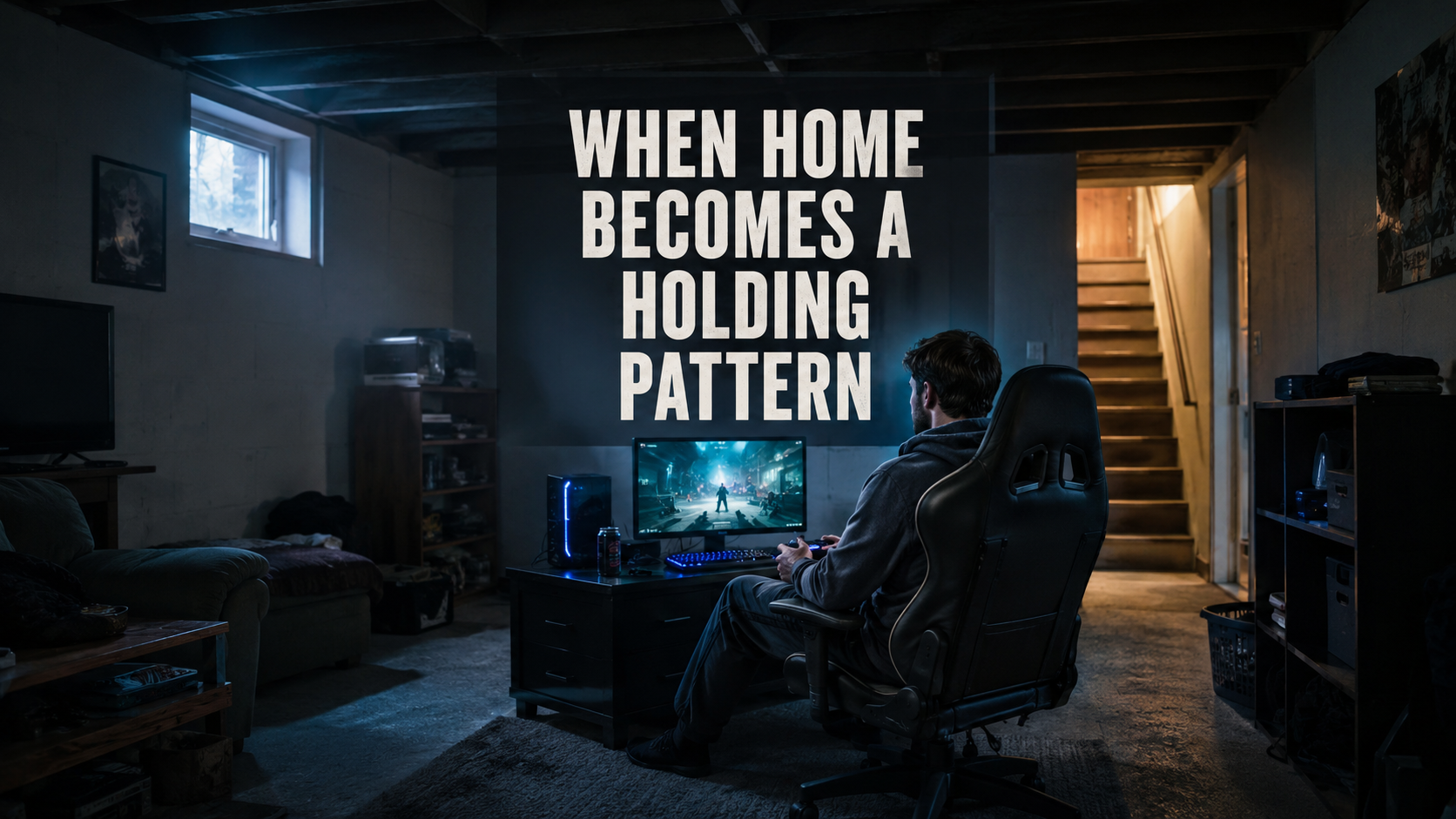
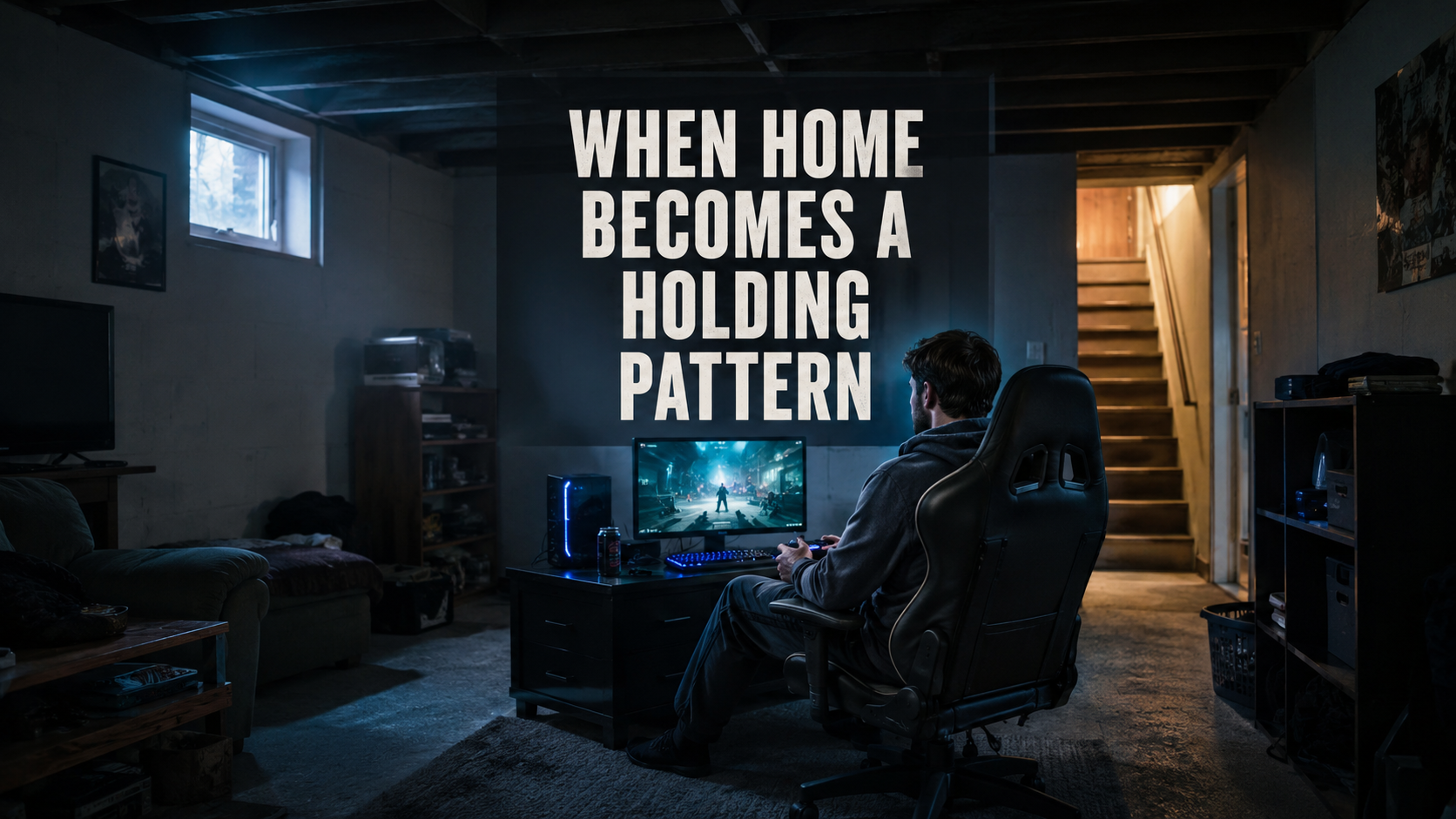
There is a bedroom at the end of the hall that was supposed to be empty by now.
The childhood posters may be gone. The trophies may be packed away. But the person sleeping there is no longer a child. He may be twenty-seven, thirty-two or thirty-eight—still living beneath the same roof where he once waited for adulthood to begin.
In the corner sits a sophisticated gaming system. Through it, he can command armies, acquire virtual property, build civilizations and compete with people around the world.
Inside the game, he advances.
Outside the game, his life may remain largely where it was years ago.
That image does not represent every adult living with parents. Many work, contribute to the household, care for relatives and save deliberately. Others return home following divorce, illness, unemployment or financial catastrophe.
But there is another group we have become reluctant to discuss: able adults whose prolonged dependence cannot be explained entirely by an unforgiving economy.
The Economy Is Difficult—but That Is Not the Entire Story
The economic obstacles confronting young adults are real.
In 2024, approximately 49% of American renter households spent more than 30% of their income on housing. More than one-quarter spent over half their income on housing. Harvard Joint Center for Housing Studies
The median age of a successful first-time homebuyer reached 40 in 2025, illustrating how far homeownership has moved beyond the immediate reach of many younger workers. National Association of Realtors
Student debt, inconsistent employment and rising living expenses can delay household formation. In 2025, the Federal Reserve reported that 49% of adults under 30 lived with a parent, up from 37% in 2019. That figure includes people as young as eighteen and should not be confused with the percentage of people in their thirties who remain at home. Federal Reserve
Among adults ages 25–34, Census figures show that 16% lived with parents in 2025. Earlier Census data also reveal a gender difference. In 2022, 19% of men in that age group lived with parents, compared with 12% of women. In 1960, the corresponding figures were 11% of men and 7% of women. U.S. Census Bureau
These numbers establish that delayed independence is real and that young men are disproportionately represented.
They do not establish that every case is unavoidable.
Economic hardship can explain why independence has become more difficult. It cannot, by itself, explain why an able adult has no plan, makes little contribution and devotes substantial time to entertainment while someone else carries the household.
Homeownership Is Not the Beginning of Adulthood
One of the most damaging cultural errors is the belief that independent adulthood begins with buying a house.
A twenty-two-year-old should not expect to graduate from college and immediately reproduce the lifestyle their parents spent decades building. Their parents’ present circumstances may represent thirty years of employment, accumulated earnings, sacrifice, failure, recovery and—sometimes—advantages that are no longer available on the same terms.
But the fact that a young adult cannot immediately purchase a house does not mean adulthood itself is unavailable.
The first independent home may be a rented room. It may be a small apartment shared with two or three other people. The furniture may be used, the car old and the budget unforgiving.
Independence has never guaranteed comfort.
Society now tells young adults, correctly, that housing has become unaffordable for many. But that message becomes destructive when “I cannot afford to purchase the home I want” silently becomes “I cannot assume responsibility for my life.”
There are many steps between a childhood bedroom and homeownership.
When Difficulty Becomes a Permission Slip
Some young adults hear that the economy is stacked against them and respond strategically. They live at home temporarily, work, contribute, reduce debt and save according to a measurable plan.
Others hear the same message and receive permission to stop moving.
A difficult job is rejected because it is unpleasant. Roommates are rejected because privacy is preferred. A second job is dismissed because it would interfere with leisure. A modest apartment is considered beneath the standard of living already available in the parent’s home.
The parent supplies the house, electricity, food and internet. The adult child experiences many of the comforts of an established household without carrying its full financial burden.
Previous generations did not all work two jobs or live with roommates. It would be inaccurate to romanticize the past or pretend that everyone overcame hardship through determination alone. Economic opportunity has never been distributed evenly.
But many young adults did accept conditions they did not particularly enjoy because independence remained the objective. They shared housing, worked overtime, drove inexpensive cars, purchased secondhand furniture and postponed comfort.
The starting line was not mistaken for the finish line.
The problem is not that today’s young adults receive assistance. Most young adults living with parents contribute something financially: Pew found that 65% helped with household expenses, 46% contributed toward rent or the mortgage, and 72% contributed in at least one of those areas. Pew Research Center
The concern is the adult who receives assistance without development, contribution or forward movement.
The World Inside the Screen
Video games are not inherently childish or harmful.
They are played by responsible adults across every age group. They can provide recreation, competition, social connection, creativity and legitimate professional opportunities.
Gaming is particularly common among men. Pew research found that 72% of men under 30 and 58% of men ages 30–49 played video games at least sometimes. Those figures do not establish that every player spends several hours gaming each day, but they confirm that gaming is a significant part of adult male leisure. Pew Research Center
The Bureau of Labor Statistics reported that adults ages 25–34 averaged 36 minutes per day playing games in 2025, plus approximately 19 minutes using computers recreationally. Those figures average together heavy players, occasional players and people who do not play at all. They should not be interpreted as the amount of time spent by a frequent gamer. Bureau of Labor Statistics
Gaming can create an unusually compelling alternative to an unsatisfying real life.
Inside a game, the objectives are clear. Achievement is visible. Progress is measured. Failure is temporary. Teammates may depend upon the player, and status can be earned without confronting landlords, employers, rejection or financial risk.
For a young man who feels unsuccessful outside the game, the virtual world may provide the competence, community and recognition missing from daily life.
That does not make gaming responsible for every failure. Excessive gaming may contribute to withdrawal, but unemployment, depression, anxiety, loneliness and poor career prospects may also drive a person deeper into gaming.
The relationship can work in both directions.
What matters is displacement.
If an adult works, pays expenses, maintains relationships and plays games afterward, gaming is recreation.
If an adult refuses work, contributes little and spends substantial hours gaming while parents finance the household, gaming has become part of the dependency structure.
The World Health Organization does not define gaming disorder merely by the number of hours played. Its critical indicators include impaired control, gaming taking priority over other activities and continued gaming despite significant negative consequences. World Health Organization
The same functional test belongs in the family home:
What is the gaming replacing?
Playing Games Is Not Working in Gaming
Gaming is a legitimate global industry. Developers, designers, professional competitors, streamers, editors, commentators and producers can earn substantial incomes.
But playing games does not automatically make someone part of the gaming industry any more than watching football makes someone an NFL employee.
Professional gamers operate within a business. They train deliberately, compete, attract audiences, maintain production schedules, negotiate sponsorships or generate commercial work.
Even then, the odds are severe.
Research into professional esports careers found that only a few hundred competitors among tens of thousands earned enough to remain exclusively professional. Earnings were concentrated among a narrow group of elite players. Journal of Sports Economics
The distinction is straightforward:
A professional produces economic value and receives income.
A recreational player consumes the product.
If gaming generates enough reliable income to support independent living, it is work. If it generates no income and prevents the player from working, training or assuming responsibilities, calling gaming an “industry” does not make the activity a career.
The Opportunity Cost of Escape
The strongest criticism of excessive gaming is not moral. It is economic.
Every hour has an alternative use.
Twenty hours of gaming each week could also be twenty hours of paid employment, professional training, job searching, exercise or household contribution.
At fifteen dollars an hour, twenty weekly working hours would produce approximately $15,600 in gross annual income before taxes.
That may not purchase a house. It could nevertheless help pay for a rented room, reduce debt, purchase transportation or establish emergency savings.
This does not mean every struggling adult must work every waking hour. Rest and recreation are legitimate human needs.
But when an adult claims independence is impossible while consistently dedicating part-time-job hours to entertainment, economic conditions are no longer the entire explanation.
Time reveals priorities.
ThatEconomic research has found evidence that improvements in gaming and recreational computing affected the labor supply of younger men. One peer-reviewed study estimated that changes in recreational technology reduced the working hours of men ages 21–30 by approximately 2%. Journal of Political Economy
That finding does not prove that gaming caused every individual player to work less. It does show that entertainment technology can influence how people allocate time between work and leisure.
The individual question remains unavoidable:
If independence is the stated goal, does the person’s use of time support that goal?
Parents Can Subsidize the Retreat
Parents may contribute to prolonged dependence intentionally or unconsciously.
Some fear an empty home. Others need to remain indispensable. Some equate protection with love or experience a child’s separation as rejection. They may discourage relocation, interfere with relationships, manage the adult child’s money or rescue the child from every consequence.
Other parents simply avoid conflict. Requiring rent, chores, employment or a departure plan may produce anger. Continuing the arrangement purchases temporary peace.
The unspoken agreement becomes:
The adult child avoids discomfort, and the parent avoids confrontation.
Research on overparenting associates excessive parental intervention with reduced self-efficacy—the belief that a person can manage challenges and produce results through personal action. It has also been associated with poorer mental-health outcomes in emerging adults. Peer-reviewed research
When parents repeatedly perform adult functions for an able child, that child loses opportunities to practice decision-making, financial management, resilience and recovery from failure.
The parent may eventually complain that the adult child is incapable while continuing the very practices that preserve that incapacity.
Support becomes harmful when it replaces development.
The Selfishness Hidden Inside the Rescue
There is a point at which parental help can no longer be described as generosity.
A parent who intentionally infantilizes an able adult child—discouraging work, preventing independent decisions, interfering with relationships or convincing the child that survival is impossible without the parent—is not protecting that child.
The parent is protecting themselves.
They may fear loneliness. They may need control. They may want a permanent companion, future caregiver or continual proof that they remain indispensable.
Whatever the motive, deliberately keeping an adult child incapable so the child will never leave is selfish.
It asks the child to surrender a future so the parent can feel secure in the present.
The arrangement also carries a consequence that cannot be negotiated away: in the ordinary course of life, parents generally die before their children.
What happens then?
Who teaches the fifty- or sixty-year-old dependent adult to manage money, maintain a home, navigate healthcare, secure employment or make consequential decisions? Who intervenes when the bills arrive, the property must be maintained or the parent’s income disappears?
The parent who prevented independence will no longer be present to manage the dependency they created.
The adult child is then left grieving two losses at once: the death of a parent and the collapse of the system upon which their entire life was built.
That is the final cruelty of intentional infantilization. The parent receives years of companionship, control or emotional reassurance.
The adult child inherits the consequences.
A loving parent does not measure success by how permanently a child remains dependent.
A loving parent prepares the child to survive their absence.
The duty of parenting is not fulfilled by making oneself necessary forever. It is fulfilled by ensuring that, when necessity ends, the adult child possesses the judgment, competence and resilience to continue living.
Anything less may look like devotion from inside the home.
But when dependence is deliberately created and preserved, it is not devotion.
It is abandonment postponed.
Interdependence Is Not Dependence
Multigenerational living should not be condemned wholesale.
In many cultures, adults remain in the family home, contribute income, care for relatives and share responsibilities. Such arrangements can be economically efficient, emotionally healthy and culturally valued.
The test is not the address.
The test is capability, contribution and choice.
Can the adult control personal income? Manage appointments and obligations? Maintain employment? Cook, clean and manage a household? Make decisions without sabotage or emotional punishment? Leave if circumstances require it?
If so, the household may be interdependent.
If not—and if the family continually obstructs the development of those abilities—the household may be preserving dependence.
Living together by mutual choice is fundamentally different from keeping an adult incapable so that departure becomes impossible.
A Plan or a Holding Pattern
The dividing line is movement.
Living at home while working, contributing and executing a documented plan can be sound strategy.
Living at home indefinitely while rejecting sacrifice and devoting substantial time to nonproductive entertainment is avoidance.
Parents do not need to expel adult children into homelessness to encourage independence. They can require proportionate household contributions, establish responsibilities, set savings expectations and schedule regular reviews of the arrangement.
An able adult should understand what the household expects and what measurable progress looks like.
The objective is not necessarily immediate departure.
It is increasing responsibility.
A healthy arrangement should answer several questions:
Is the adult child employed, studying, training or actively seeking work?
Does the adult child contribute financially according to ability?
Do they perform a fair share of household labor?
Are they managing their own appointments, transportation, finances and obligations?
Is there a savings or debt-reduction plan?
Is the arrangement reviewed periodically?
Is gaming or other entertainment occurring after responsibilities—or replacing them?
Could the adult child function if parental support ended unexpectedly?
If the family cannot answer those questions, it may not have a plan.
It may have a holding pattern.
The Complete Truth
Young adults deserve the complete truth.
Yes, housing has become less affordable.
Yes, wages, debt and unstable employment can delay independence.
Yes, some previous economic opportunities are no longer available on the same terms.
But adulthood was never promised to be immediate,
private, comfortable or easy.
A person may not be able to buy a house at twenty-five. That does not mean they cannot work, contribute, save, share housing and build the capacity to leave.
Gaming can be recreation. For a select few, it can become a career. It can also become an escape financed by parents who are unwilling to establish boundaries.
The question is not simply whether an adult child still lives at home.
The question is whether home is being used as a bridge—or as shelter from the responsibilities required to cross it.
A parent’s final responsibility is not to ensure that an adult child will always need them.
It is to prepare that child for the day when they are no longer there.
The empty bedroom at the end of the hall should not represent rejection or abandonment.
Properly understood, it represents the completion of a sacred assignment.
The child did not leave because the parent became unnecessary.
The child left because the parent’s work succeeded.
Author’s Note
This article is cultural commentary about prolonged dependence—not a judgment against every adult who lives with parents or every person who plays video games. Multigenerational living may be financially prudent, culturally customary, mutually beneficial, or necessary because of disability, illness, caregiving, education, housing costs, unemployment, divorce, or other circumstances.
The concern addressed here is a narrower pattern: an adult who remains capable of greater responsibility but is not progressing toward independence, while excessive gaming or another absorbing activity displaces work, contribution, skill development, relationships, or ordinary adult obligations—and while the household continues supporting that stagnation without a defined plan.
Gaming alone does not establish addiction, immaturity, or a mental-health condition. Families facing persistent withdrawal, functional impairment, depression, substance use, threats, financial exploitation, or serious conflict should seek appropriately qualified professional guidance. This article provides general social and educational commentary; it is not medical, mental-health, financial, or legal advice.