
GENXFINITY MAGAZINE
Stories for the generation that still has more to give.
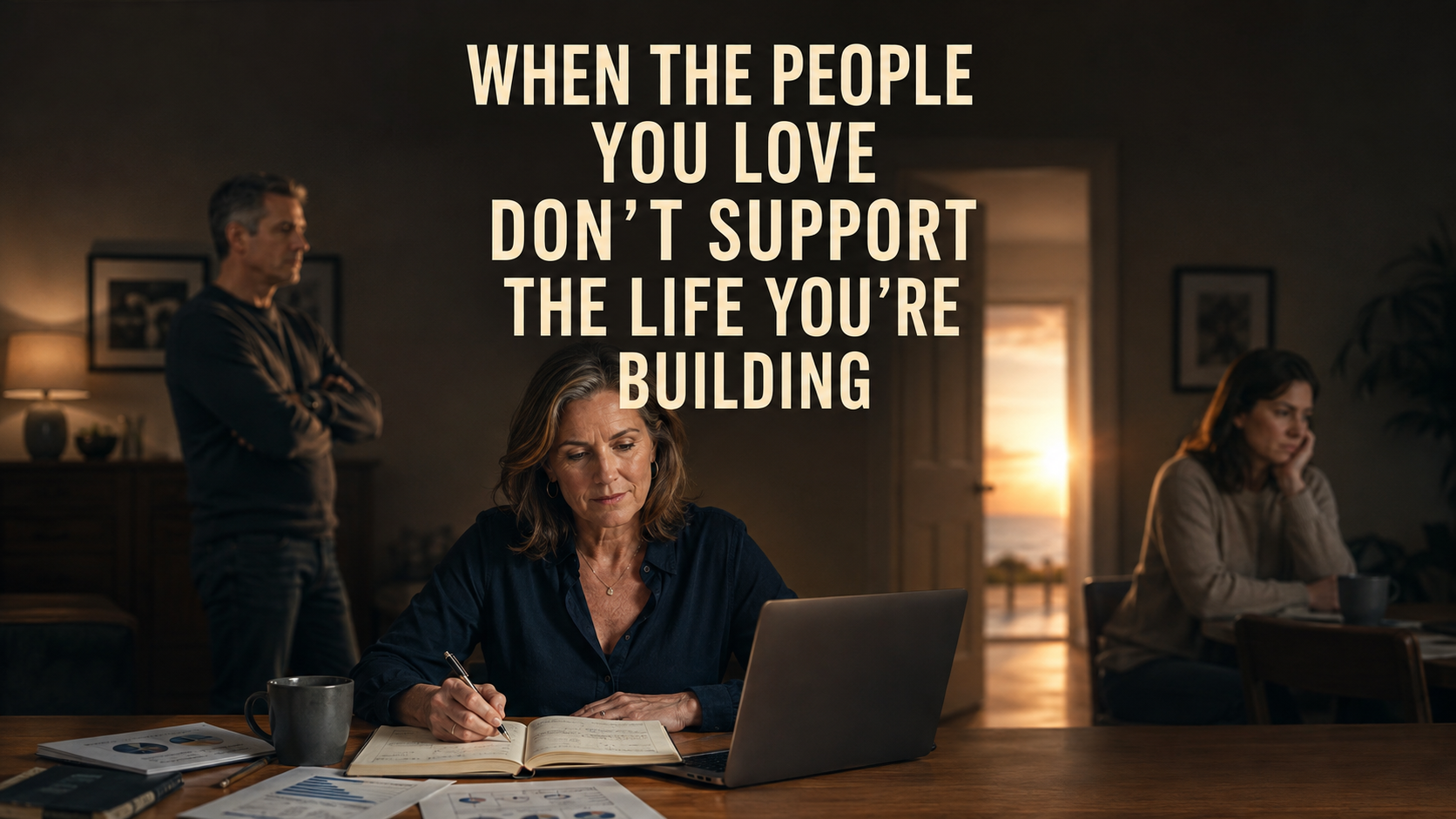
When the People You Love Don’t Support the Life You’re Building
A new venture can become especially lonely when the people closest to you do not understand the person you are becoming. This reflection examines family resistance, entrepreneurial identity, self-trust, and the difference between protecting a vision and refusing legitimate scrutiny.
You can take a new direction seriously without expecting everyone to understand it immediately. The work is learning which doubts deserve an answer—and which expectations no longer fit.
I received an email from someone who follows my work. Generation X. Smart. Capable. Experienced. And stuck.
They were afraid to start: to build something of their own, make a career pivot, or leave behind the version of themselves everyone else had grown comfortable with. The question that stayed with me was simple:
“What if my family doesn’t support me?”
I know what that feels like. I faced it when I began changing the direction of my own life in 2015.
The beginning rarely looks tidy
My reinvention was not one clean move. I moved from restaurants to real estate, then into politics, intellectual-property research, branding, and multimedia. From the outside, that progression may have looked unstable. From inside my life, it felt necessary.
I could feel the pull of the rules I had grown up with: choose a predictable path, remain useful, protect stability, and avoid changes other people might not understand. Responsibility matters. So does providing for the people who depend on us.
But the familiar path was leading me toward a life that no longer fit. I wanted to change direction while I still had the strength and energy to make consequential decisions. So I began moving more intentionally. Some decisions created uncertainty, distance, and resentment.
Somebody had to go first. In my life, that somebody was me.
Support is not the same as agreement
When the people close to you have never built a business, they may struggle to understand why you would take on the uncertainty. But disagreement alone does not tell you what someone’s motives are. A concerned question and a dismissive remark deserve different responses.
A spouse who asks about debt, insurance, household expenses, or money invested in a venture may be asking responsible questions. If the consequences affect the household, the household belongs in the conversation.
Healthy support can include skepticism. It should also include respect. Someone can challenge your assumptions without diminishing your worth. And you cannot label every objection “negativity” simply because it is uncomfortable.
The research is more complicated than “supportive family, successful founder.” A 2020 study followed 61 entrepreneurs over 14 days and found that the relationship between family support, stress, and well-being differed depending on whether the stress involved finances or workload. That small study cannot explain any one family, but it is a useful reminder that support is not a single, simple ingredient. Read the study in the Journal of Business Research.
The practical question is whether everyone involved can discuss the risks honestly and respectfully.
You do not have to choose between standing still and blowing up your life
It can feel as though the options are to remain the person everyone understands or change everything at once. There is room between those extremes.
You can test an idea while remaining employed. Build a portfolio before changing careers. Talk with potential customers before investing heavily. Agree on financial boundaries with the people whose lives are tied to yours.
Consider separating the conversation into three questions:
What exactly worries you about this plan?
What evidence would help us evaluate that concern?
What time, money, and responsibilities are we agreeing to protect while I test it?
Those questions are an invitation to discussion, not a script guaranteed to win approval. Sometimes a concern will reveal a weakness worth fixing. Sometimes the answer will remain no. You can listen carefully and still decide what belongs in your future.
Belief needs something to stand on
Self-belief can help you begin. It cannot establish customer demand or make the numbers work.
The U.S. Small Business Administration’s planning guidance recommends examining demand, market size, competitors, and pricing. Those are useful questions to bring to the table before a dream becomes a substantial financial commitment. Explore the SBA’s market-research and business-planning guidance.
Here is a manageable place to start:
Describe the problem you want to solve in one clear sentence.
Identify who experiences it and speak with potential customers.
Test a small version of the offer before building the expensive version.
Write down the time and money you are prepared to commit.
Decide what evidence would justify continuing, changing direction, or stopping.
You do not have to defend the entire future. Explain the next responsible test: what you will try, what you can afford, and what you need to learn. A plan gives the conversation something concrete to work with; it does not guarantee the business will succeed.
Build another layer of support
Your family does not have to fill every role. Someone can love you deeply and still be the wrong person to evaluate a pricing model or a licensing question.
Look for people who understand the work: an experienced founder, a mentor, a professional association, or an adviser with the relevant expertise. The SBA’s counseling network includes SCORE and Small Business Development Centers, with free counseling and other assistance available through its partners. Check the particular program for services and costs. Find business counseling through the SBA.
Outside support serves a different purpose from family support. It can give you a place to ask basic questions, challenge assumptions, and receive feedback from someone who knows the territory.
You are allowed to be experienced and still be learning.
What I have learned
You do not need everyone to understand your vision at the beginning. You do need enough self-trust to take a responsible next step—and enough humility to change direction when the evidence calls for it.
Some people may understand later. Some may remain skeptical. You cannot make their acceptance the only measure of whether your work deserves a fair test.
If you feel the pull toward something different, investigate it. Test it. Cost it. Listen to legitimate concerns. Let courage and judgment travel together.
We have already lived through enough change to know that the first version of a plan is rarely the last. That experience is worth bringing with you.
The next step does not have to be dramatic. It has to be yours to take—and responsible enough to stand behind.
Related reading
The Career Pivot After 50
Walking Into the Noise
Author’s note: This essay combines personal reflection with general business-planning information. It does not assess your family relationships or provide individualized financial or legal advice. The personal experiences are the author’s account; the linked research supplies context rather than proof of anyone’s motives.