
GENXFINITY MAGAZINE
Stories for the generation that still has more to give.
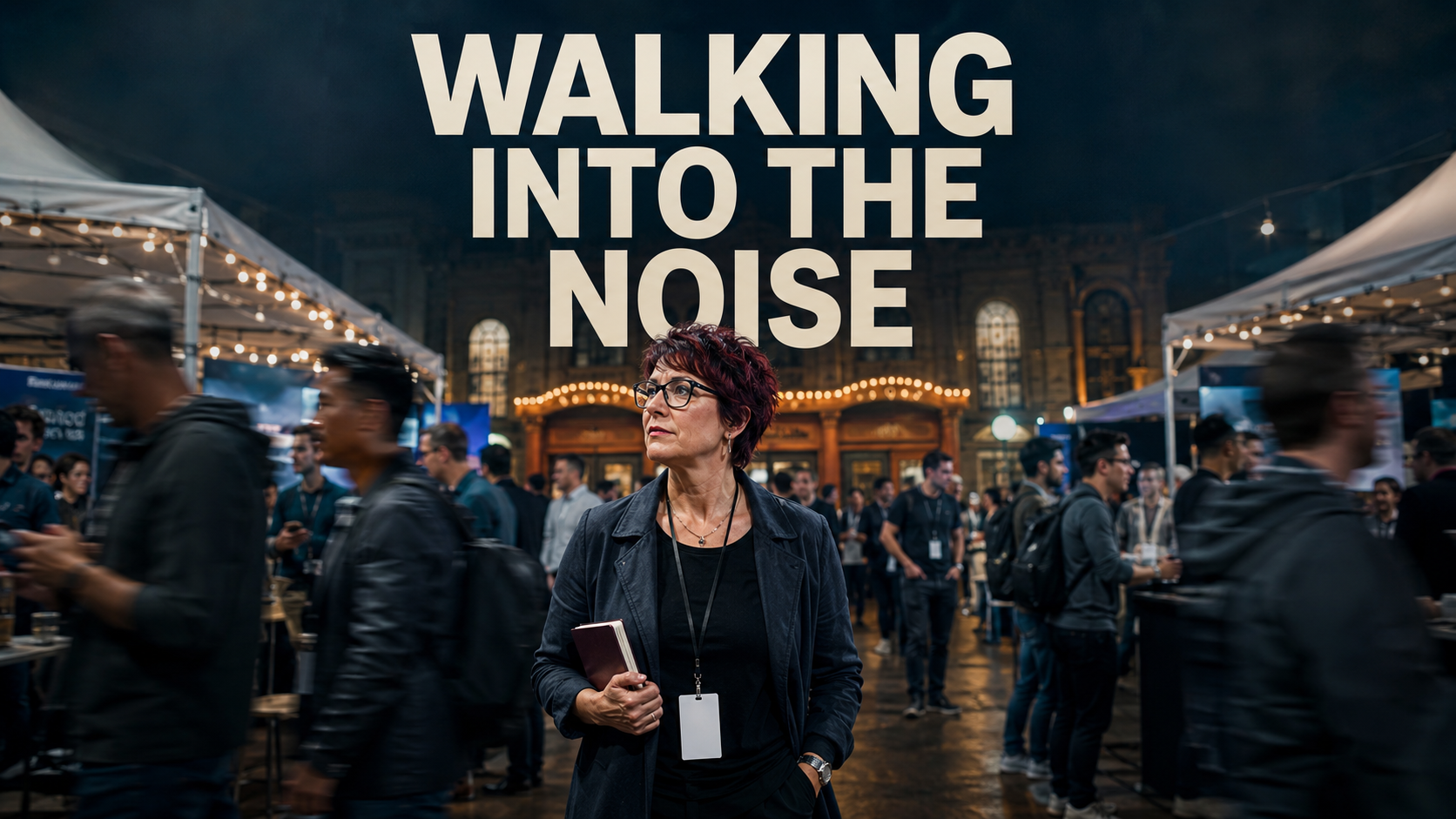
Walking Into the Noise
At the 2026 Startup Grind Conference, Christine Silva entered a world built around speed, visibility and constant pitching. What she discovered was not that she was too late—but that observation must eventually become participation.
A first trip into startup culture reminded me that experience belongs in the room—and that eventually, observation has to become a conversation.
Startup Grind Conference, Redwood City, California | April 28–29, 2026
I walked into the 2026 Startup Grind Conference knowing I was entering a world I had studied but never truly operated within. The theory was familiar. The room was something else.
By then, I knew the private side of building something: the experimentation, mental resets, and moments when you question whether you made the right decision. My feeling of being an impostor arrived long before I reached the conference.
Five years earlier, I had left the Bay Area and moved to South Carolina. Being back meant seeing my brothers, my sister, and friends who knew me before this change in direction. That felt familiar. Walking into Silicon Valley’s startup world brought an entirely different rhythm.
Inside the room
Startup Grind listed the main event for April 28–29 at Redwood City’s Fox Theatre and promoted it as an opportunity to join approximately 5,000 others. That was the organizer’s invitation, not an independently verified attendance count. See the official event listing.
Booths filled the exhibition areas. Conversations overlapped. Founders delivered practiced pitches, each trying to capture attention in an environment built around visibility.
I understood the purpose. I also found it exhausting.
Inside the Fox Theatre, the energy focused. People listened. The speakers who held my attention sounded grounded in experience. Then I would step outside, and the overlapping conversations returned like the noise of a high-volume industrial kitchen.
It was a rhythm I could recognize without feeling at home in it.
The pressure to match the pace
I felt the pull: speak faster, move faster, become visible. Instead, I moved through the conference quietly and deliberately. I was observing, much as I observe operations, people, and systems in my professional work.
There were people actively creating conversations and others who appeared more selective about their attention. I formed impressions about who might be an investor or established leader, but I could not know their roles without speaking to them or reading their badges.
That distinction matters. What I was noticing was behavior, not proof of status.
Ashton Kutcher, according to my family
Startup Grind announced Ashton Kutcher of Sound Ventures as a mainstage speaker. See the organizer’s speaker announcement.
My sister would probably identify him first as Mila Kunis’s husband and second as Michael Kelso. I was thinking about his investment work. Regardless of the hierarchy, I knew I had better get close enough for a picture or hear about it when I got home.
The conversation I did not start
At one point, I sat behind a man who appeared to be an investor and used a cane. I thought there might be a conversation to begin about the movement concept I was developing through the Freedom Flow Method.
And I said nothing.
Part of my hesitation came from a familiar rule: prepare first, speak when you are certain, and do not step forward until you have earned the right. That rule had value in my working life. In that moment, it also helped me delay.
I waited for a better time or a more controlled conversation. The moment passed.
Looking back, his cane did not tell me his interests, medical history, or willingness to discuss mobility. A respectful introduction could have started with the work and left him free to decide whether to engage.
For example: “I’m developing a movement concept informed by my recovery. Would you be open to a brief conversation about how founders test an early idea?”
That is a possible opening, not a conversation that happened. I did not need to share confidential details or deliver an entire pitch. I needed to begin and leave room for the other person’s answer.
The founder I cannot name
I met a woman developing an application intended to help people create AI-generated movies. I did not retain her name and have not identified her company with enough certainty to name it responsibly. I will not guess.
Her idea stayed with me because I understood the human problem: carrying a visual concept that you cannot quite communicate. I could see the appeal of a tool that lets someone develop and revise that idea privately before sharing it.
I did not evaluate her product, so this is not a recommendation or a claim about what it can deliver. It is a reminder that a useful business idea often begins with a problem someone recognizes immediately.
Sometimes the missing piece is a way to show what you mean.
Then there was the burrito
Later, I stepped into a nearby Mexican restaurant. At another table, a man spoke loudly and quickly on his phone. He sounded as though a breakthrough might be happening.
Then the call ended. After a pause, he looked down and said, “Yeah…I’ll just take a burrito.”
That moment captured the rhythm I had been watching: anticipation, momentum, uncertainty, and reset. Then ordinary life returns and asks what you want for lunch.
I followed a path in which family, employment, and daily responsibilities came before starting a business. That history does not disappear when you walk into a conference. It comes with you, along with the experience it produced.
Later does not mean unqualified
The young-founder image is not the whole story. In a study of U.S. ventures, the mean founding age for the one-in-1,000 fastest-growing firms was 45. That is a finding about a specific group, not a prediction for my business—or yours. Read Age and High-Growth Entrepreneurship.
Experience earns a place in the conversation. It still has to meet a real customer need.
But experience is not a reason to count yourself out, either. The work is to make that experience useful to someone else.
A Gen X Startup Grind
I still think there is room for a Startup Grind gathering that feels a little more like a fire pit: people bringing business ideas, honest questions, and perhaps a Diet Coke.
I initially joked that Jimmy Buffett might call the difference a moat. Wrong Buffett.
Warren Buffett described a durable competitive advantage as a business “moat” in his 2007 shareholder letter. My age and my story would not supply one on their own.
The story may earn attention. The product still has to solve a problem.
Arriving with different tools
I left with a useful challenge for myself. I did not have to imitate the room, but I did have to participate.
If you recognize that hesitation, consider one modest aim for your next event: one introduction, one honest question, and one follow-up you have permission to send. You do not have to perform certainty. You can arrive curious and prepared.
Observation has value. Preparation has value. Then comes the moment when an observation becomes a conversation.
That is the work now.
Keep it Move’n.
— Christine Silva
Related reading
When the People You Love Don’t Support the Life You’re Building
The Career Pivot After 50
Editorial note: Conference scenes and conversations are the author’s recollections. The example introduction is explicitly hypothetical. Organizer claims are attributed; research findings do not guarantee an individual business outcome.