
The Last Version of Us: Why Families Become Strangers While Everyone Is Still Alive
Family estrangement is a grief without a funeral. Parents, adult children, grandparents, and extended families often carry different versions of the same story. This article explores generational patterns, accountability, family systems, and whether people deserve to be remembered as more than the moment everything broke.
A reflection on family estrangement, generational wounds, accountability, and the stories we inherit
Family is often the first place we experience love. It can also be the first place we experience pain.
Maybe that is why losing family while they are still alive creates a grief so difficult to explain.
There is no funeral.
No final goodbye.
No moment where people gather together and acknowledge what disappeared.
The person is still somewhere in the world. Their birthday still comes. Their memories still exist. Their voice can still be remembered.
But the relationship is gone.
A parent wonders how years of sacrifice became silence.
An adult child wonders why distance became necessary.
A grandparent wonders if the next generation will inherit only one chapter of a story they never lived.
Everyone has memories. Everyone has wounds.
And often, everyone believes they were the one left behind.
⸻
The Photograph Where Time Stopped
When people are hurt, they remember.
It is part of being human. Pain teaches. Pain protects.
But sometimes the moment designed to protect us becomes the place we stay.
A person becomes frozen in the moment they hurt us.
The argument. The betrayal. The mistake. The words spoken. The words never said.
Everything before that moment begins competing with everything after it.
The parent asks:
“How did my worst moments erase everything I gave?”
The adult child asks:
“How can you not understand those moments changed me?”
Both questions matter.
They usually break when people stop believing the other person understands their pain.
⸻
The Parenting Manual Nobody Received
Before parents were parents, they were children.
They watched. They learned. They inherited.
How do families argue?
How do families apologize?
How is love expressed?
What happens when someone makes a mistake?
Many previous generations grew up in homes where survival was the priority.
Love was often action.
Work hard. Provide. Protect. Keep moving.
A full refrigerator was love.
Working overtime was love.
Showing up was love.
Many people were not taught to explain pain.
They were taught to endure it.
Then those children became parents.
They raised families using the tools they inherited.
Years later, some adult children looked at those tools and said:
“These hurt me.”
And perhaps one of the most complicated questions in family history appeared:
“How do you give something nobody ever showed you?”
⸻
Survival Skills in a Changing World
Every generation tries to correct the one before it.
A parent who experienced hardship may prioritize security.
A parent who experienced judgment may try to prepare a child for criticism.
A parent who understands how cruel the world can be may try desperately to toughen a child for it.
The message intended:
“I do not want you to hurt the way I did.”
The message received:
“You do not understand who I am.”
Both can be true.
Intent explains where behavior came from.
Impact explains what it felt like.
Neither cancels the other.
⸻
When Protection and Control Look the Same
Parenting begins with responsibility.
Protect. Teach. Guide. Warn.
Then adulthood arrives, and the relationship changes.
Authority becomes influence. Rules become advice. Protection becomes perspective.
That transition is difficult.
Parents sometimes mistake fear for wisdom.
Adult children sometimes mistake wisdom for control.
A parent’s experience does not guarantee they are right.
An adult child’s independence does not guarantee they cannot be wrong.
Growth requires both sides to ask:
“What am I not seeing?”
⸻
When Love Says Something Difficult
Not every painful conversation is harm.
Sometimes love comforts. Sometimes love confronts.
Sometimes the person willing to risk an uncomfortable conversation is the person deeply invested in the outcome, like a mother or a father.
But delivery matters.
A truth delivered without compassion can become criticism.
A concern delivered without listening can become control.
And independence without reflection can become avoidance.
The person speaking must ask:
“How did my words affect them?”
The person listening must ask:
“Am I rejecting this because it is untrue, or because it is uncomfortable and I don’t want to look at the fact that what is being said to me may very well be true”.
⸻
The Family Around the Fracture
Estrangement rarely happens in isolation.
Families are systems, generations of systems built by our ancestors and the cultures they were raised in.
When one relationship breaks, every surrounding relationship responds.
Parents.
Children.
Grandparents.
Aunts.
Cousins.
Friends.
Partners.
In-laws.
Each person carries influence.
Sometimes these voices become bridges.
They protect. They support.
They help establish necessary boundaries.
But sometimes they (those in their specific family systems) unintentionally (or intentionally) become walls.
They preserve one version of events. They reinforce pain without reflection. They allow the broken relationship to become normal.
A wise supporter does not ask only:
“Who hurt you?”
They also ask:
“What else might be true?”
⸻
When Families Adapt to Absence
One of the least discussed parts of estrangement is how quickly families reorganize around loss.
The holidays continue. The gatherings continue. The conversations and the gossip continue.
The missing person becomes part of the new normal. Sometimes this distance is necessary.
Some relationships cannot continue without change.
But sometimes families learn how to live around wounds instead of examining whether healing is possible.
Maintaining connection with one person should not require rejecting another.
Support should not require permanent division.
⸻
The Adult Child’s Truth
Parents must face something difficult.
Love does not erase harm. Good intentions do not erase impact.
A parent may have provided. Protected. Sacrificed. Tried. And still caused pain.
Children experience actions more than intentions.
One of the hardest questions a parent can ask is:
“What was it like to be loved by me?”
And then have the courage to hear the answer.
⸻
The Parent’s Truth
Adult children must also face something difficult.
Parents are not only parents. They are people. They had childhoods before their children existed. They carried fears. Lessons. Survival patterns. Unfinished healing.
Understanding this does not remove accountability.
But context matters.
A person’s worst chapter may be part of their story.
But is it the entire book?
⸻
The Grandchildren Who Inherit the Silence
Estrangement does not stop with two people. It moves forward.
Grandchildren inherit missing pieces. Stories never told. Traditions never shared.
Histories never explained.
Sometimes that separation protects the future. Sometimes it is necessary.
But sometimes a generation inherits the ending of a story without ever knowing the beginning.
⸻
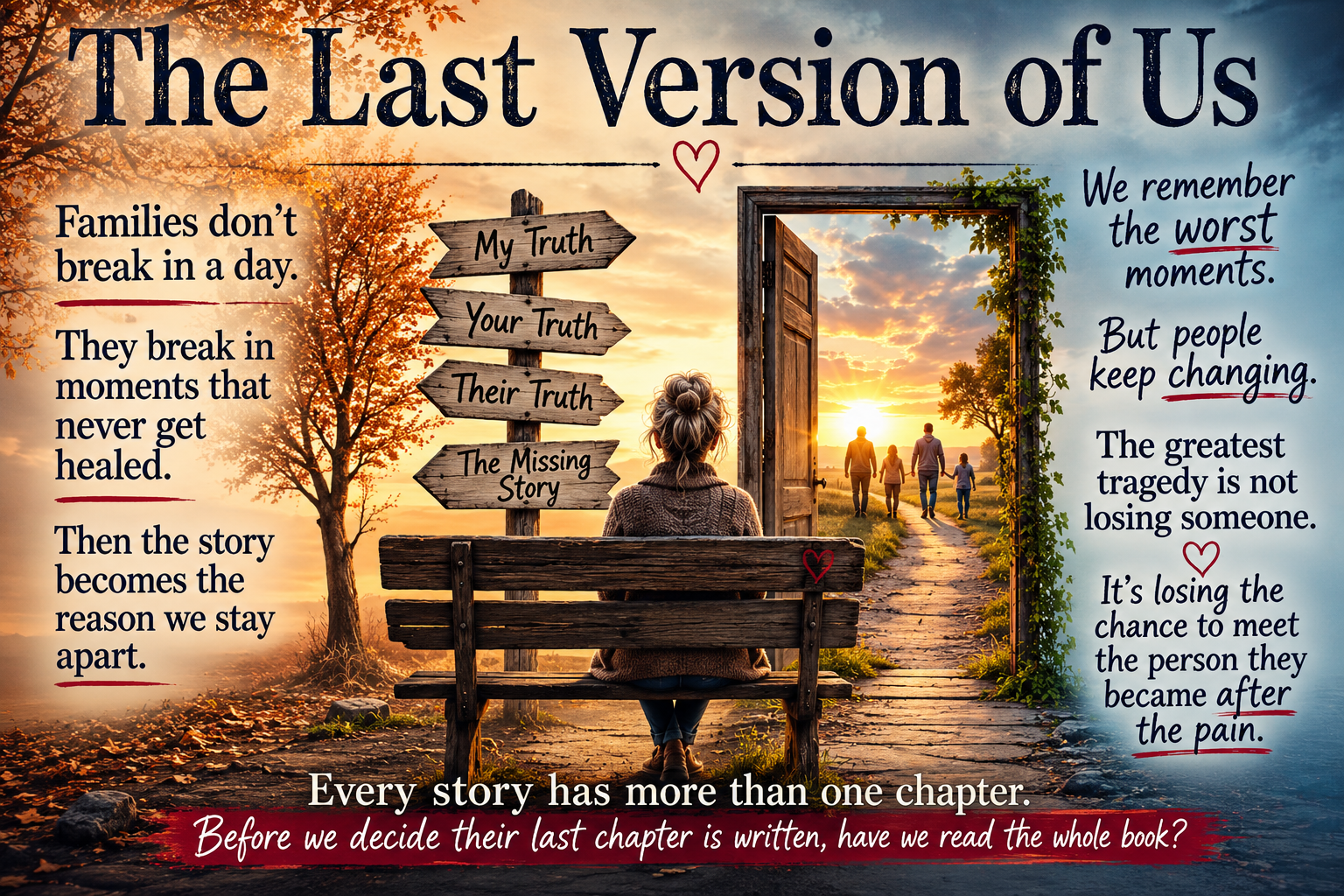
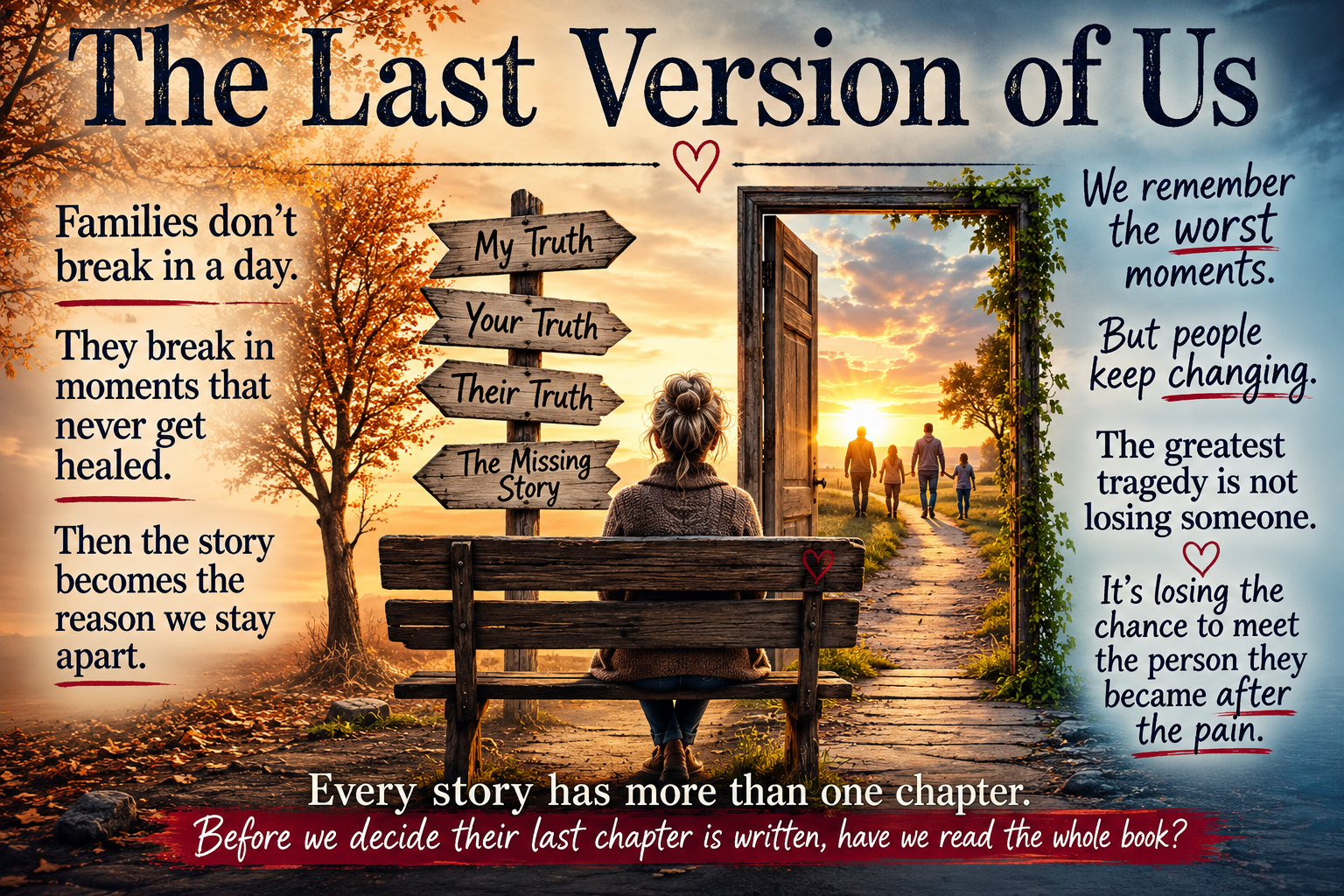
The Last Version of Us
Every person hopes to be remembered fairly.
Not only by their greatest failure.
Not only by their biggest mistake.
Not only by the moment someone decided who they were.
But fully.
The love.
The hurt.
The lessons.
The growth.
The person they became afterward.
Families can spend years asking:
“Who caused the wound?”
Maybe another question belongs beside it:
“Who are we now?”
Because human beings are not one chapter.
They are the entire book.
And sometimes the greatest tragedy is not that people stopped loving each other.
It is that they changed into people who might finally understand each other —
but never met again.
The tragedy of estrangement.
We Grew Up In One World And Aged Into Another
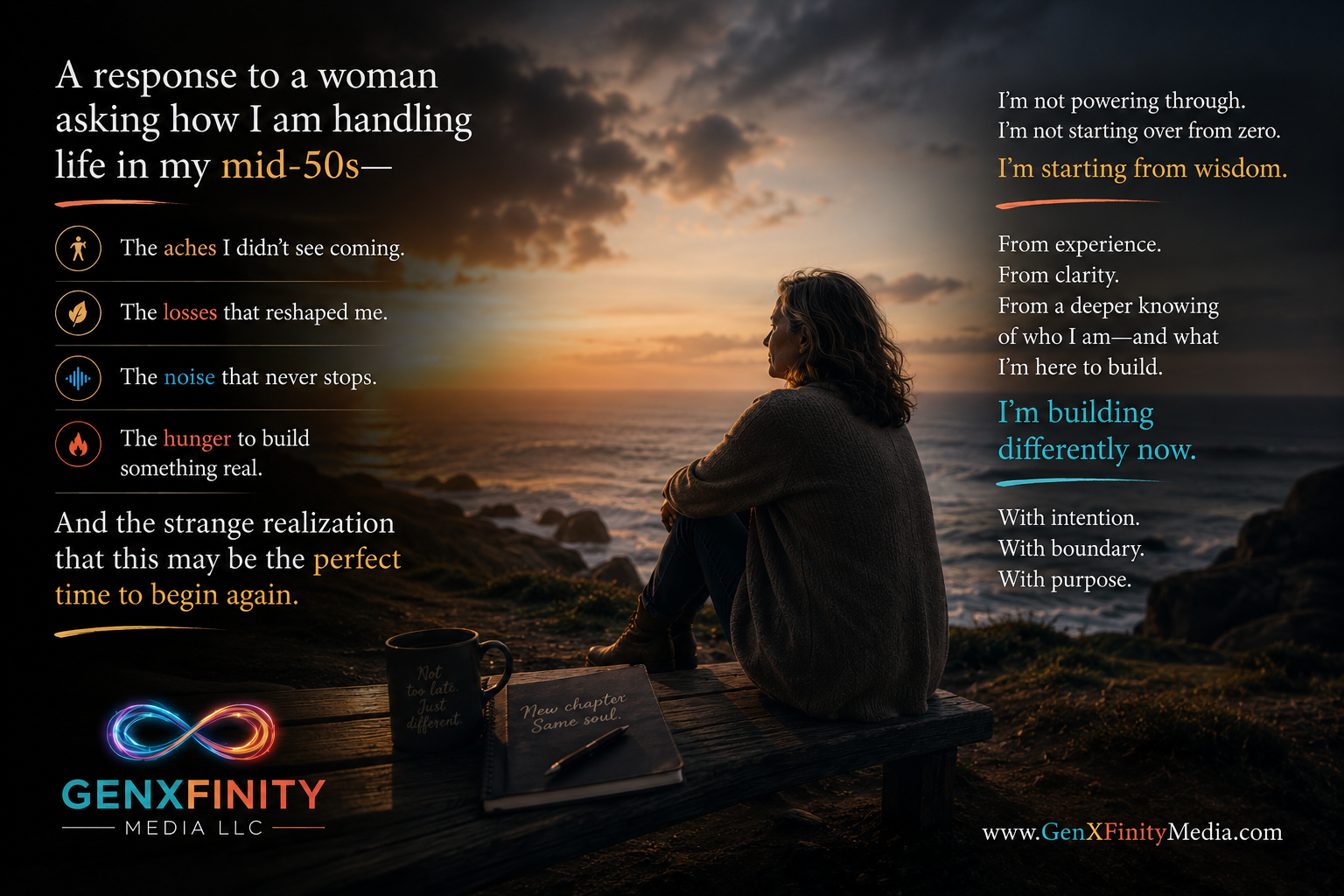
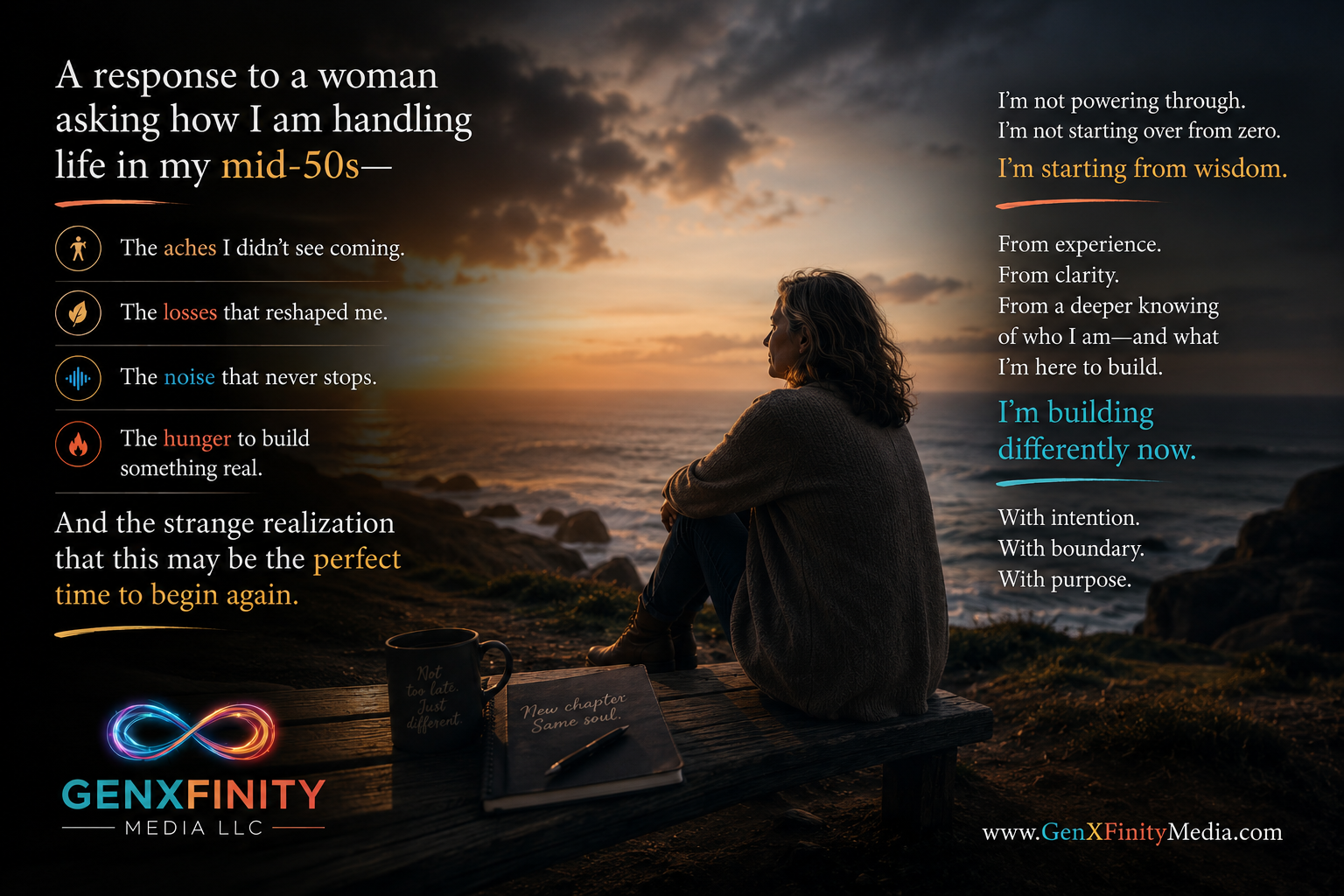
A response to a woman asking how I am handling life in my mid-50s — the aches, the losses, the noise, the hunger to build something real, and the strange realization that this may be the perfect time to begin again.
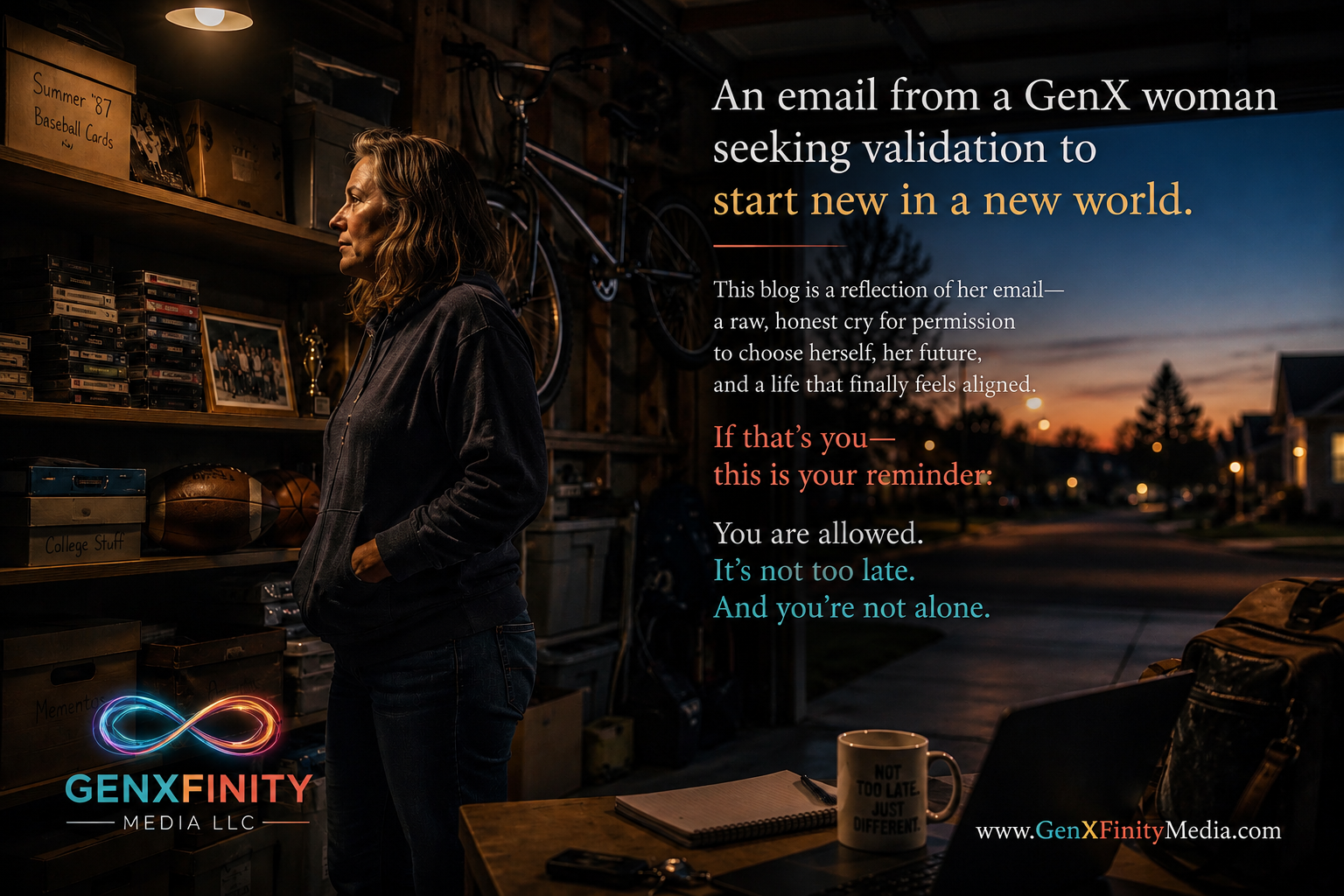
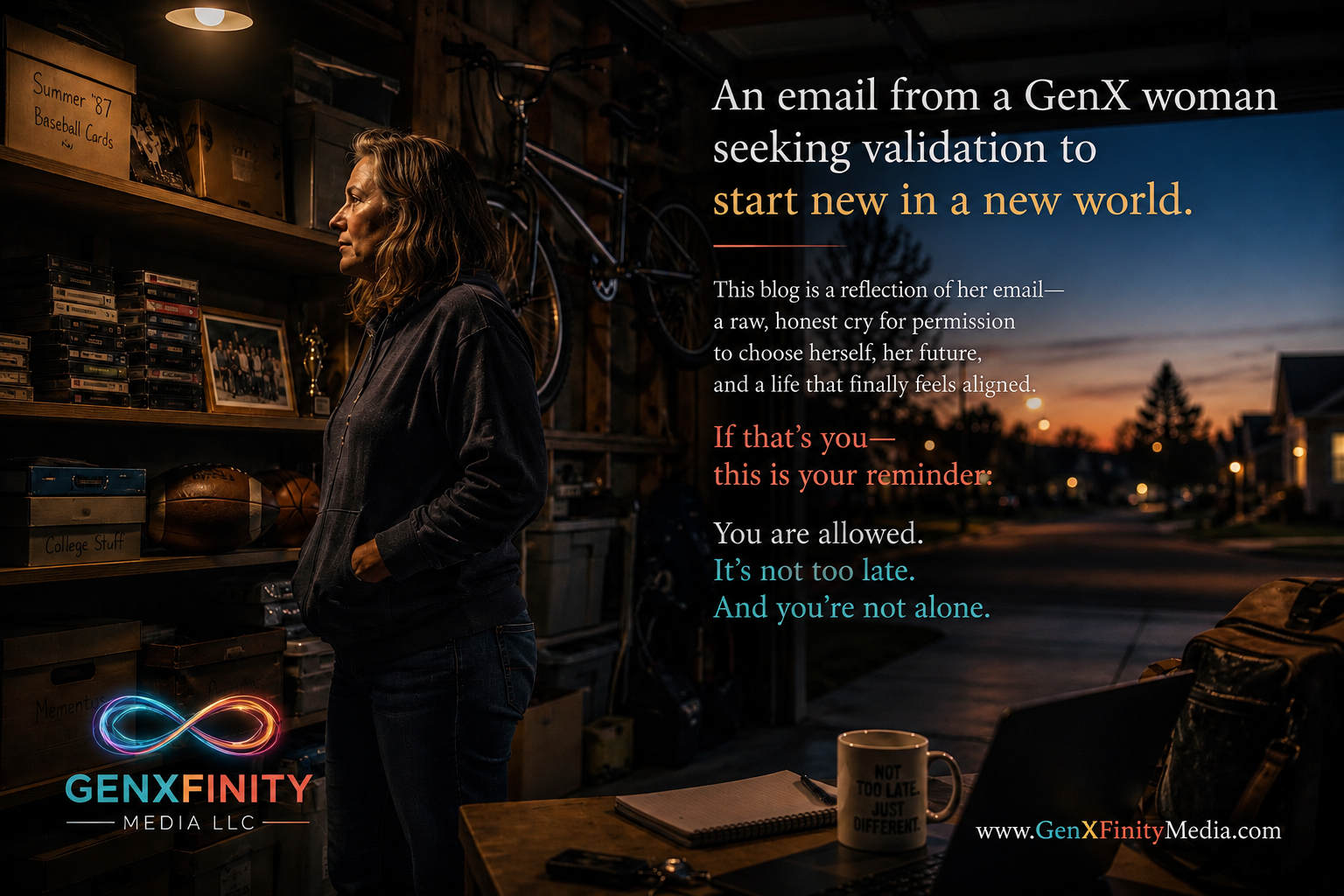
A woman recently sent me an email asking how I am handling life in my mid-50s.
Not financially.
Not professionally.
Life itself…
The emotional side of it.
The physical side of it.
The strange feeling of looking around one day and realizing the world no longer operates like the one you grew up preparing for.
I understood exactly what she meant.
Because I think a lot of Generation X are quietly trying to figure that out right now.
There’s a particular kind of exhaustion that arrives in this stage of life.
Not dramatic exhaustion.
The quieter kind.
The kind that builds over decades.
The kind that comes from adapting over and over again while pretending you’re fine.
We grew up in one world and aged into another.
We grew up riding bikes until the streetlights came on.
We memorized phone numbers.
We knocked on doors.
We sat in garages talking for hours without documenting it for strangers online.
We had friendships that existed without algorithms.
People talked to each other differently then.
Now everybody sounds like a press release.
Every opinion feels rehearsed.
Every interaction feels optimized.
Even ordinary life has started sounding branded.
People brand themselves now.
Market themselves.
Package themselves (self-included).
Somewhere along the way, sincerity became almost uncomfortable.
Generation X notices this shift because we remember when people still spoke casually without feeling like they were building an audience.
And while the culture was changing, most of us were busy building lives.
Working.
Raising children.
Holding marriages together.
Trying to survive recessions, layoffs, rising costs, and responsibilities that never seemed to slow down.
Then somewhere along the line, our bodies changed too.
Not overnight.
Just slowly enough to catch you off guard.
Your knees start talking to you in the grocery store.
Your back tightens after long drives.
You think strategically before lifting something heavy.
Recovery takes longer.
Sleep becomes valuable.
Peace becomes valuable.
By this age, people begin understanding the value of ordinary things differently.
A quiet house.
A healthy medical report.
A good conversation.
Energy when you wake up.
One more phone call with somebody you love.
The absence of those things changes people.
Especially after loss enters your life.
Parents die.
Friends disappear.
Children grow up and build lives of their own.
And nobody really prepares you for how emotionally disorienting that feels.
One day you realize an entire chapter of your life has ended quietly while you were busy managing responsibilities.
People do not talk enough about that part.
Not the dramatic grief.
The gradual kind.
The accumulation.
The feeling of becoming unfamiliar to yourself while staying responsible for everyone else.
I think a lot of people in their 50s walk around carrying grief they never fully processed because life kept moving.
That includes grief over the world itself changing.
Not because the past was perfect.
It wasn’t.
But there was something more grounded about it.
Life felt slower.
Conversations felt more sincere.
People were allowed to exist privately.
Not every thought needed to be announced.
Not every moment needed validation.
Now the noise never stops.
And I think many people my age are exhausted from pretending this level of noise feels normal.
Human beings were not designed to absorb this much information, comparison, outrage, advertising, and artificial urgency every day.
Eventually something inside starts pushing back.
That’s where I think many Gen X adults are right now.
Not trying to become younger.
Trying to reconnect with themselves.
Trying to remember who they were before life became entirely responsibility, stress, caregiving, work schedules, bills, and survival.
And maybe that is also why so many people in midlife suddenly feel the pull toward building something of their own.
Not because they have lost their minds.
Not because they are chasing internet fantasies.
Because after decades of working for companies, raising families, surviving setbacks, adapting to change, and carrying responsibility, many people finally realize they have developed something valuable that cannot be taught quickly.
Judgment.
Pattern recognition.
Discipline.
Resilience.
The ability to recover after disappointment.
The ability to read people.
The ability to survive uncertainty without collapsing emotionally.
You do not develop those things at twenty-five.
Those qualities are earned slowly through ordinary life.
Through showing up when you were tired.
Through going to work when your heart was broken.
Through raising children when money was tight.
Through burying people you loved and still waking up the next morning because life required it.
Through doing what had to be done before anyone applauded you for it.
That kind of experience becomes infrastructure.
And for many Generation X adults, there is a quiet realization beginning to happen.
The hunger is still there.
Not the reckless hunger of youth.
Something different.
A more focused hunger.
A hunger for excellence.
A hunger to build.
A hunger to succeed on your own terms after spending decades helping other systems succeed.
A hunger to find out whether there is still another chapter left.
And there is.
That does not mean it will be easy.
Starting something in your 50s requires nerve.
It requires humility.
It requires learning new tools, new platforms, new language, and new ways of reaching people.
It requires admitting you are both experienced and inexperienced at the same time.
That is not comfortable.
But it is honest.
And honesty is a strong foundation.
In many ways, this may be the perfect time for entrepreneurship.
Not because midlife is glamorous.
Because midlife is clarifying.
By this age, you know what waste feels like.
You know what bad leadership looks like.
You know what false promises sound like.
You know when people are performing.
You know when something has substance.
You know what it costs to keep building someone else’s dream while your own ideas sit quietly in the background waiting for permission.
At some point, you stop waiting for permission.
You begin to understand that the structure instilled in you early in life still has value.
Work ethic.
Follow-through.
Responsibility.
Common sense.
Respect for the process.
The ability to get up and do the work even when nobody is watching.
Those are not outdated traits.
Those are survival traits.
And in a world full of noise, they may become competitive advantages.
That’s part of why movement has become so important to me personally as I’ve gotten older.
Not movement tied to punishment or appearance.
Movement that makes me feel connected to myself again.
Movement that reminds me I am still alive inside this body instead of simply managing it.
I think many people in midlife are searching for that same feeling right now, whether they realize it or not.
Not perfection.
Not performance.
Something real.
Something grounding.
Something that cuts through the noise long enough for a person to hear themselves again.
Because despite what the culture tells us, life is not over in your 50s.
If anything, this may be the first time many of us are finally honest about what we want, what we are tired of, what we still believe in, and what we are no longer willing to postpone.
Maybe this is not the beginning of decline.
Maybe this is the age where illusion burns off.
Maybe this is the age where experience becomes fuel.
Maybe this is the age where the hunger comes back — not to prove something to the world, but to finally build something that feels like your own.
And maybe returning to yourself is not a step backward.
Maybe it is the beginning of your strongest chapter yet.
The Reinvention Nobody Prepared Generation X For
Starting Over When Time Moves Faster and the Life You Built Begins Asking Different Questions
There comes a point somewhere after fifty when life changes tone.
Not dramatically.
Not all at once.
Just enough to notice.
The phone rings less.
Or it rings late.
Some are helping aging parents through medication schedules, specialist appointments, and memory lapses. Others catch themselves reaching for a phone that can no longer call home.
The children may still need guidance, reassurance, or help getting established in an economy that feels harder than the one we entered. Or they’ve grown distant in the ordinary ways adulthood sometimes creates — careers, marriages, geography, exhaustion, life moving too fast for deeper conversations.
Meanwhile the mortgage still drafts on schedule.
Groceries cost more every few months.
The economy keeps reinventing instability and presenting it as normal.
And somewhere inside all of this, many Generation X adults are quietly confronting a question that arrives without warning:
Now that I’ve spent decades building a life for everyone else… what happens to the parts of me that waited?
Not abandoned.
Waited.
There is a difference.
We Followed the Blueprint We Were Given
Many Gen X men and women did exactly what they were taught to do.
Graduate.
Find work.
Marry young.
Start families.
Stay loyal.
Keep the lights on.
Push through difficulty privately.
For many, that path was not limitation.
It was commitment.
We came from an era where stability carried emotional weight. Divorce waves, layoffs, addiction, and economic volatility shaped many households during the seventies and eighties. A lot of people simply wanted to create solid ground for their children — something dependable, something calmer than what they inherited.
And many succeeded.
Children were raised.
Bills were paid.
Homes were maintained.
Families were carried forward through sheer persistence.
But responsibility has a way of consuming oxygen.
Years disappear into routines:
school pickups
double shifts
sports practices
aging parents
home repairs
doctor visits
commutes
taxes
recovering from one financial setback before the next one arrives
Then one day you look up and realize decades have passed at full speed.
Not wasted.
Spent.
Generation X Remembers a Different Kind of Freedom
What many people misunderstand about Generation X is that our nostalgia is not rooted in objects.
It is rooted in atmosphere.
We remember what it felt like to exist before constant visibility.
Before every opinion became public.
Before every moment became documentation.
Before identity turned into performance for strangers online.
We vanished for entire afternoons as teenagers.
No location tracking.
No smartphones.
No permanent digital trail.
You grabbed your bike and disappeared into neighborhoods until the streetlights flickered on.
You wandered malls for hours with friends and no agenda beyond movement itself.
Arcades glowed like tiny worlds hidden inside shopping centers. Music drifted from record stores into crowded hallways. Friday nights felt open-ended in a way difficult to explain to younger generations raised inside notification culture.
Generation X may have been the last group to experience prolonged psychological privacy during adolescence.
And that shaped us.
We learned self-reliance early.
We learned how to sit alone with our thoughts.
We learned how to improvise.
We learned how to tolerate uncertainty without immediate reassurance.
Now we live inside a culture that rarely stops talking.
Perhaps that is part of why so many people our age feel mentally exhausted in ways difficult to articulate.
Modern life does not simply demand attention.
It harvests it.
Reinvention After Fifty Carries a Different Emotional Weight
The internet romanticizes reinvention.
Real reinvention is usually quieter than that.
Especially later in life.
By fifty, risk is no longer theoretical. Choices affect retirement, marriages, healthcare, savings, family stability, physical energy.
You understand consequence differently because you have already lived through enough of it.
Generation X entered adulthood believing loyalty and hard work still meant something structurally. Then many watched pensions disappear, corporations downsize entire departments overnight, housing markets collapse, and industries digitize faster than people could emotionally adapt.
That leaves a mark.
It changes how people approach uncertainty.
Which is why many Gen X adults are rebuilding themselves carefully instead of loudly.
At kitchen tables after everyone goes to bed.
Inside converted spare bedrooms.
Learning editing software, online business systems, video production, new technologies, entrepreneurship.
Not because they suddenly became dreamers.
Because survival by itself eventually stops feeling sufficient.
There comes a point where people begin asking whether they still recognize themselves beneath decades of obligation.
Nostalgia Hits Harder After Fifty Because the Body Remembers Too
A song plays in a grocery store and suddenly your nervous system unlocks a forgotten version of yourself.
Not younger.
Lighter.
Before chronic stress settled into the shoulders.
Before movement became strategic.
Before exhaustion followed you into the morning.
That reaction is not sentimentality.
It is stored sensory memory.
Generation X carries unusually strong emotional associations with music because music accompanied nearly every phase of our independence:
driving alone for the first time
late-night MTV
roller rinks
parking lot conversations
concert tickets folded into wallets
cassette tapes worn thin from repetition
songs recorded off the radio while hoping the DJ stayed quiet through the intro
Those memories are attached to motion, freedom, anticipation, possibility.
Which is why nostalgia can feel almost physical after midlife.
The body remembers what unrestricted living once felt like.
And many people quietly mourn how difficult that feeling has become to access consistently.
Not because life is hopeless.
Because life became compressed.
Scheduled.
Measured.
Managed.
The nervous system rarely gets to exhale anymore.
The Fear Was Never Aging
It Was Losing Independence
Generation X understands mortality.
Most of us encountered instability young enough that permanence never felt guaranteed anyway.
But dependence feels different.
That is the shadow hanging quietly in the background for many people entering this stage of life.
The fear of becoming physically limited.
Financially trapped.
Burdensome to others.
Unable to move freely through the world.
Especially for a generation raised on movement.
Skateboards.
Bikes.
Pickup games.
Road trips.
Concerts.
Physical freedom before physical caution entered the equation.
And yet something unexpected is happening too.
Many people are becoming more honest with age.
Less performative.
Less interested in appearances.
Less willing to participate in exhausting social theater.
There is a certain clarity that only arrives after enough life strips illusion away.
Not cynicism.
Precision.
You begin understanding what actually matters.
Maybe Reinvention Is Not About Becoming Someone New
Maybe it is about recovering the parts of yourself that survival forced into the background.
The creative part.
The curious part.
The ambitious part.
The calm part.
The version of you that existed before exhaustion became your baseline setting.
Generation X stands in a strange historical position.
We remember analog life yet must function inside relentless digital life.
We understand solitude but live in a culture of constant exposure.
We were taught independence while aging into systems increasingly designed around dependency.
That tension lives quietly inside millions of people right now.
And perhaps that is why so many are beginning again.
Not impulsively.
Not chasing youth.
Not trying to relive the past.
But trying, with hard-earned wisdom and fewer illusions, to build lives that still feel meaningful while there is still time left to live them.