GENXFINITY MAGAZINE
Stories for the generation that still has more to give.
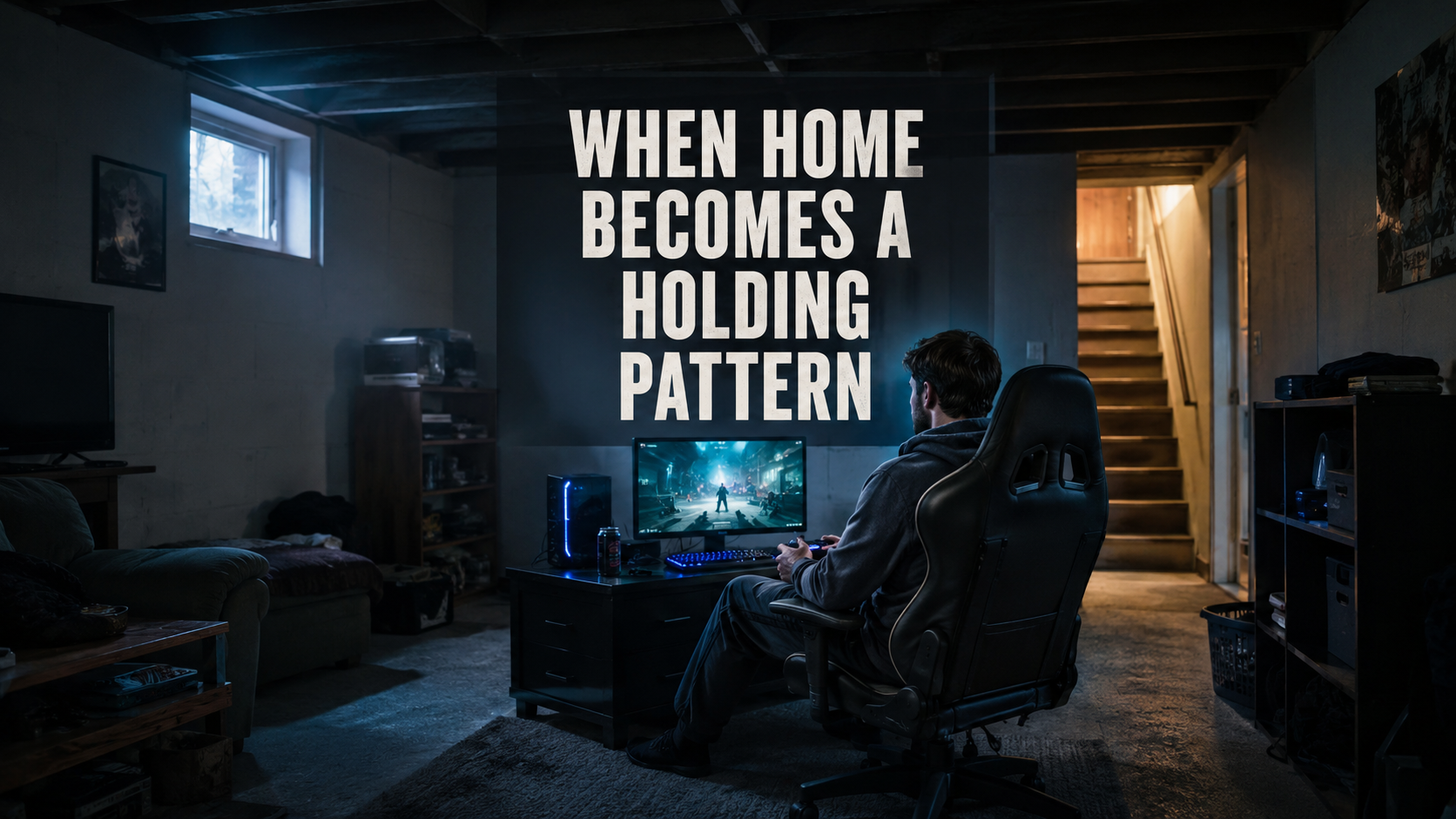
When Home Becomes a Holding Pattern
Living with family can be a practical choice. The harder question is whether everyone has a way forward. A grounded look at shared expectations, contribution, and the conversations that help adult children and parents plan the next step.
How families can turn support into a workable plan for contribution, capability, and greater independence.
There is a bedroom at the end of the hall that was supposed to be empty by now. Life had other plans.
Maybe the person in it is working and saving. Maybe they came home after a job loss, an illness, or the end of a relationship. Maybe the family has chosen to share a home for the long run.
Or perhaps everyone is frustrated because the arrangement has no clear expectations and no direction. The bills keep arriving. The household work keeps falling to the same person. Conversations about what happens next end with “soon.”
That is the situation worth examining. The useful question is what this arrangement is helping everyone build.
Start with the circumstances, not the stereotype
Housing costs are a real obstacle. Harvard's Joint Center for Housing Studies found that 49% of U.S. renter households spent more than 30% of their income on housing in 2024. Read its analysis of housing affordability.
Living with parents is also an established part of the picture. The Census Bureau reported that, in 2022, 19% of men and 12% of women ages 25–34 lived in a parent's home. Those are figures for 2022, reported in its May 2024 article. Read the Census account of living arrangements.
And support often runs in both directions. In Pew Research Center's 2024 report, 72% of adults ages 18–34 who lived with a parent said they contributed toward household expenses, rent, or the mortgage. Read Pew's findings on financial help and independence.
An address tells us very little about a person's effort. A household conversation can tell us much more: What is each person contributing? What is difficult right now? What would progress look like?
Buying a house is not the entry exam for adulthood
A first independent home might be a rented room or an apartment shared with friends. It may involve used furniture and a careful budget. For another family, continuing to share a home may be the most sensible choice.
Responsibility can grow in any of those settings. Managing appointments, understanding bills, doing household work, learning a skill, earning income where possible, and caring for a relative all count.
The important distinction is between needing help and handing over every manageable responsibility. If a parent is doing something the adult child could learn to handle, that is a place to begin.
Ask, “What can you take ownership of this month?” Then make enough room for the person to do it.
Talk about the work that is getting missed
Gaming often becomes the visible target in these arguments. The screen is on while the chores are undone, so the screen becomes the explanation for everything.
Start with what you can observe. Was an agreed task completed? Was an appointment missed? Did somebody spend money that was needed for a shared bill? Those questions give a family something concrete to discuss without pretending to know what is happening inside another person's head.
A hobby can be part of a full, responsible life. It becomes a household concern when it repeatedly displaces agreed responsibilities, whether the activity is gaming, scrolling, or something else.
Gaming disorder is a separate clinical question. The World Health Organization describes impaired control, gaming taking priority over other activities, and continuing despite negative consequences. Diagnosis requires significant impairment and ordinarily a pattern evident for at least 12 months. A family dispute about chores does not establish that diagnosis. Read WHO's explanation of gaming disorder.
When someone is struggling to function, seek appropriate professional support as well as discussing household expectations. A label shouted across the kitchen will not tell you what help is needed.
Treat a proposed career like a proposed career
If an adult child wants to build a gaming, streaming, or creative career, take the proposal seriously enough to ask practical questions.
What work are they producing? What skills are they developing? Is there an audience, a customer, or a paying opportunity? What has the effort earned after expenses? How long can the household afford to support the experiment?
An early venture may not earn enough to live on. That makes a budget, milestones, and a review date especially useful. Enthusiasm deserves a chance to become a plan.
The same questions belong beside a parent's business idea. Standards are easier to respect when they apply across generations.
Put the arrangement on paper
Choose a calm time to talk. Begin with the actual household costs and workload, then work toward an agreement everyone understands.
A useful agreement can cover:
Money: a contribution that reflects income, essential expenses, and ability.
Household work: specific recurring tasks, with a clear owner and timing.
Work or learning: practical next steps toward employment, training, education, or another agreed goal.
Personal administration: who handles appointments, transport, applications, and bills, with support where needed.
Privacy and shared space: quiet hours, guests, and respect for each adult's belongings and decisions.
A review date: when everyone will discuss what is working and what needs changing.
Be concrete. “Help more” is difficult to measure. “Handle dinner and cleanup on Tuesday and Thursday” gives both people something they can recognize.
An agreement should also acknowledge unpaid care and disability-related needs. Fair contribution is about the household's real circumstances, not identical dollar amounts or tasks.
Parents have a part in this, too
It is worth looking at what happens after the agreement. Does the parent take over before the adult child has a chance to try? Are expectations stated clearly, or revealed through frustration? Are decisions genuinely handed over, or repeatedly reversed?
Those are behaviors a family can change. We do not have to assign motives such as selfishness or fear of being alone to address them.
Support might mean demonstrating how to compare a bill, then letting the other person handle the next one. It might mean helping prepare for an appointment while leaving the adult to make the call. It can include admitting that a previous arrangement no longer works for the parent.
Respect goes both ways. An adult receiving help should take agreed responsibilities seriously. A parent offering help should respect adult autonomy and be honest about what they can sustain.
Plan for a change in support
Ask what would happen if your household’s usual arrangements changed. A parent could become ill, income could fall, or a caregiver could need a break.
Who knows which bills are due? Who understands the household budget? What skills or support would each person need? Where ongoing care is necessary, what backup arrangements should be explored?
Preparing for change can be an act of care. The aim is to make fewer essential things depend on one person always being available.
Give the next month a purpose
Begin with one conversation and a short, realistic agreement. Pick two or three responsibilities, identify any help needed to carry them out, and set a date to review progress.
If the plan stalls, examine why. An unclear task, a missing skill, a health concern, and repeated disregard for an agreement call for different responses. Stay specific enough to tell them apart.
Living together can be a bridge, a long-term choice, or part of a care arrangement. What matters is whether the people in the home have a voice, share responsibility as they are able, and understand what they are working toward.
The goal is greater capability and a fairer household. That is progress you can begin building before anyone packs a box.
About this article
Cultural commentary with linked research and practical discussion prompts. Household examples are illustrative. Persistent difficulties with daily functioning warrant individualized professional support.
Related reading: The Last Version of Us and The Career Pivot After 50.