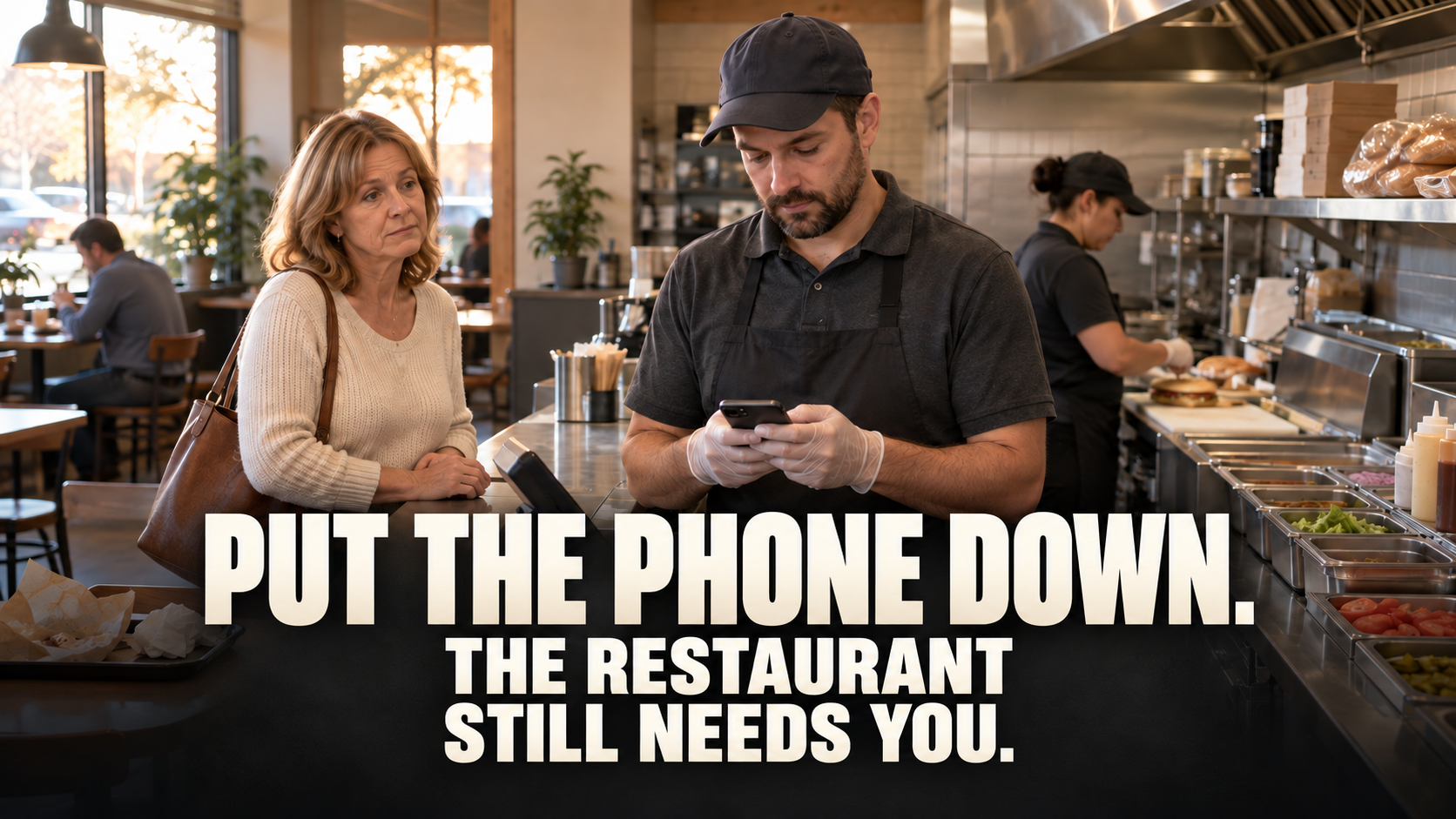
Put the Phone Down. The Restaurant Still Needs You.
What nearly four decades in food service taught me about attention, accountability, and the standards we cannot afford to lose.
By Christine Silva | GenXFinity Media
Updated September 2026 from an article originally published November 28, 2017.
In my original article, I described a sandwich shop in the middle of the afternoon: employees on their phones, some wearing food-handling gloves, while the dining room needed attention. Papers on the floor. Dirty tables. Folded napkins holding a table steady.
What bothered me was the work sitting in plain sight, waiting for someone to care enough to do it.
Nearly nine years later, I wish I could say that concern feels dated. From what I continue to observe, it feels more urgent.
Personal phones have become a serious problem in the restaurant environment. But the damage reaches beyond the person looking down at a screen. It reaches the customer waiting to be acknowledged, the coworker picking up the slack, and the manager whose silence tells everyone that this is acceptable.
I have spent too much of my life in this industry to shrug at that.
My first job was in a drive-through restaurant. I grew up in the 1970s and 1980s, riding bikes, playing sports, and spending much of my time outside. The movement and pace of restaurant work suited me. There was something satisfying about finding your rhythm in the chaos and becoming part of a team that could handle it together.
Over the following decades, I learned to operate restaurants with millions of dollars in sales and take responsibility for multiple locations. I learned how staffing, training, food safety, service, and costs connect. A weak decision in one area rarely stays there.
I also learned that accountability applies to the person in charge.
Early in my management career, I was demoted. That belongs in this story because I am asking other people to accept a standard I have also had to answer to. A title does not make your performance good enough. You still have to do the work.
The best lessons I carried forward were practical: know your operation, develop your people, explain your expectations, and follow through.
Those lessons still apply in 2026.
Attention is part of the job.
A restaurant requires people to notice what is happening around them. The customer approaching the counter. The order that needs checking. The teammate carrying something hot. The dining room that needs cleaning before the next rush.
When personal scrolling interrupts those responsibilities, “just checking my phone” becomes somebody else’s delay or additional work.
Research supports taking that distraction seriously. In a controlled attention experiment, researchers found that phone notifications could impair performance even when participants did not pick up their phones. That experiment did not measure restaurant service or establish an industry-wide decline. It does, however, give us reason to question the assumption that an ignored notification is harmless. Read the research explanation by study author Cary Stothart.
There is also a difference between using a device to complete an assigned task and using it for personal entertainment during service. Digital tools can help a restaurant operate. The purpose, timing, and handling of the device matter.
Managers need to make those boundaries clear, including how employees can respond to an emergency or an approved need. Then managers need to follow those boundaries themselves.
A phone policy loses credibility when the person enforcing it spends the shift scrolling.
Some of the consequences are bigger than bad service.
In the early 1990s, I worked for the company involved in the devastating hamburger-associated E. coli outbreak. The CDC describes the 1993 outbreak as sickening more than 700 people across four states and killing four children. CDC’s account of the outbreak.
That history is part of why I take food safety so seriously. There are families on the other side of our procedures.
I am not suggesting that phones caused that outbreak. It happened long before today’s smartphone habits. The lesson is that failures in food handling can carry consequences far beyond a complaint or a refund.
The sight of a food worker handling a phone with gloves on should prompt an immediate question: what happens before those hands return to food?
Gloves need proper handling, too. The FDA’s model Food Code addresses handwashing after activities that contaminate hands and discarding single-use gloves when soiled or when interruptions occur in their use. Applied to phone handling during food preparation, the operational lesson is to stop and restore proper hand hygiene and glove use before resuming the task. The Food Code is a model; applicable requirements depend on jurisdiction. FDA Food Code, sections 2-301.14 and 3-304.15.
Training needs to explain that connection. An employee should understand who the procedure protects and why it matters, then demonstrate it correctly.
A sense of urgency has to be taught.
My original article spent considerable time comparing generations. Looking back, the useful lesson is in the skills we pass on.
Being young does not make someone careless. Being older does not make someone competent. Every generation has people who take pride in their work and people who need stronger guidance or accountability.
A sense of urgency means recognizing what needs attention and responding safely, accurately, and promptly. It means knowing the next priority. It means being ready for demand instead of waiting until the operation is overwhelmed.
That requires instruction and practice. “Move faster” tells an employee very little. Show them how to organize a station, sequence a task, communicate a delay, and prepare for the next customer. Let them practice. Watch. Correct. Explain.
Someone who has never been taught how to see the work around them needs more than a manager’s frustration.
And someone who has been taught, has the tools, and repeatedly chooses to disregard the standard needs consistent accountability.
Leadership cannot outsource its example.
When I see an operation struggling, I want to understand the decisions above the front line as well as the behavior on it.
Who trained the manager? Who checks whether that training carries into the shift? Are staffing and workload realistic? Does the team have functioning equipment and time to complete essential tasks? Does anyone act when employees raise a concern?
A written policy cannot answer those questions for you. You have to spend time in the operation.
Restaurant economics also deserve an honest place in this discussion. The National Restaurant Association’s 2026 outlook identifies persistent operating costs, restrained consumer spending, and difficulty finding experienced managers and chefs. Those pressures help explain why running a restaurant remains difficult. They also mean that blaming phones for every industry problem would miss other significant causes. National Restaurant Association’s 2026 industry outlook.
High standards need investment behind them. Employees need adequate training, workable staffing, breaks, respectful treatment, and the equipment to do their jobs. Owners cannot demand excellence while withholding the conditions that make it possible.
Employees also have a responsibility to give the work their attention. Both obligations belong in the same conversation.
What I would tell the next generation of restaurant leaders today.
Start by observing a real shift. Follow an order through the operation. Watch how customers are acknowledged, how food is handled, and how the team communicates. Listen to the people doing the work.
Address immediate safety concerns first. Then choose specific operational problems to improve. Name the person responsible, provide the training and resources, and establish how you will check progress.
Teach managers before expecting them to teach everyone else. Have people demonstrate what they learned. Keep coaching until the behavior is reliable, and revisit it when performance slips.
Make personal phone expectations explicit. Define appropriate work use and exceptions. Apply the standard consistently, including to leadership.
Recognize the employees who do the job well. Dependable people should not become the permanent solution to everyone else’s lack of effort. Give them support, development, and a reason to stay.
Above all, explain why. Why we check. Why we clean. Why we prepare. Why a customer should never have to compete with our personal feed to get our attention.
I still believe restaurant work deserves pride. There is dignity in feeding people safely, running an organized shift, and helping someone become capable of more than they thought they could do.
The message I wrote nearly nine years ago still stands: put your phone away, lead by example, and hire people who know how to develop a team.
To that, I would add this: the standards you remember will only survive if you teach them to someone else.
The next customer is walking through the door.
LOOK UP!!!