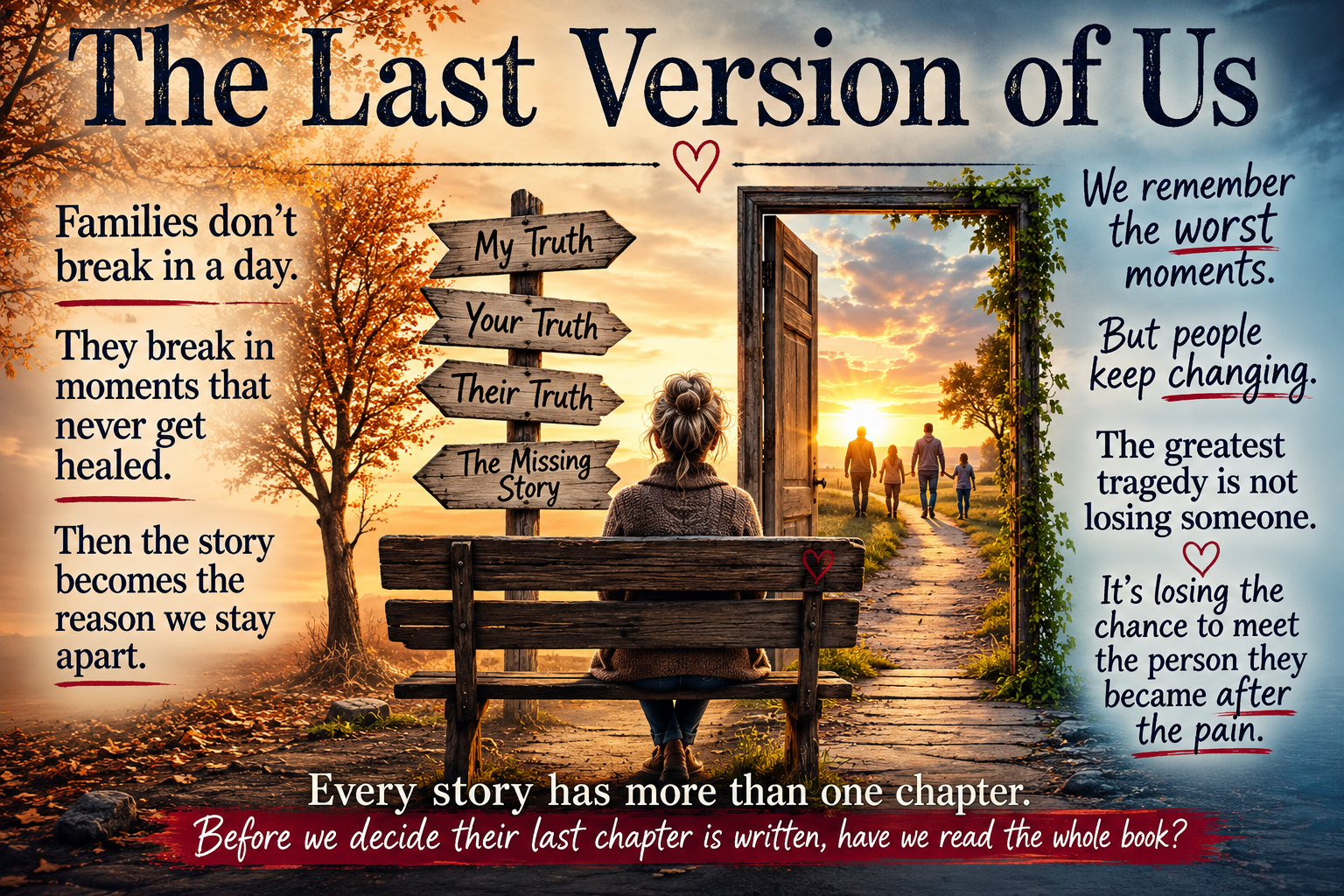

The Last Version of Us: Why Families Become Strangers While Everyone Is Still Alive
Family estrangement is a grief without a funeral. Parents, adult children, grandparents, and extended families often carry different versions of the same story. This article explores generational patterns, accountability, family systems, and whether people deserve to be remembered as more than the moment everything broke.
A reflection on family estrangement, generational wounds, accountability, and the stories we inherit
Family is often the first place we experience love. It can also be the first place we experience pain.
Maybe that is why losing family while they are still alive creates a grief so difficult to explain.
There is no funeral.
No final goodbye.
No moment where people gather together and acknowledge what disappeared.
The person is still somewhere in the world. Their birthday still comes. Their memories still exist. Their voice can still be remembered.
But the relationship is gone.
A parent wonders how years of sacrifice became silence.
An adult child wonders why distance became necessary.
A grandparent wonders if the next generation will inherit only one chapter of a story they never lived.
Everyone has memories. Everyone has wounds.
And often, everyone believes they were the one left behind.
⸻
The Photograph Where Time Stopped
When people are hurt, they remember.
It is part of being human. Pain teaches. Pain protects.
But sometimes the moment designed to protect us becomes the place we stay.
A person becomes frozen in the moment they hurt us.
The argument. The betrayal. The mistake. The words spoken. The words never said.
Everything before that moment begins competing with everything after it.
The parent asks:
“How did my worst moments erase everything I gave?”
The adult child asks:
“How can you not understand those moments changed me?”
Both questions matter.
They usually break when people stop believing the other person understands their pain.
⸻
The Parenting Manual Nobody Received
Before parents were parents, they were children.
They watched. They learned. They inherited.
How do families argue?
How do families apologize?
How is love expressed?
What happens when someone makes a mistake?
Many previous generations grew up in homes where survival was the priority.
Love was often action.
Work hard. Provide. Protect. Keep moving.
A full refrigerator was love.
Working overtime was love.
Showing up was love.
Many people were not taught to explain pain.
They were taught to endure it.
Then those children became parents.
They raised families using the tools they inherited.
Years later, some adult children looked at those tools and said:
“These hurt me.”
And perhaps one of the most complicated questions in family history appeared:
“How do you give something nobody ever showed you?”
⸻
Survival Skills in a Changing World
Every generation tries to correct the one before it.
A parent who experienced hardship may prioritize security.
A parent who experienced judgment may try to prepare a child for criticism.
A parent who understands how cruel the world can be may try desperately to toughen a child for it.
The message intended:
“I do not want you to hurt the way I did.”
The message received:
“You do not understand who I am.”
Both can be true.
Intent explains where behavior came from.
Impact explains what it felt like.
Neither cancels the other.
⸻
When Protection and Control Look the Same
Parenting begins with responsibility.
Protect. Teach. Guide. Warn.
Then adulthood arrives, and the relationship changes.
Authority becomes influence. Rules become advice. Protection becomes perspective.
That transition is difficult.
Parents sometimes mistake fear for wisdom.
Adult children sometimes mistake wisdom for control.
A parent’s experience does not guarantee they are right.
An adult child’s independence does not guarantee they cannot be wrong.
Growth requires both sides to ask:
“What am I not seeing?”
⸻
When Love Says Something Difficult
Not every painful conversation is harm.
Sometimes love comforts. Sometimes love confronts.
Sometimes the person willing to risk an uncomfortable conversation is the person deeply invested in the outcome, like a mother or a father.
But delivery matters.
A truth delivered without compassion can become criticism.
A concern delivered without listening can become control.
And independence without reflection can become avoidance.
The person speaking must ask:
“How did my words affect them?”
The person listening must ask:
“Am I rejecting this because it is untrue, or because it is uncomfortable and I don’t want to look at the fact that what is being said to me may very well be true”.
⸻
The Family Around the Fracture
Estrangement rarely happens in isolation.
Families are systems, generations of systems built by our ancestors and the cultures they were raised in.
When one relationship breaks, every surrounding relationship responds.
Parents.
Children.
Grandparents.
Aunts.
Cousins.
Friends.
Partners.
In-laws.
Each person carries influence.
Sometimes these voices become bridges.
They protect. They support.
They help establish necessary boundaries.
But sometimes they (those in their specific family systems) unintentionally (or intentionally) become walls.
They preserve one version of events. They reinforce pain without reflection. They allow the broken relationship to become normal.
A wise supporter does not ask only:
“Who hurt you?”
They also ask:
“What else might be true?”
⸻
When Families Adapt to Absence
One of the least discussed parts of estrangement is how quickly families reorganize around loss.
The holidays continue. The gatherings continue. The conversations and the gossip continue.
The missing person becomes part of the new normal. Sometimes this distance is necessary.
Some relationships cannot continue without change.
But sometimes families learn how to live around wounds instead of examining whether healing is possible.
Maintaining connection with one person should not require rejecting another.
Support should not require permanent division.
⸻
The Adult Child’s Truth
Parents must face something difficult.
Love does not erase harm. Good intentions do not erase impact.
A parent may have provided. Protected. Sacrificed. Tried. And still caused pain.
Children experience actions more than intentions.
One of the hardest questions a parent can ask is:
“What was it like to be loved by me?”
And then have the courage to hear the answer.
⸻
The Parent’s Truth
Adult children must also face something difficult.
Parents are not only parents. They are people. They had childhoods before their children existed. They carried fears. Lessons. Survival patterns. Unfinished healing.
Understanding this does not remove accountability.
But context matters.
A person’s worst chapter may be part of their story.
But is it the entire book?
⸻
The Grandchildren Who Inherit the Silence
Estrangement does not stop with two people. It moves forward.
Grandchildren inherit missing pieces. Stories never told. Traditions never shared.
Histories never explained.
Sometimes that separation protects the future. Sometimes it is necessary.
But sometimes a generation inherits the ending of a story without ever knowing the beginning.
⸻
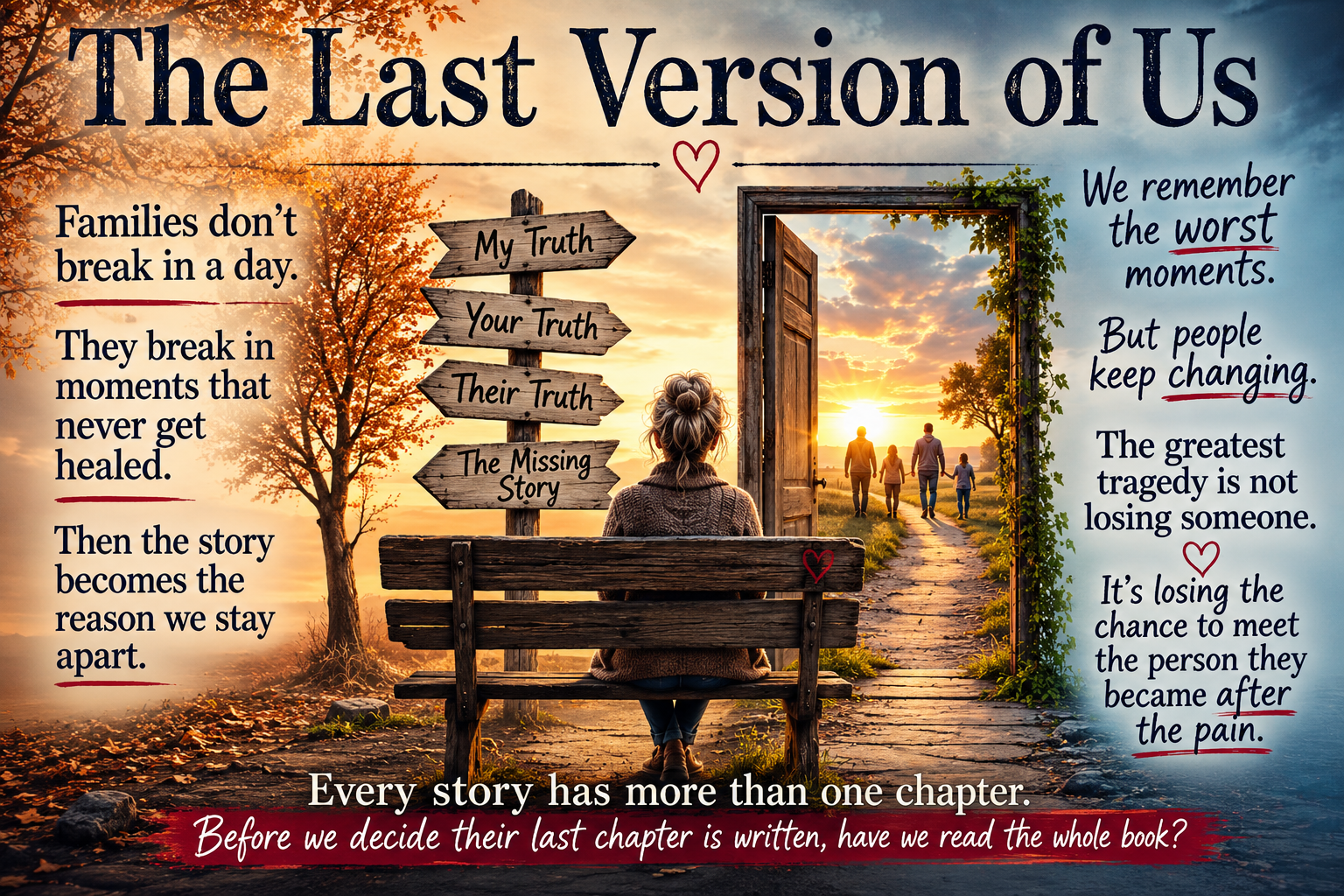
The Last Version of Us
Every person hopes to be remembered fairly.
Not only by their greatest failure.
Not only by their biggest mistake.
Not only by the moment someone decided who they were.
But fully.
The love.
The hurt.
The lessons.
The growth.
The person they became afterward.
Families can spend years asking:
“Who caused the wound?”
Maybe another question belongs beside it:
“Who are we now?”
Because human beings are not one chapter.
They are the entire book.
And sometimes the greatest tragedy is not that people stopped loving each other.
It is that they changed into people who might finally understand each other —
but never met again.
The tragedy of estrangement.