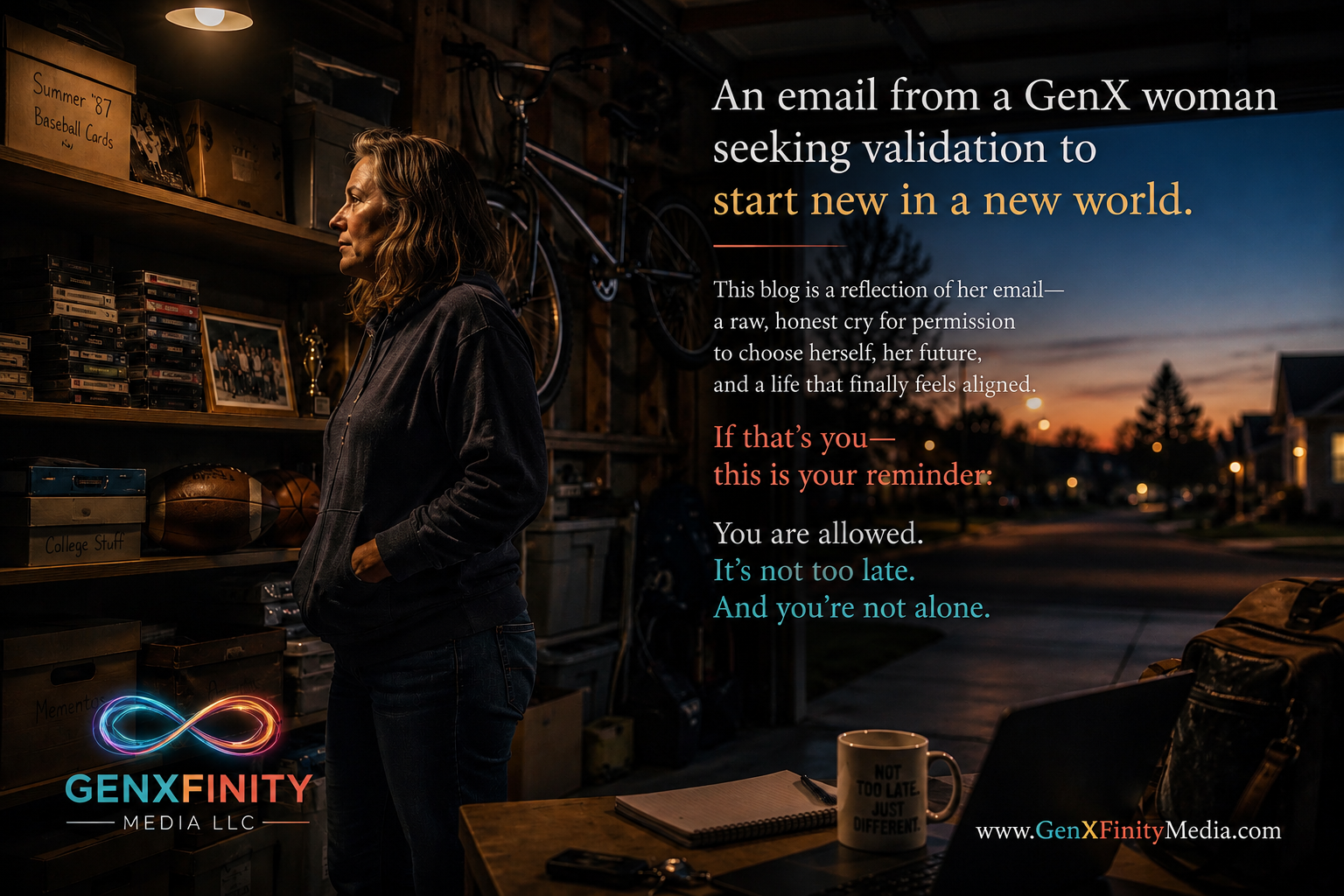

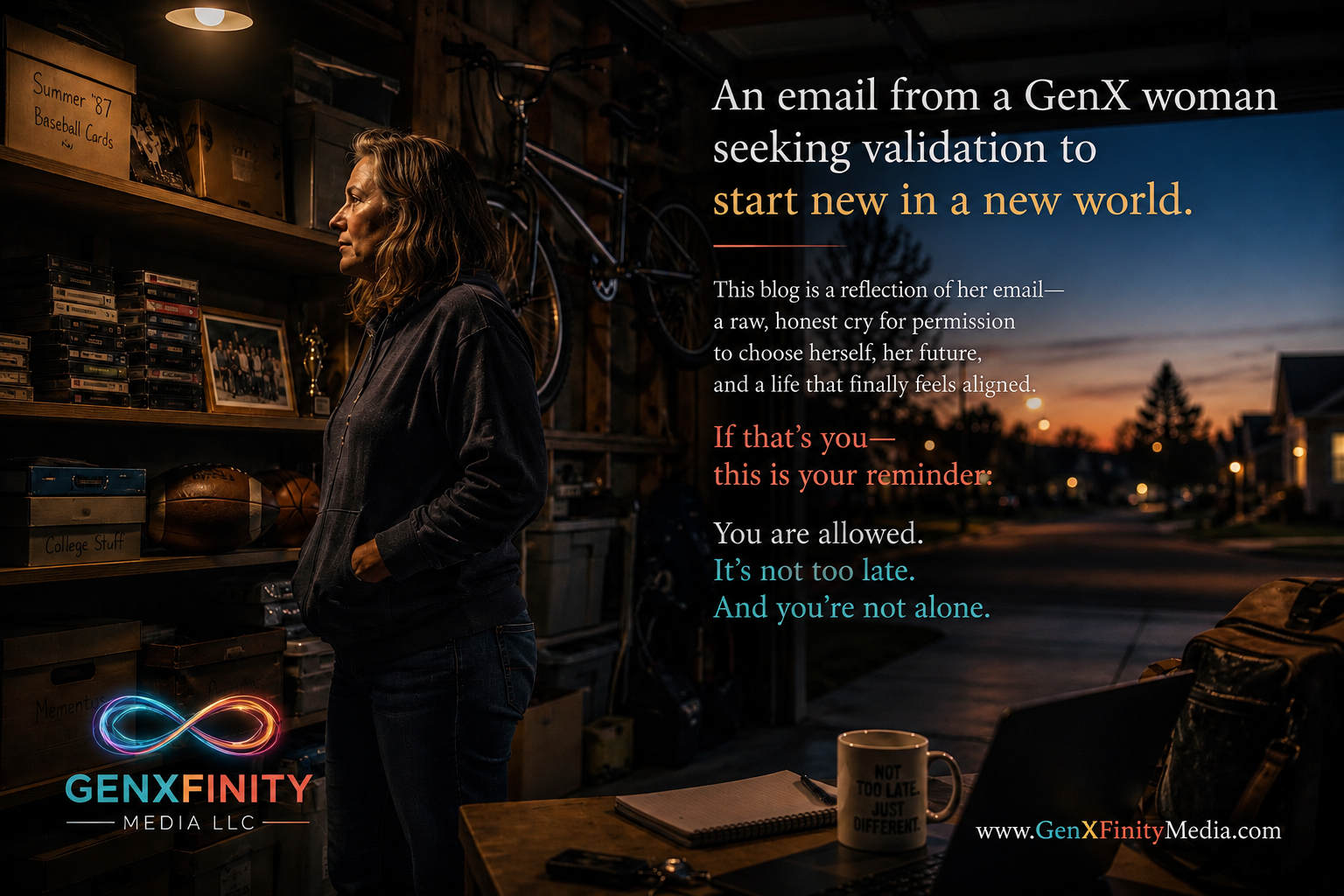
The Reinvention Nobody Prepared Generation X For
Starting Over When Time Moves Faster and the Life You Built Begins Asking Different Questions
There comes a point somewhere after fifty when life changes tone.
Not dramatically.
Not all at once.
Just enough to notice.
The phone rings less.
Or it rings late.
Some are helping aging parents through medication schedules, specialist appointments, and memory lapses. Others catch themselves reaching for a phone that can no longer call home.
The children may still need guidance, reassurance, or help getting established in an economy that feels harder than the one we entered. Or they’ve grown distant in the ordinary ways adulthood sometimes creates — careers, marriages, geography, exhaustion, life moving too fast for deeper conversations.
Meanwhile the mortgage still drafts on schedule.
Groceries cost more every few months.
The economy keeps reinventing instability and presenting it as normal.
And somewhere inside all of this, many Generation X adults are quietly confronting a question that arrives without warning:
Now that I’ve spent decades building a life for everyone else… what happens to the parts of me that waited?
Not abandoned.
Waited.
There is a difference.
We Followed the Blueprint We Were Given
Many Gen X men and women did exactly what they were taught to do.
Graduate.
Find work.
Marry young.
Start families.
Stay loyal.
Keep the lights on.
Push through difficulty privately.
For many, that path was not limitation.
It was commitment.
We came from an era where stability carried emotional weight. Divorce waves, layoffs, addiction, and economic volatility shaped many households during the seventies and eighties. A lot of people simply wanted to create solid ground for their children — something dependable, something calmer than what they inherited.
And many succeeded.
Children were raised.
Bills were paid.
Homes were maintained.
Families were carried forward through sheer persistence.
But responsibility has a way of consuming oxygen.
Years disappear into routines:
school pickups
double shifts
sports practices
aging parents
home repairs
doctor visits
commutes
taxes
recovering from one financial setback before the next one arrives
Then one day you look up and realize decades have passed at full speed.
Not wasted.
Spent.
Generation X Remembers a Different Kind of Freedom
What many people misunderstand about Generation X is that our nostalgia is not rooted in objects.
It is rooted in atmosphere.
We remember what it felt like to exist before constant visibility.
Before every opinion became public.
Before every moment became documentation.
Before identity turned into performance for strangers online.
We vanished for entire afternoons as teenagers.
No location tracking.
No smartphones.
No permanent digital trail.
You grabbed your bike and disappeared into neighborhoods until the streetlights flickered on.
You wandered malls for hours with friends and no agenda beyond movement itself.
Arcades glowed like tiny worlds hidden inside shopping centers. Music drifted from record stores into crowded hallways. Friday nights felt open-ended in a way difficult to explain to younger generations raised inside notification culture.
Generation X may have been the last group to experience prolonged psychological privacy during adolescence.
And that shaped us.
We learned self-reliance early.
We learned how to sit alone with our thoughts.
We learned how to improvise.
We learned how to tolerate uncertainty without immediate reassurance.
Now we live inside a culture that rarely stops talking.
Perhaps that is part of why so many people our age feel mentally exhausted in ways difficult to articulate.
Modern life does not simply demand attention.
It harvests it.
Reinvention After Fifty Carries a Different Emotional Weight
The internet romanticizes reinvention.
Real reinvention is usually quieter than that.
Especially later in life.
By fifty, risk is no longer theoretical. Choices affect retirement, marriages, healthcare, savings, family stability, physical energy.
You understand consequence differently because you have already lived through enough of it.
Generation X entered adulthood believing loyalty and hard work still meant something structurally. Then many watched pensions disappear, corporations downsize entire departments overnight, housing markets collapse, and industries digitize faster than people could emotionally adapt.
That leaves a mark.
It changes how people approach uncertainty.
Which is why many Gen X adults are rebuilding themselves carefully instead of loudly.
At kitchen tables after everyone goes to bed.
Inside converted spare bedrooms.
Learning editing software, online business systems, video production, new technologies, entrepreneurship.
Not because they suddenly became dreamers.
Because survival by itself eventually stops feeling sufficient.
There comes a point where people begin asking whether they still recognize themselves beneath decades of obligation.
Nostalgia Hits Harder After Fifty Because the Body Remembers Too
A song plays in a grocery store and suddenly your nervous system unlocks a forgotten version of yourself.
Not younger.
Lighter.
Before chronic stress settled into the shoulders.
Before movement became strategic.
Before exhaustion followed you into the morning.
That reaction is not sentimentality.
It is stored sensory memory.
Generation X carries unusually strong emotional associations with music because music accompanied nearly every phase of our independence:
driving alone for the first time
late-night MTV
roller rinks
parking lot conversations
concert tickets folded into wallets
cassette tapes worn thin from repetition
songs recorded off the radio while hoping the DJ stayed quiet through the intro
Those memories are attached to motion, freedom, anticipation, possibility.
Which is why nostalgia can feel almost physical after midlife.
The body remembers what unrestricted living once felt like.
And many people quietly mourn how difficult that feeling has become to access consistently.
Not because life is hopeless.
Because life became compressed.
Scheduled.
Measured.
Managed.
The nervous system rarely gets to exhale anymore.
The Fear Was Never Aging
It Was Losing Independence
Generation X understands mortality.
Most of us encountered instability young enough that permanence never felt guaranteed anyway.
But dependence feels different.
That is the shadow hanging quietly in the background for many people entering this stage of life.
The fear of becoming physically limited.
Financially trapped.
Burdensome to others.
Unable to move freely through the world.
Especially for a generation raised on movement.
Skateboards.
Bikes.
Pickup games.
Road trips.
Concerts.
Physical freedom before physical caution entered the equation.
And yet something unexpected is happening too.
Many people are becoming more honest with age.
Less performative.
Less interested in appearances.
Less willing to participate in exhausting social theater.
There is a certain clarity that only arrives after enough life strips illusion away.
Not cynicism.
Precision.
You begin understanding what actually matters.
Maybe Reinvention Is Not About Becoming Someone New
Maybe it is about recovering the parts of yourself that survival forced into the background.
The creative part.
The curious part.
The ambitious part.
The calm part.
The version of you that existed before exhaustion became your baseline setting.
Generation X stands in a strange historical position.
We remember analog life yet must function inside relentless digital life.
We understand solitude but live in a culture of constant exposure.
We were taught independence while aging into systems increasingly designed around dependency.
That tension lives quietly inside millions of people right now.
And perhaps that is why so many are beginning again.
Not impulsively.
Not chasing youth.
Not trying to relive the past.
But trying, with hard-earned wisdom and fewer illusions, to build lives that still feel meaningful while there is still time left to live them.